Cartoon Family Group of Three — Knitted Sculpture, Reykjavík
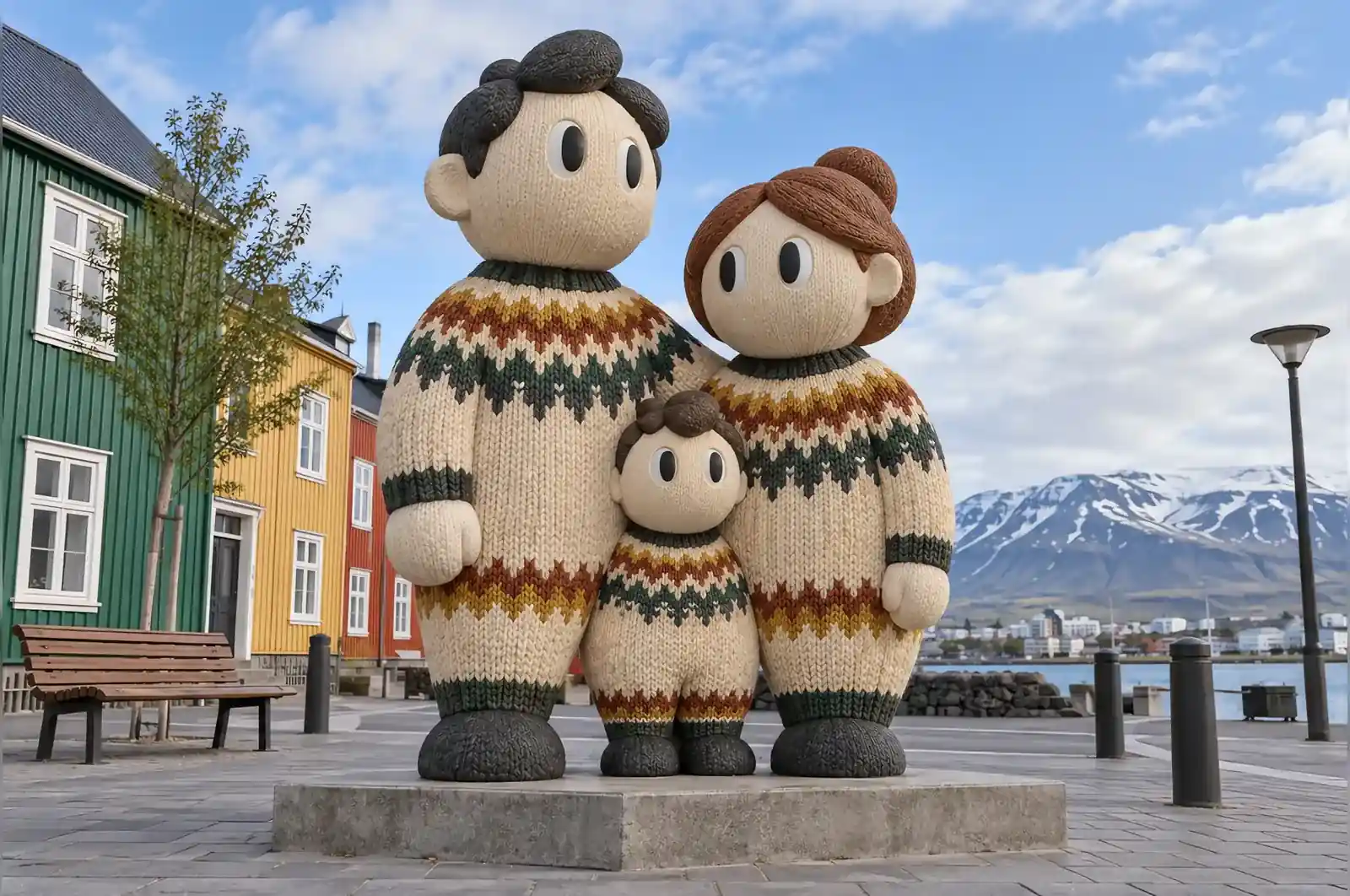
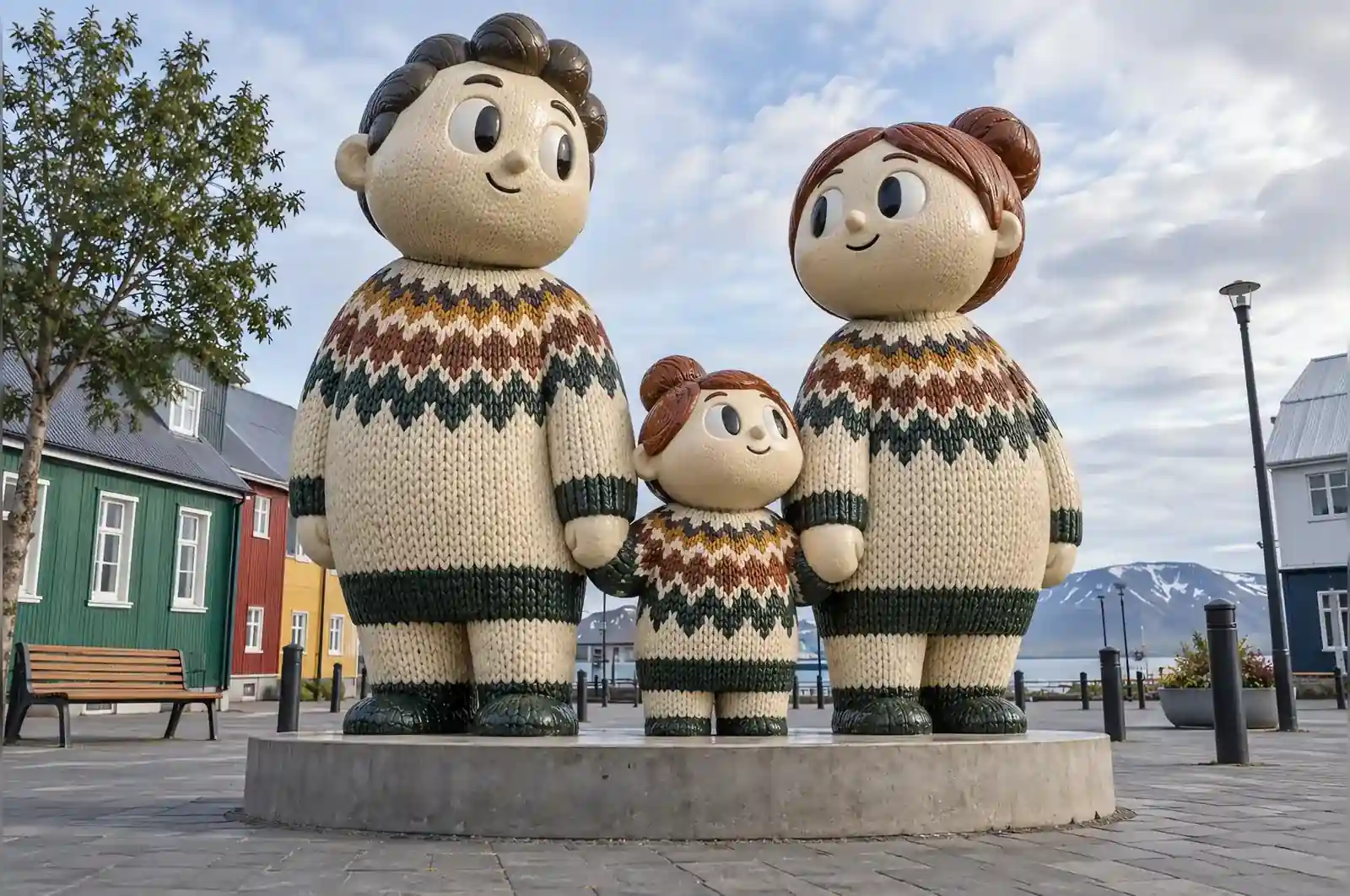
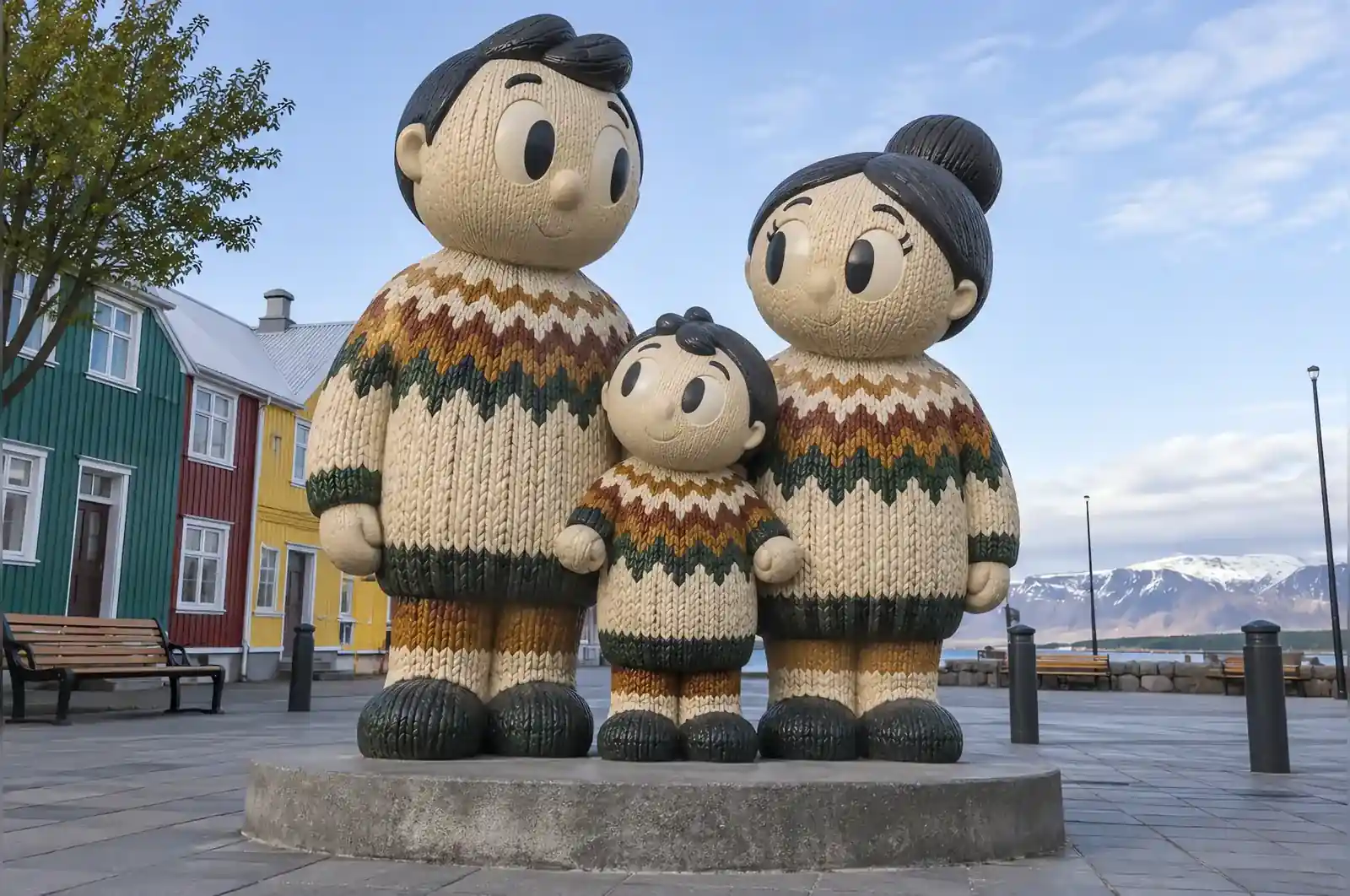
Reykjavík’s winter market runs outdoors for six weeks and the stallholders wanted something at the entrance that said the market was theirs rather than the city’s. What they specified was not a material or a subject. It was a garment.
The brief, essentially
A family of three at the market entrance, about 2 m, cartoon proportions, everyone wearing a lopapeysa — the Icelandic yoked jumper. Not holding one, not draped over a shoulder. Wearing it.
Getting a knit right
A knitted object has a specific structure: courses and wales, the horizontal and vertical lines of the stitches, and the way a pattern is bounded by those lines. The yoke pattern on this piece is a real one, taken from a jumper the association lent us, and it is laid out across the shoulders in the eight bands it would really have.
The stitch texture is modelled, not painted: roughly 90,000 individual stitch shapes across the three figures, each about 40 mm wide at this scale, slightly irregular because a hand-knitted stitch is never quite even. The three figures have different stitch counts, because the child’s jumper is knit at the same gauge as the adults’, which is exactly what happens in a real family.
The cuffs and the collars
Ribbing is the detail that makes the whole illusion hold. Every wrist, every ankle and every collar is finished in a band of raised alternating vertical ridges with a slightly tighter, softer profile than the body stitch. Without it, the piece reads as a decorated object; with it, it reads as clothing.
At the market
It stands at the entrance to the square through the six weeks of the market and is stored indoors for the rest of the year, which the association organised before we had finished making it. Three local knitters have independently identified the yoke pattern, which the association considers the highest available form of review.
What the market entrance fixed
The brief came with one immovable condition: the three figures wear the jumper. It was never an option to suggest a family holding a folded sweater, or one draped over a shoulder, because the association was buying a garment scene, not a portrait of people. Everything downstream followed from that.
The first thing it fixed was scale. A knitted texture only reads as knitting when a single stitch is large enough to be seen from the far side of a market square. At 2.2 m tall the stitches are about 40 mm wide; if the group had been brought down to about 1.2 m, the same stitch would read as a printed pattern and the piece would become a painted figure wearing clothes rather than a knitted family. That is the decision that set the 40 mm figure.
The second thing it fixed was the finish. The wool illusion depends on a matte surface. A gloss coat would have caught the low winter light off the square and read as fibreglass within a day. The matte is what makes the stitch texture legible as yarn, and it is why the whole piece is finished as it is.
The third was where it could live. The association had arranged indoor storage for the months the market does not run, before we had finished making it. That agreement is the only reason a matte finish was a defensible choice; if the piece were to stand in the square all year, we would have recommended a tougher, glossier surface and accepted a softer wool reading.
Carrying a shallow form in an open square
The group is 2.2 m tall and 1.9 m wide but only 0.6 m deep — a thin, wide wall of a sculpture standing in an open square through six weeks of Icelandic winter, and wind is the load that governs it. The figures are hand-laminated FRP over an internal steel frame, and the frame’s job is as much to hold the piece down as to hold it up.
A 1.9 m-wide flat form presents a large sail area for its depth. At 2.2 m tall, even a moderate gust across the square develops a significant overturning force at the top of the group that has to be resisted at the base. The steel frame runs the full height of each figure and ties the three together as one rigid assembly, so the piece behaves as a single object rather than three loose figures that could flex apart in a storm. The feet and the shared base are weighted and footed so the overturning moment is carried back into the ground.
The surface asks for one specific kind of care. The raised stitches leave shadowed recesses, and a matte finish collects dust and water marks in those recesses far more readily than a gloss would. Cleaning is with a soft cloth and clean water, no abrasives, so the ridge profiles stay crisp; once the ribbing softens, the piece stops reading as clothing. The six-week run is short enough that a gentle clean at the start and end of the season is all it needs — a duty cycle a matte finish can carry.
What to settle before you ask for a quote
Three questions, each of which changed the work here.
One. Do you have the garment, or do we invent it? The association lent a real jumper and the yoke pattern is laid out in the eight bands it really has. Without a garment to copy, the pattern is designed from reference, and that changes the work before anything is laminated.
Two. Must it read as the material from a distance, or is it a portrait of a thing? Reading as knitted yarn across a market square is what set the scale at 2.2 m and the stitch at 40 mm. If your brief is a likeness rather than a material, the piece can be smaller, and the scope of the work changes with it.
Three. Where will it live between seasons? Indoor storage is what made the matte wool finish possible here. If yours will stand outdoors all year, expect a tougher, glossier surface and a slightly different reading.
Settle those three first and a quote is a fair comparison. Leave them open and you will be comparing different objects.
Icelanders know a lopapeysa pattern from thirty metres. Ours is real, and three knitters have already told us which pattern it is.
A winter market association in Reykjavík, Iceland