Cartoon Family Group — Three Figures, Seattle, Washington
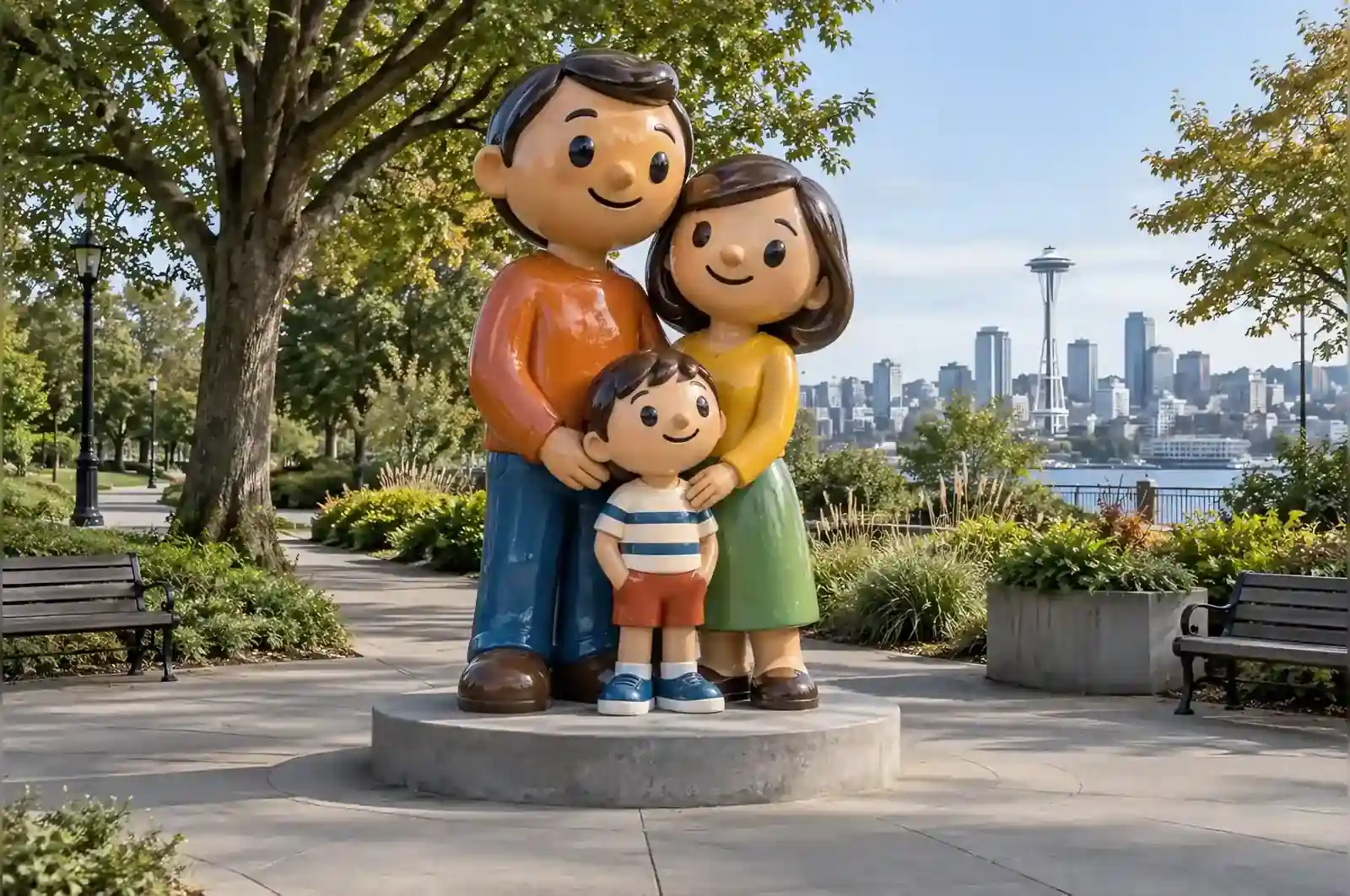
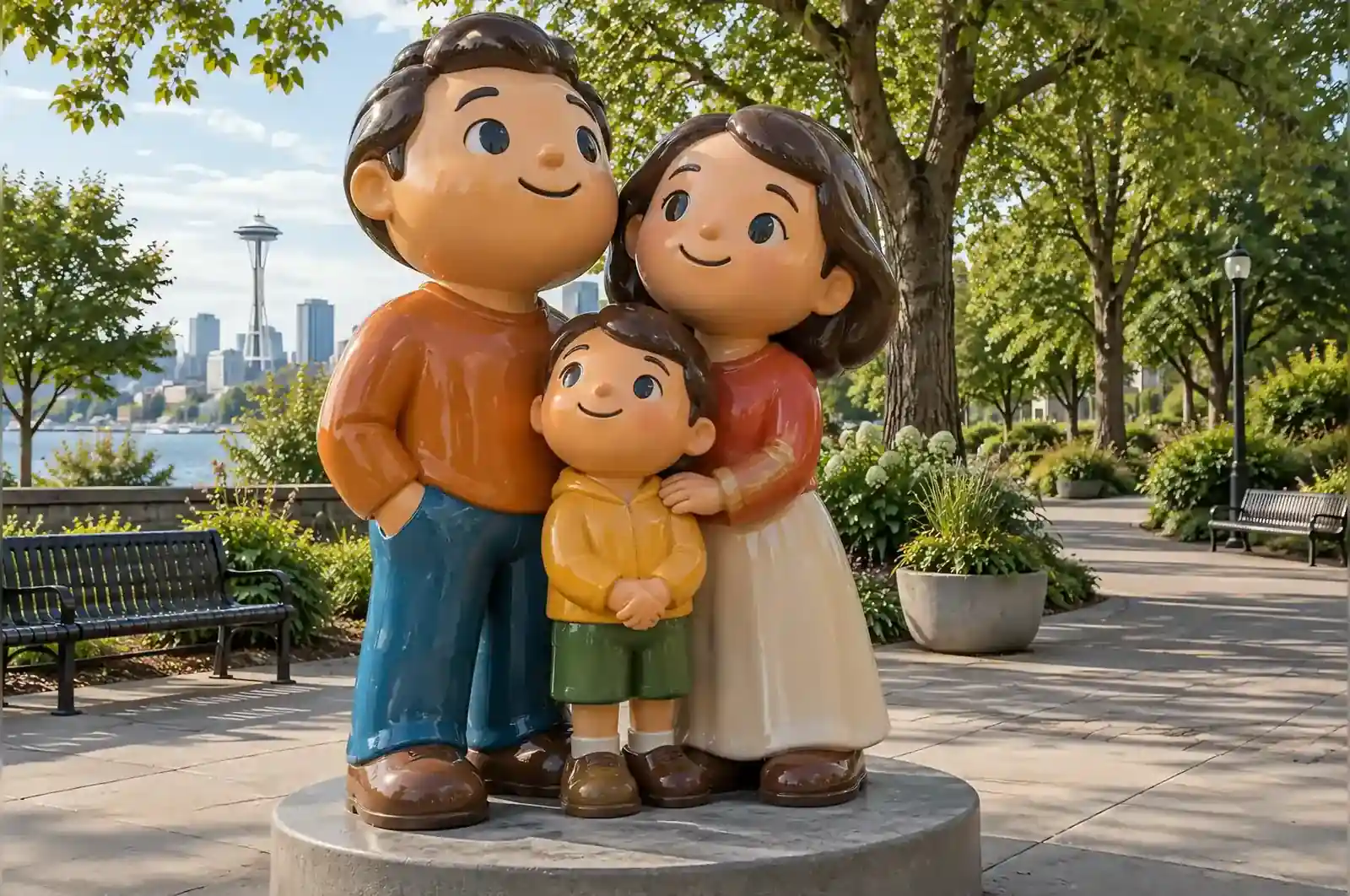
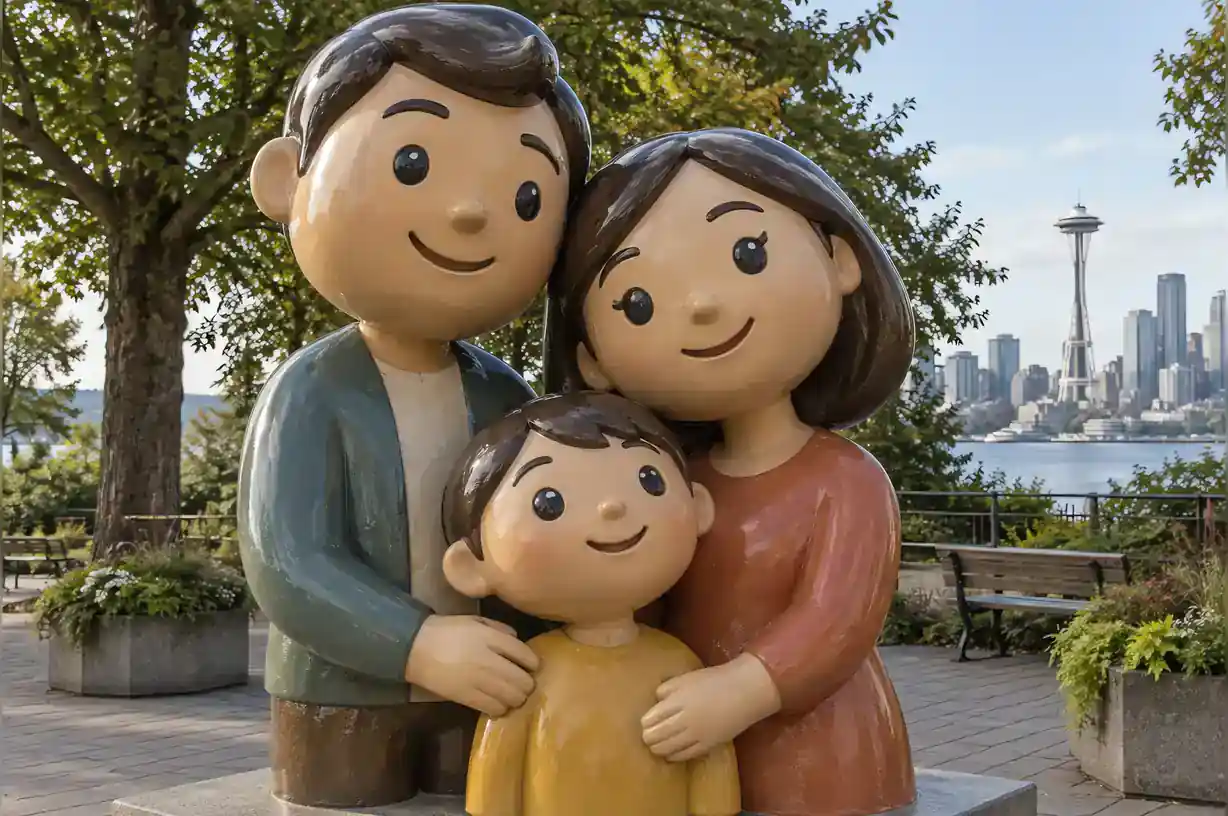
A family in Seattle commissioned three figures — two adults and a child — for the park they walk through every weekend. The brief was unusual: they wanted the group to read as one object from a distance and as three people up close.
What they asked for
A cartoon family group at roughly 2.0 m, three figures on a shared base, each individually recognisable and the group composed as a single silhouette. Warm contemporary colours.
Building it at full size
Built at 2.0 m over an engineered frame carrying all three figures. Group pieces are a composition problem before they are a sculpting problem: who stands where, how the heads relate, where the negative space falls. We resolve all of that in 3D and you approve the arrangement. The frame is what carries the load; the fibreglass shell is a surface over it, which is why the two sections can be bolted together on site without the figures sagging or settling over time.
The finish
Gloss-painted fibreglass, hand-painted detail across all three figures, UV clear coat. Paint consistency across a group matters more than on a single piece, because any difference in finish between figures is immediately visible.
Installation
Set on a prepared pad beside the park path, assembled on site in two sections and bolted through. Thirteen weeks from 3D approval, most of it in the frame and the group composition.
What it cost
Above 2 m, surveyed fibreglass cartoon groups run $3,800–$15,000. This commission came in at $13,200 delivered and installed.
What was non-negotiable
Three decisions on this piece were settled before any modelling started, and each one follows from the fact that the group stands in an open public park. The first was the 2.0 m height. At that scale the figures read as a landmark rather than a garden ornament: tall enough to be seen across the path, low enough that the child reads as a child and not a miniature. Dropping to 1.2 m would have lost that presence entirely and left the group looking like a garden figure, so the height was not negotiable.
The second was the shared base. Because the brief asked for one silhouette, the three figures had to be carried on a single structural base rather than standing as three separate pieces. That is what lets the group be read as a single object from a distance and as three people up close. If the base had been split, the composition would have fallen apart at the first viewing angle.
The third was the gloss finish with a UV clear coat. Outdoors in Seattle, where the light is soft and rain is frequent, a flat or matte paint would have shown water marks and chalked within a couple of seasons. The gloss and the clear coat are what keep the warm contemporary colours reading cleanly in a park setting. Had any one of these three been relaxed — a smaller height, separate bases, a matte finish — the commission would have been a different, and cheaper, piece.
Looking after it in a Seattle park
The one thing this finish needs, and the reason it was specified, is the UV clear coat on top of the gloss. Seattle’s climate is the reason it matters: the park is open to rain, and the figures sit in soft, low-angle light for much of the year. The clear coat is the layer that stops the paint from chalking and the warm colours from bleaching, and it is what lets the hand-painted detail survive contact with weather and with park visitors. On a group this is more important than on a single figure, because any difference between the three figures is immediately visible.
The group is bolted through its base onto a prepared pad, in two sections, so the load is carried by the frame rather than by the fibreglass shell. In a wet climate that means the fixing points are the part to check: the pad has to drain, and the bolts are inspected after the rainy season so nothing works loose and no water pools against the base. The FRP shell itself needs no repainting for years; the clear coat is the sacrificial layer and can be renewed when it dulls, without touching the colour beneath.
What this means for your own brief
If you are commissioning a cartoon group like this, settle three questions before you ask for a quote. First, how will it be read — as one object from a distance, as three separate people, or both? That single answer decides the base, the spacing and the silhouette, and it is the biggest driver of the composition time. Second, where will it stand? An outdoor park setting demands a UV clear coat, a drained pad and bolted installation; an indoor or covered position does not, and can use a softer finish and a lighter base.
Third, how visible must it be at scale? The 2.0 m height here was chosen to clear the path and hold its own against the park. If your site is smaller, or the group is meant to be a close-up piece rather than a landmark, a lower height is a legitimate choice — but say so up front, because it changes both the frame and the base. Settling these three before the quote is what keeps the price and the lead time realistic: this piece ran 13 weeks from 3D approval, most of it in the frame and the group composition, and came in at $13,200 delivered and installed.
Three people have to work as one piece, and it does. Each of us is obviously ourselves.
Kenji and Sarah Nakamura