
Iridescent Cartoon Runner — Life-Size Sculpture, Stadium Plaza, Doha
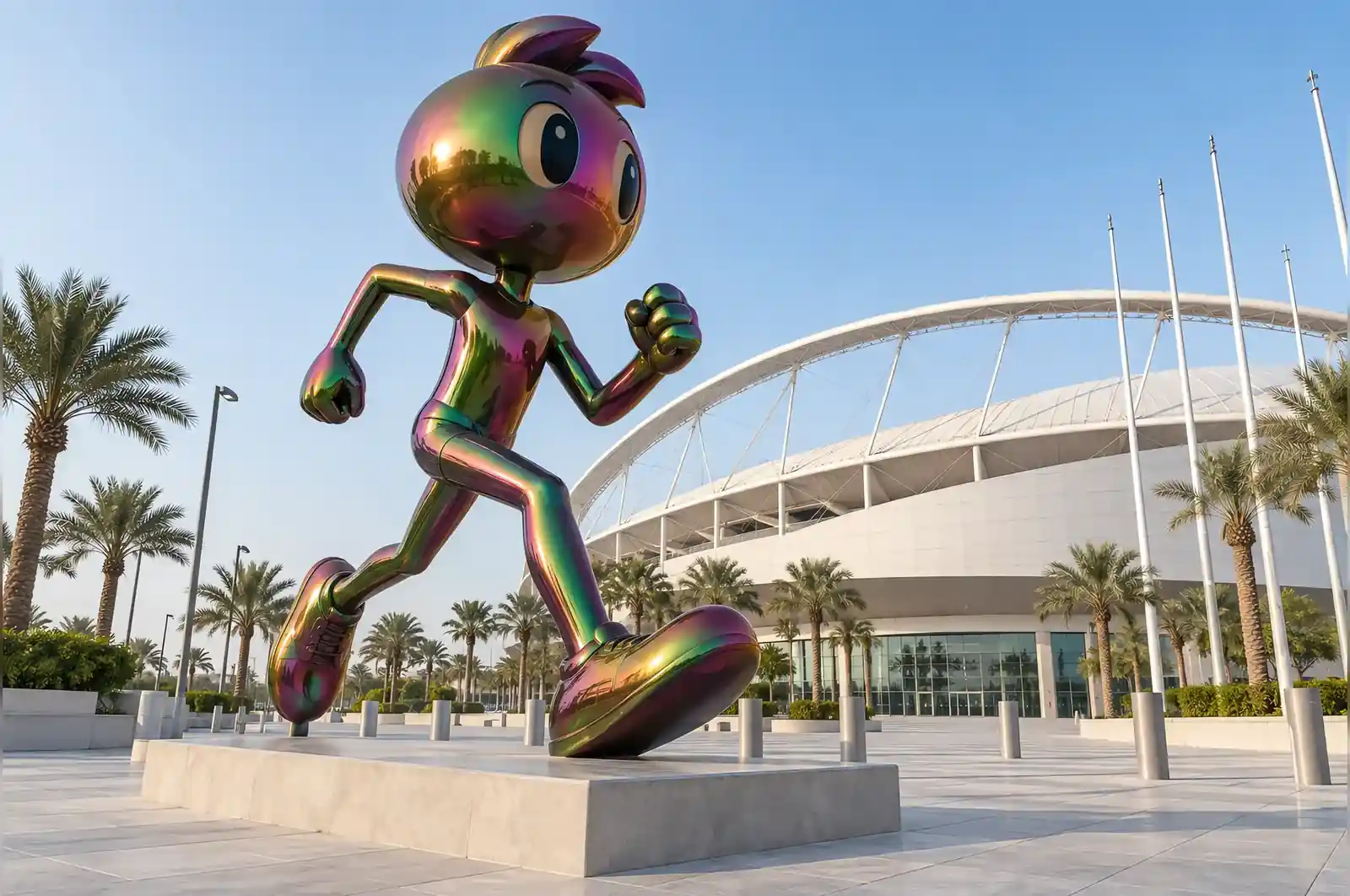
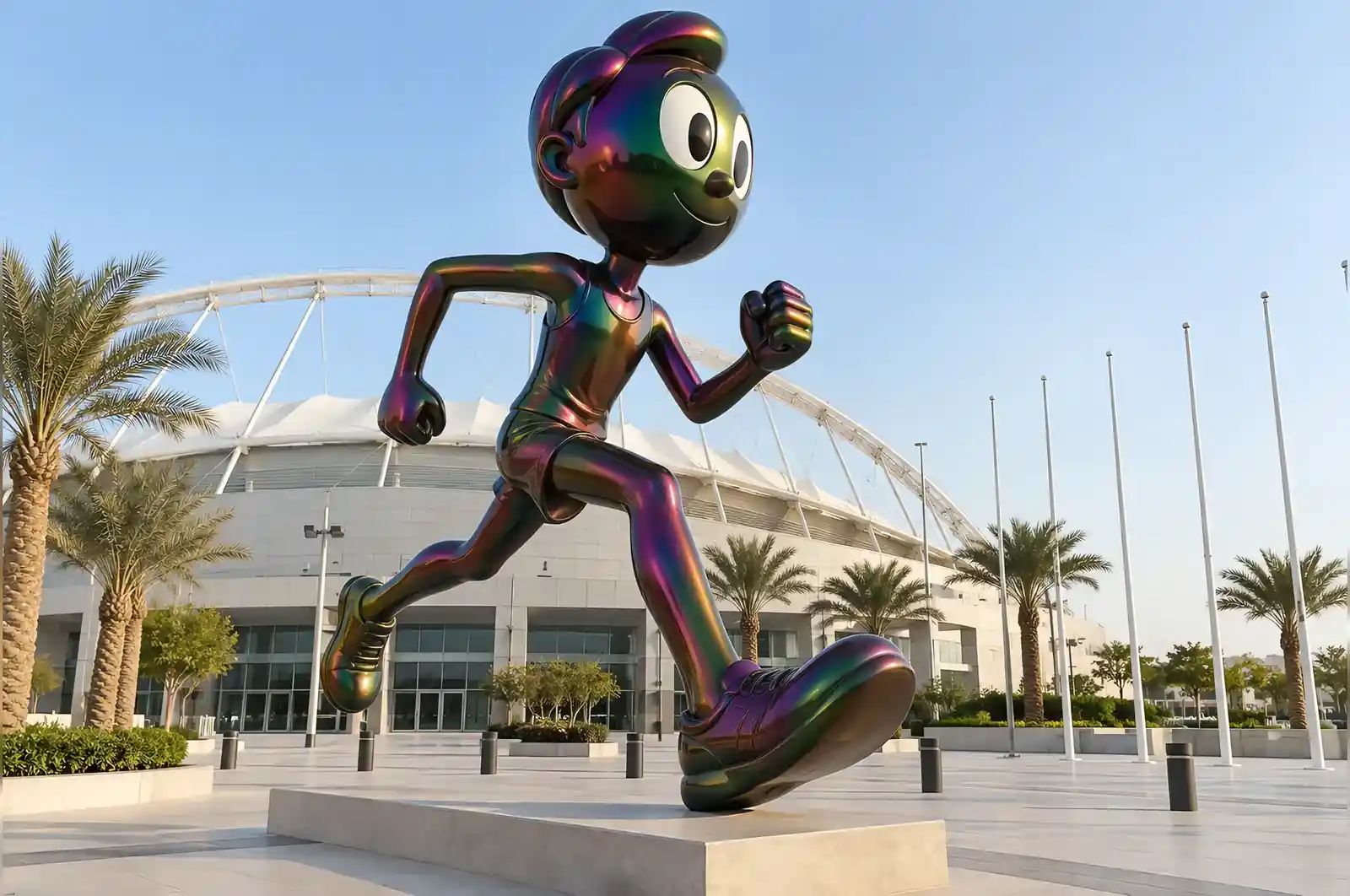
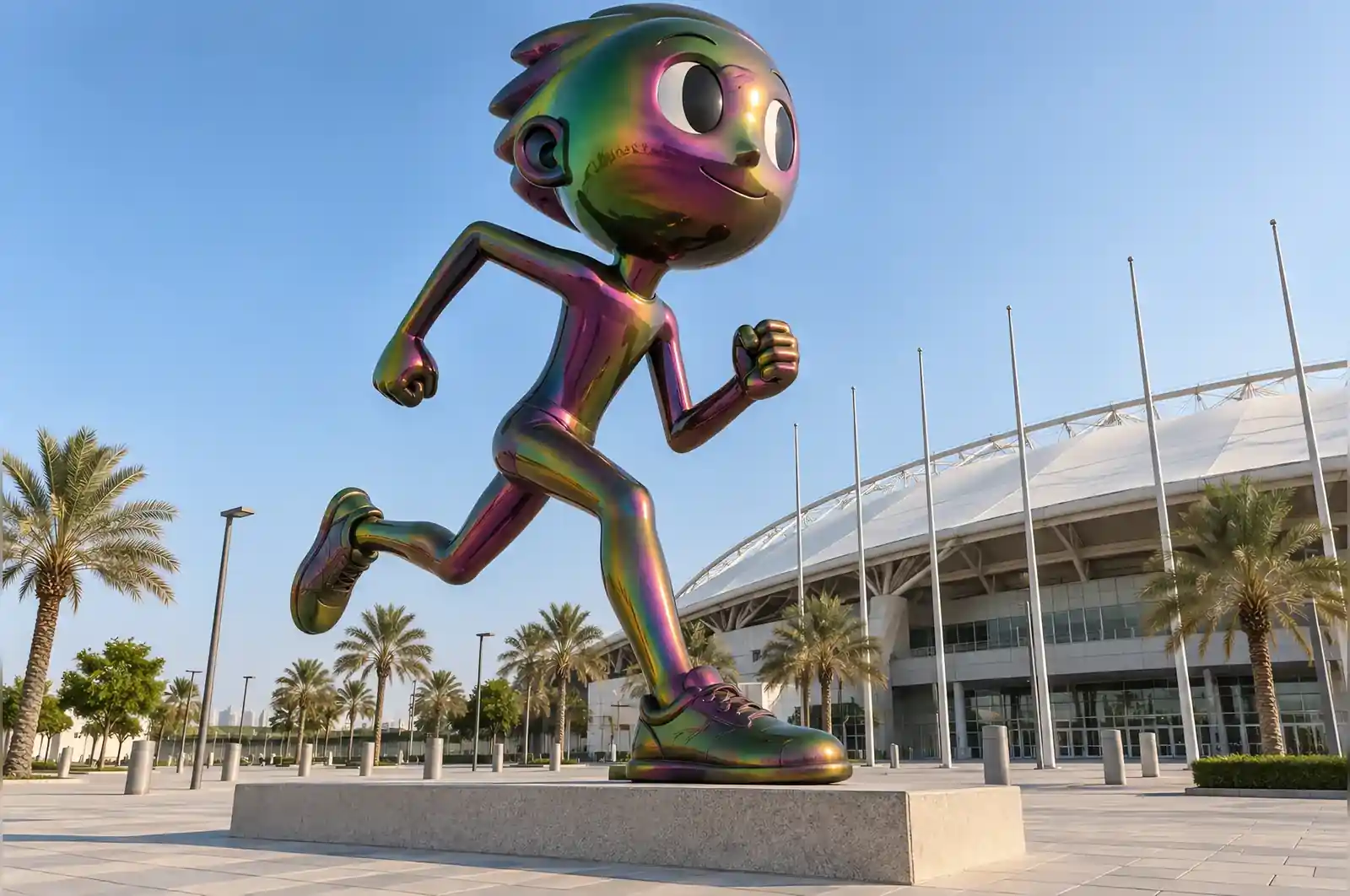
The stadium plaza is roughly the size of four football pitches, and the problem with a plaza that size is that anything smaller than a bus disappears in it.
The brief
A runner at about 2.5 m, cartoon proportions, positioned where arriving crowds pass it. And one instruction about colour: it had to be worth looking at in the middle of the day, in a place where the middle of the day is the problem.
Why colour-shift, specifically here
Doha’s midday light is extremely flat and extremely bright. A sculpture in a single flat colour under that light goes pale and loses its form entirely. Colour-shift pigment behaves differently: it is not the colour of the surface but a function of the angle between the surface, the light and your eye, so under a hard overhead sun it produces strong internal contrast across a single object.
Over a dark base, the figure shifts through green, magenta and gold as you walk past it. At 8 a.m. it is green. At 6 p.m. it is magenta. At noon it is a shifting patchwork, which is the one time of day the plaza needs the help.
Shaping for a moving surface
Colour-shift reads on curvature, so the pose was chosen for it. The driving arms are two long curves, the trailing leg is a single run of convex surface, and the head is a large sphere. Flat planes were avoided anywhere they could be: even the plinth top is dished very slightly so it does not read as a dead grey rectangle.
The face is the exception, as it always is. A near-solid dark area across the front of the head, with the shift held to the outer edges, so the character has somewhere to live that is not moving.
On the plaza
It stands at 2.5 m on the main route from the metro stop to the north gate, bolted through the paving into a fabricated sub-frame, with uplighting specified from the start because the piece is at its most dramatic after dark. The authority has asked us not to explain the colour to visitors, and we have agreed.
What was non-negotiable
Three things were settled before the commission moved, and each one follows from the site rather than from the subject. The size, at 2.5 m high by 1.9 m wide by 0.7 m deep, was set by the plaza and not by the runner: a figure much below two metres would have been swallowed by the pavement on a site that is roughly the size of four football pitches, and one much above three metres would have stopped reading as a person and become a landmark. The finish was set by the light, and it is the single reason the piece works at noon. The position was set by the crowd — on the main route from the metro stop to the north gate, so that a visitor passes within a few metres of it whether they mean to or not.
Had the site been different, the commission would have gone a different way, and it is worth naming what would have changed. Indoors, the flat overhead sun that makes the colour-shift necessary is gone, and the figure would more likely have been a single saturated colour under controlled lighting rather than a flip finish. At a smaller scale — a lobby scale, a desk-side scale — the same runner would not have carried the curvature the shift depends on, so we would have simplified the pose and kept the colour-shift only on the head and shoulders rather than risk a surface that does not change as you walk.
Building and keeping it, at this size and in this climate
The structural core is an internal steel frame, and the runner is a hand-laminated FRP shell laid over it rather than bolted to it. The two are separated by a calculated gap so the laminate carries the load and the frame carries the wind. At 2.5 m tall with a 1.9 m span of outstretched arms, the piece has to behave as one stiff object, so the steel is welded into a single armature and the shell is laid on in one continuous run rather than in joined panels. That is why it reads as one body from any angle and why there are no joints to work loose on the two long curves of the driving arms.
The maintenance load is a surface, not a structure. Doha’s sun is hard on any gloss clear coat, and a flip paint shows every scuff, so the UV clear coat is specified at a thickness that can be cut back and re-flowed rather than stripped and resprayed. On an outdoor plaza the piece is washed down as part of the authority’s routine, and the finish is inspected on a schedule rather than when something goes wrong — a coat that is cut back early lasts years, one that is left until it chalks does not.
What this means for your own brief
Before you ask for a quote on something similar, settle three things.
First, where exactly it stands, and at what distance people pass it. The position on this commission — close to a crowd route, in a wide open plaza — is what justified both the 2.5 m size and the colour-shift finish. The same figure at 1.5 m in a courtyard, or in a flat single colour against a busy background, would have been a different and weaker piece. Give us the ground plan, not just a photograph.
Second, what it must do at its worst hour. This piece is at its most useful at noon, when the plaza light flattens everything else on the site. If your worst hour is dusk, or a packed match day, then the finish and the pose change with it. Say what the failure looks like and we design to that.
Third, who maintains it. The wash-down and the UV clear coat inspection here are on a schedule the authority owns. If you have no one to do that, we would specify a more forgiving surface — and you should know that before you commit, not after.
At eight in the morning it is green. At six in the evening it is magenta. Nobody has explained this to visitors and nobody has asked.
A sports authority in Doha, Qatar