Quinn — Pop-Art Cartoon Horse, Comic Museum, Brussels
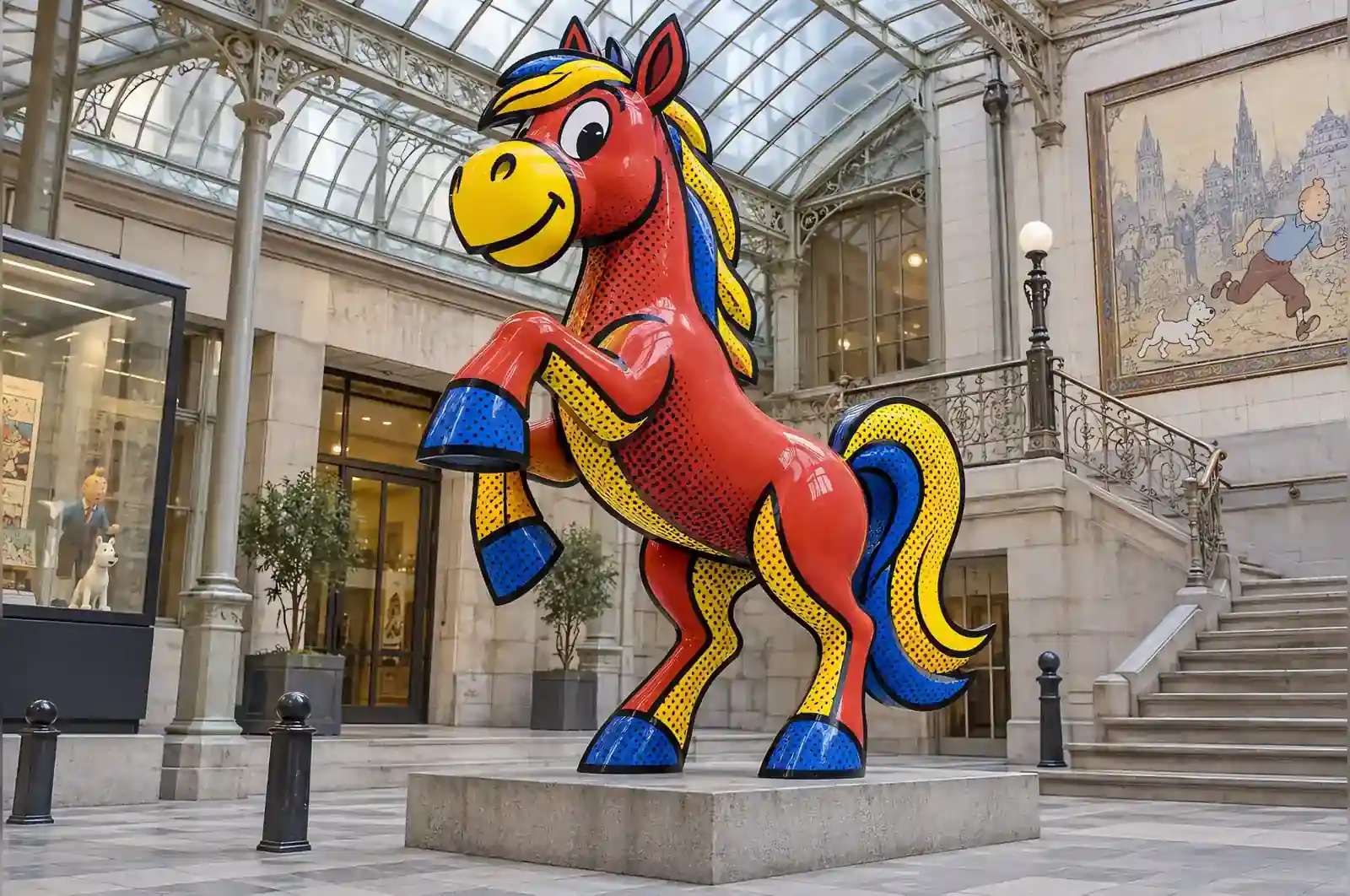
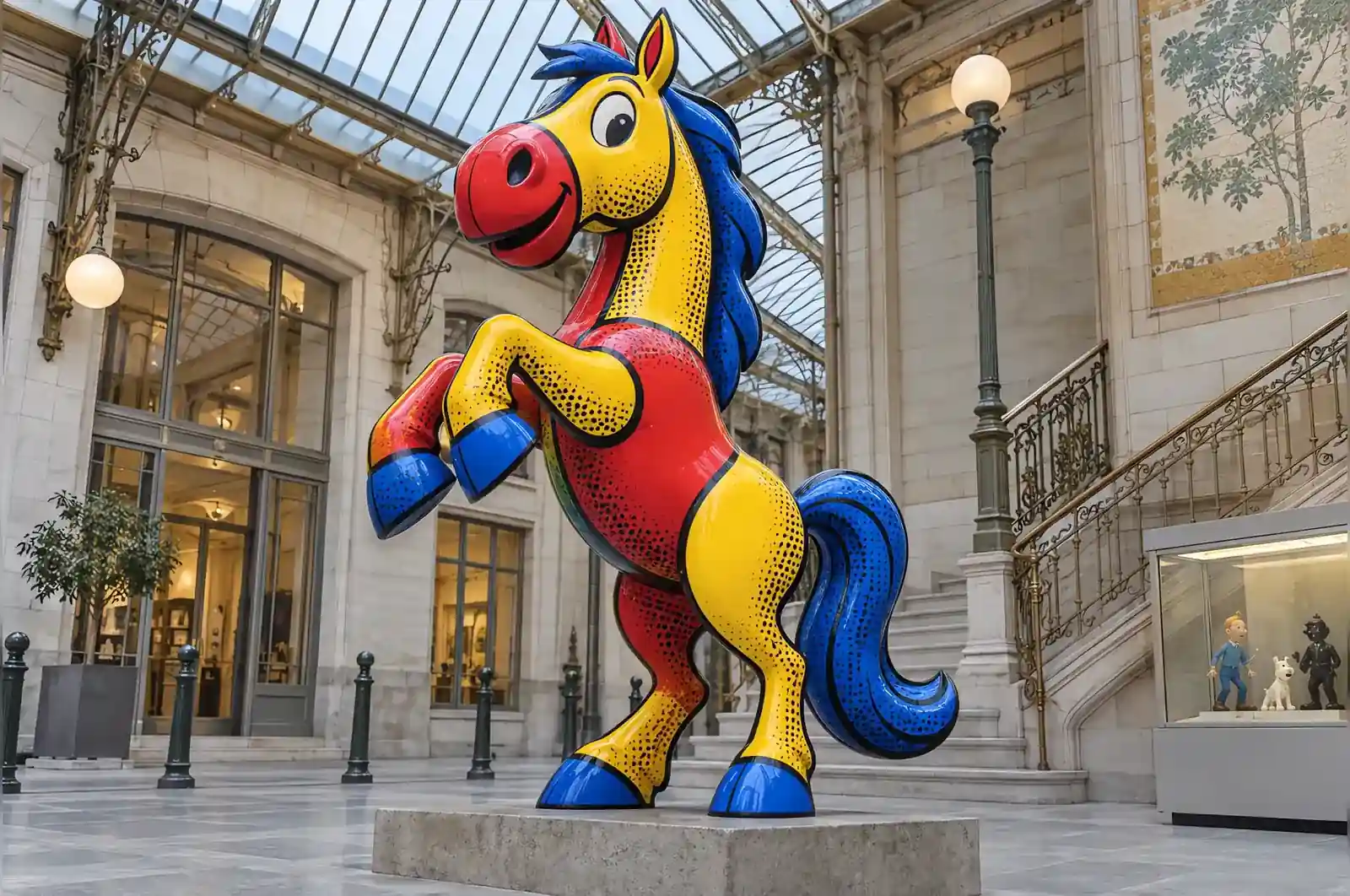
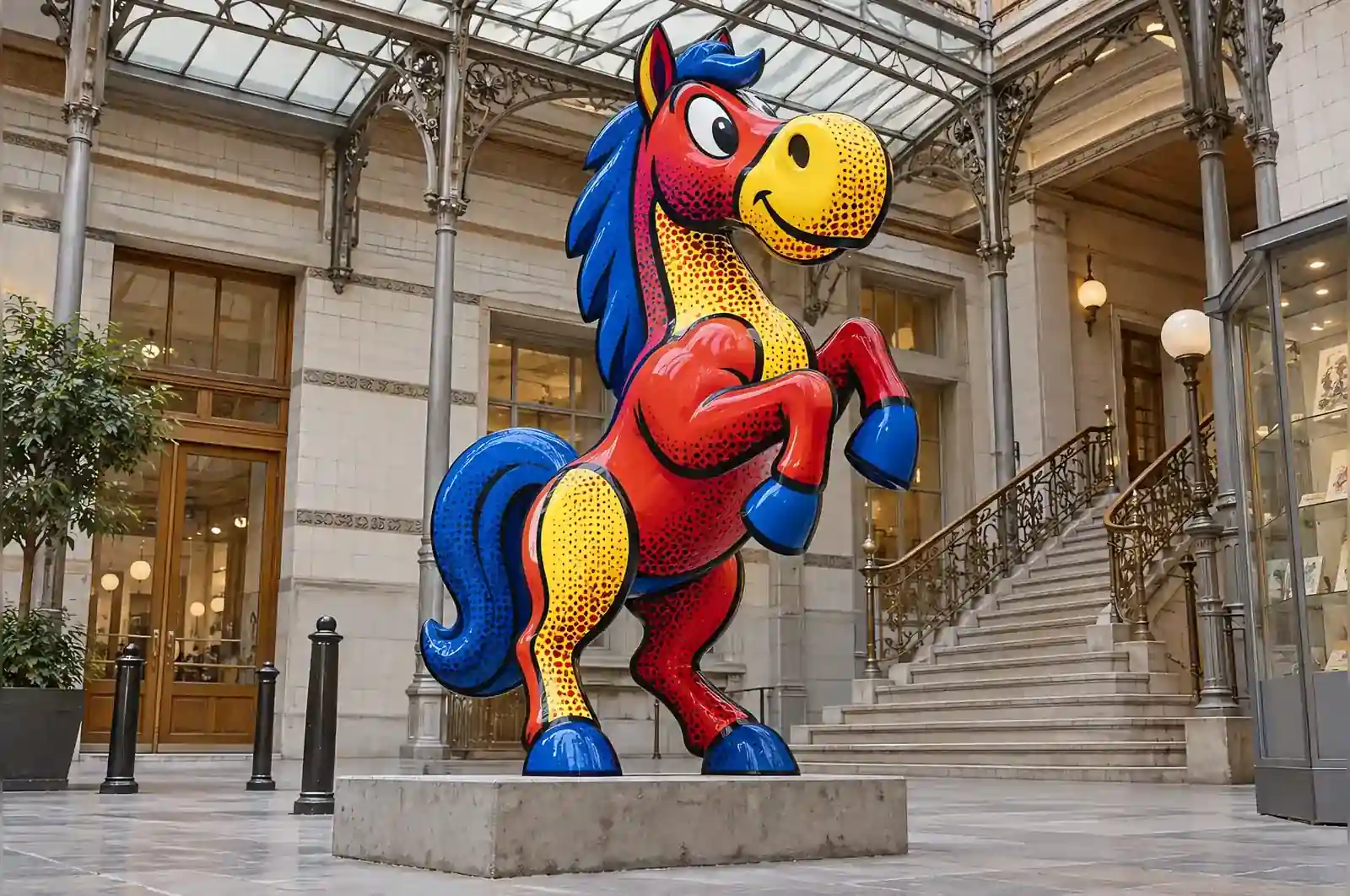
Belgium prints comics. The museum wanted a horse that looked as though it had come off a press, and they were specific about what that meant.
The four rules
Flat primary colour, hard-edged, no gradients. Thick black contour lines around every form. Ben-Day halftone dots filling every shaded area. Nothing realistic anywhere.
Dots on a curve, again
Halftone is a printing artefact: a screen of dots at a fixed angle, larger in the shadows and smaller in the light. Wrap that onto a curved animal and it immediately becomes an obvious pattern on an object — the illusion collapses.
What saved it was letting the dot grid stay flat in space rather than conforming to the surface, exactly as it would if the sculpture had been photographed and then printed. The dots run at a consistent angle across the whole piece, and the shading is entirely a function of dot size. It is the only sculptural decision we made that follows the logic of a two-dimensional process, and it is the reason the piece reads as printed.
Contours are not decoration
The black contour lines carry the drawing. Where they are thick, the form is heavy; where they stop, a volume ends. We run roughly 130 metres of black line across the piece, all masked by hand, all of it around 9 mm wide. On the eyes only, the contour is doubled, which is a comic-strip convention for making a character look alive, and it is the single most effective thing on the sculpture.
Build
Fibreglass over a steel frame, gloss clear coat. Gloss rather than matte because printed ink has a slight sheen, and because flat primary colours under a matte finish in a glass courtyard go grey. The dots are under the clear coat so they will not wear off where visitors touch the flank, which they do.
In the courtyard
It stands at the foot of the iron staircase, on the main circulation route. The museum’s guide for schools now ends there, with an exercise in which the children count the different sizes of dot. They get to nine.
Visitors assume we drew it and then printed it very large. Being mistaken for a printing process is the best compliment the piece could get.
A comic-strip museum in Brussels, Belgium