Tag — Graffiti Cartoon Horse, Youth Centre, Berlin
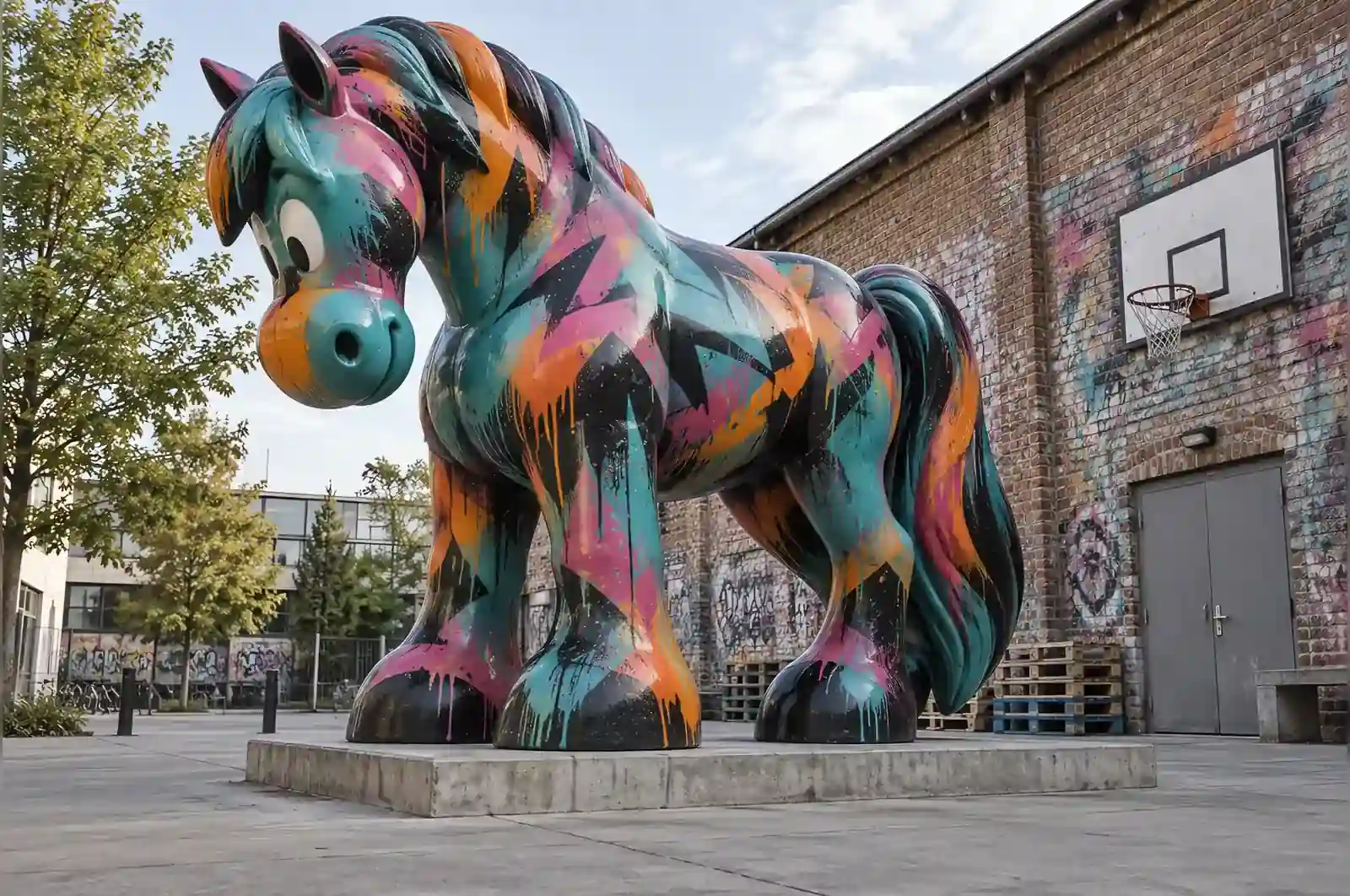


The centre runs spray-painting workshops for teenagers. They came to us with a photograph of the wall in their yard and a question: could a sculpture be treated like a wall?
The answer, and the condition
Yes, with one condition we insisted on. No readable lettering. Not because lettering is a problem artistically — it is the reason graffiti works — but because the piece had to be permanent. A sculpture carrying a name or a tag becomes dated within a season, and the young people who painted it move on.
So the piece carries a wildstyle geometric pattern: interlocking angular forms that read as graffiti at a distance and resolve, as you approach, into pure shape with nothing to read.
What we would not compromise on
The condition was the one part of the brief we would not trade. The piece is 2.8 m high, 1.0 m wide and 2.9 m long, and it stands in a yard that is open to the weather all year. A name or a tag on a surface that size would be dated within a season, and the group that painted it would have moved on by then — so the piece carries pattern instead of words. At 2.8 m it is close to a storey of wall, which is why the group could treat it as one; at half that height the same pattern would have read as a decoration on a toy rather than as a wall.
Had the condition not been accepted, three things would have changed. The painters would have worked to a simpler surface, because readable lettering needs crisp edges and a flatter, cleaner panel than an all-over wildstyle pattern does. We would have steered them toward a mark or a single colour field that carries meaning without anything to read. And we would have argued for an indoor position, where a seasonal element could be repainted without re-rigging a 2.8 m sculpture in a yard.
Built by the people who will use it
The shell was laminated and primed at our workshop, then the surface work was done at the centre over six evenings by nine young people working with two experienced writers. They laid down colour fields, built the fades with airbrush, added the drips, then sealed it.
Their two rules for the piece, which we accepted: nothing above eye level on the head, so the animal keeps its face, and nothing over the eyes at all. It is a horse first. That was their call and it was the right one.
How the paint survives the yard
The build splits in two. The shell was hand-laminated over an internal steel frame at our workshop — that frame is the structural core, and it is what carries the wind load on a 2.8 m piece standing free in an open yard. The paint was applied at the centre, over those six evenings, and then sealed. The seal is the part that earns its keep.
Spray paint is not a finish on its own outdoors. Airbrush fades and drips in acrylic will chalk and wash out under Berlin rain, frost and UV without a protective layer. The high-gloss clear coat is what keeps the colour fields reading at full strength; it is also what makes the surface cleanable, which matters on a sculpture that nine young people and two writers worked across and that the whole centre now touches.
Maintenance is one job a year. Check the clear coat for dulling or chalking — the first sign that it is thinning — and if it has dulled, re-coat it. Everything else is a wipe with water. The paint is the story; the coat over it is what keeps the story. In Berlin the seasonal cycle is the real test: frost in winter, heat and UV in summer, rain in between. The clear coat takes all three, and that is the whole point of it.
The horse underneath
We designed the form to be a heavy horse with the head lowered, because a lowered head gives one large curving surface down the neck and shoulder — an area roughly two metres square, which is the size of a wall section and the size these painters are used to working at.
In the yard
It stands against the north wall, where the afternoon light rakes across the painted surface and the airbrush fades read at full strength. The centre says the group that painted it now brings visitors to see it, which is a thing that had not happened before.
What this means for your own brief
Three questions settle most of a brief like this before any quote.
First, does the lettering need to be readable? If it does, plan for it to be seasonal or budget for re-doing it, because a readable element dates faster than anything else on the surface. If it does not, you get the all-over pattern treatment, and that is what keeps a piece like this current.
Second, who applies the paint, and at what scale? This commission worked because a lowered head gives one curving surface down the neck and shoulder roughly two metres square — a wall-sized working area. A standing pose gives smaller, tighter panels and a different working rhythm. State the surface you want to hand over before the shell is built.
Third, where will it stand? The finish and the sealing are chosen by that answer. This piece is outdoors in Berlin, so it got a weather-proof clear coat; indoors, the same paint would sit differently and need no such protection. Settle placement first, because it is the cheapest thing to decide at the start and the most expensive to reverse once the clear coat is on.
The kids here see a wall every day. Now they see a wall that stands up and walks. That got their attention in a way nothing else has.
A youth arts centre in Berlin-Neukölln