
Pet Memorial Statues for Dogs: A Buyer’s Guide
2026-09-18
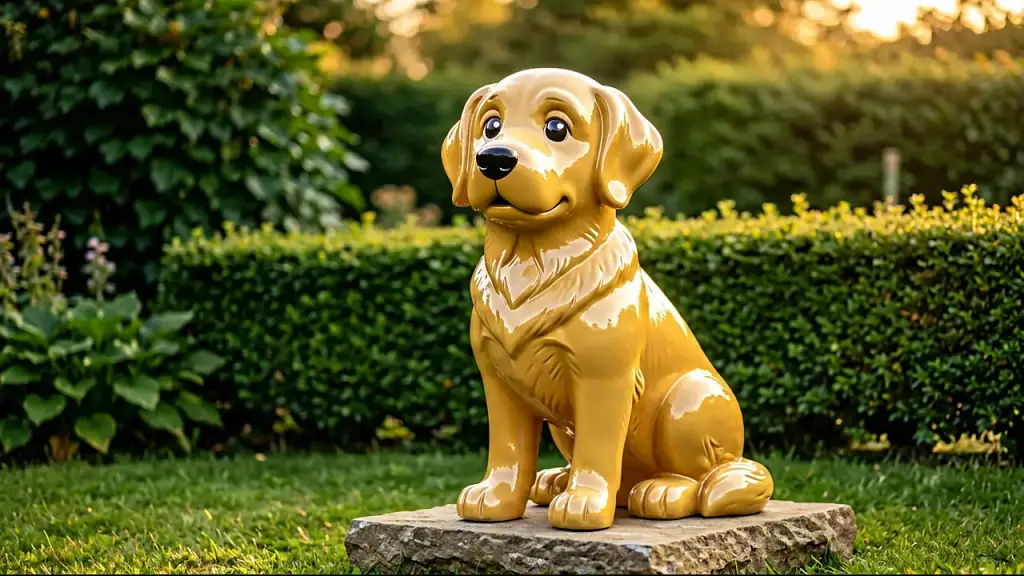
Losing a dog empties a house in a way that is hard to explain to anyone who has not had one. The families who come to us are rarely looking for a headstone. They want something they can walk past every morning and say good morning to — which is why a custom pet memorial statue sits somewhere between a marker and a portrait, and why the questions we are asked about it are almost never about price first.
This guide answers those questions in the order they actually come up: what a memorial sculpture is for, why ours are cartoon-style rather than lifelike, how to choose for a dog or a cat, and what you are really deciding when you commission one.
Why a statue, and not an urn or a photograph
An urn holds ashes. A photograph holds a moment. Neither takes up room the way the animal did, and neither gives you somewhere to go on the day you need it.
A memorial statue does three things the alternatives cannot. It occupies a place — a corner of the garden, a spot by the door, a shelf you pass ten times a day. It is physical, so it can be touched, which matters more than most people expect in the first year. And because it is built in gloss-painted fibreglass rather than ceramic or stone, it can sit outdoors in weather without being an object you have to worry about.
We build every piece at 1.5 m and up. That floor is deliberate: below it, a figure reads as an ornament, and an ornament does not carry a memory the way a sculpture does.
What “cartoon” means in a memorial sculpture
Our house style is cartoon, and for memorial work that is a considered choice rather than a shortcut.
A photorealistic sculpture enters a competition it cannot win. It is compared, every single day, with your memory of a living animal — the way the ears actually sat, how the chest looked when they breathed — and it will lose that comparison no matter how skilled the sculptor is. A cartoon sculpture is released from that contest. It exaggerates what you loved: the size of the head, the set of the ears, the way the weight settled onto the front paws. Warm, rounded, friendly proportions. It still has to be unmistakably your dog, and that is the standard we hold ourselves to during the 3D-approval stage.
What it is not is abstract. Some studios now sell “memorial forms” — polished abstract shapes that stand for a loss without ever showing the animal. That is a different product, and if you want it, we are the wrong workshop. Our work keeps the cartoon feel: you look at it and you see the dog, not a shape you have to interpret.
The eight styles we build in — from pet and portrait through to horse, bust and abstract character — are set out on the cartoon pet memorial sculptures page, where you can see where a memorial sits in the range.
Pet memorial statues for dogs: choosing size and pose
The dog memorials we are asked for fall into two groups: the domestic tribute — a piece for a garden, a hallway or a grave — and the working-dog memorial, usually commissioned by a unit, a club or a school for a service animal. Both are built the same way; the difference is scale and setting.
Pose matters more than most clients expect. The single most requested pose is the seated front view: upright, weight even, head level, ears relaxed. It is the pose you see most often in the photographs people already have, and it is the pose that reads best at a distance. Lying poses — the settled “sphinx” shape with the head down — suit indoor pieces and low garden beds. A standing pose is the hardest to get right and the one we most often talk clients out of at 1.5 m, because a standing figure at that height can look thin from every angle except the front.
Breed is rarely the problem. We work from photographs, so a cross-breed is no harder than a pedigree; what we need is a clear front view, a profile, and one close frame of the eyes. If your photographs are old, a phone photo of a printed picture is usually enough, but the guide to how many photos a commission needs explains exactly which frames matter and why.
Where the piece will stand decides the rest. In a garden, the statue is seen from three or four metres away and from slightly above, so we exaggerate the head a little and keep the base low and wide for stability. Indoors, it is seen from a metre and a half, so the proportions get tighter and the paintwork gets more attention. Working-dog memorials are usually set on a plinth or paving, so we plan the base around the fixing points before we start the full-size build.
The dog memorial range, with sizes and the FRP price bands, is on the cartoon dog sculptures page.
Pet memorial statues for cats: what works differently
Cats are a different problem, and the mistake is to treat them as small dogs.
A cat is read almost entirely from the head, the shoulder line and the tail. Get those three right and the piece is the animal; get them wrong and no amount of accurate fur saves it. A cat’s face is flat and triangular where a dog’s is long and rounded, so at 1.5 m we widen the chest and simplify the ruff — the neck line on a real cat is far too fine to survive being blown up to that size without looking fragile.
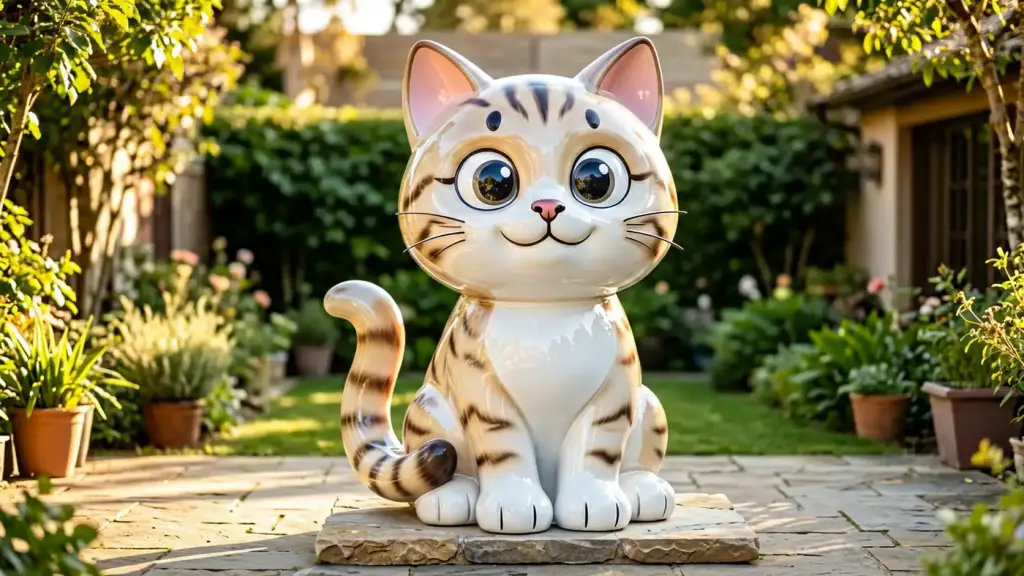
The tail is the whole silhouette. A seated cat with the tail wrapped around the front paws is a stronger memorial than a standing pose, because the wrap is the shape people remember from a cat that chose them. The mirror-image traps to avoid are an over-long tail (reads as a statue of a cat, not a portrait of one) and too much detail in the fur (reads as a figurine).
Cats also suit indoor settings unusually well. A 1.5 m seated cat beside a doorway, in a colour matched to the animal’s coat, is the same height as a child and reads as a companion rather than a monument. A custom cat memorial statue is usually the smallest piece we build and the one most often commissioned for a hallway, a window sill’s worth of floor, or a small city garden where a larger figure would crowd the space.
If you want a cat memorial sculpture that works beside a dog memorial — a pair, the two animals together — tell us at the start. Building the pair as one commission keeps the scale and the paintwork consistent, which is much harder to achieve if the two pieces are ordered years apart. The full range, including how coat colour is matched, is on the cartoon cat sculptures page.
Custom pet memorial statues: the five decisions
Every commission comes down to five choices. Settle them in this order and the quote writes itself.
| Decision | What you are choosing | Our default if you have no preference |
|---|---|---|
| Species and subject | The animal, one figure or several (dog and cat together is the most common pairing) | One seated figure, front view |
| Size | Overall height, from 1.5 m upward; every 0.5 m step is a new mould and a new cost band | 1.5 m for indoors, 2 m for a garden |
| Pose and expression | Seated, lying or standing; the tilt of the head; the set of the mouth | Seated, head level, relaxed ears |
| Colour and finish | Gloss-painted in the animal’s own markings, or a single commemorative colour | Natural markings, gloss finish |
| Plinth and lettering | Nothing, a simple base, or a lettered nameplate cast into the base | Low base; names added in the paint stage |
None of these decisions is irreversible until you approve the 3D model. Changing the pose at the maquette stage costs nothing; changing it after the full-size form has been built does, which is why we push hard for a decision on the pose in week one. The full sequence is on the process page.
Materials: why we build memorials in fibreglass
We build in FRP fibreglass and we build nothing else. It is weatherproof, it holds a moulded detail that hand-carved materials lose, and it is light enough to move without a crane at the sizes we work in. It also takes gloss paint extremely well, which is what gives the cartoon finish its depth.
The material is compared against stainless steel, bronze and cold-cast resin — honestly, including where each of them would be the better choice — on the materials page. For a memorial the summary is simple: steel and bronze are more expensive and colder in feel; resin is fine for a small keepsake but too brittle for a piece that has to stand in a garden for decades. Fibreglass is the material that lets a two-metre memorial exist at a price most families can actually consider.
We also publish what every quote contains and where the size floor sits, so the life-size and large sculpture page is the place to check the upper end of the range before you choose a size.
Where the statue will stand
Tell us the site before we quote, because it changes the build. An indoor memorial gets a lighter base, a finish that tolerates handling, and lettering that can be more delicate. An outdoor piece gets a heavier base, stainless fixing plates, and paintwork specified for UV and wet-freeze cycles. A grave or columbarium setting usually needs a smaller footprint than a garden, and we plan the base to fit the plot rather than the other way round.
What a commission costs, and how long it takes
Price is driven by size, pose and finish, not by breed or by how many photographs you send. A 1.5 m seated memorial and a 2.5 m one are different builds with different moulds; the smaller piece will not scale up without being rebuilt. Every quote states the size, the material, the finish, the lead time and the shipping in writing, and the honest lead time is usually ten to fifteen weeks from 3D approval — the stages that take the time are set out in how long a custom cartoon sculpture takes.
If we think a smaller piece would serve you better, or that a different material would, we will say so in the quote. You can see finished commissions at every size on the commissioned works archive — including the camouflage service-dog memorial built for a handler in Christchurch, which is the closest thing we have to a working example of a dog memorial commission.
Questions we are asked most
Do you need the ashes?
No. A memorial sculpture is a portrait of the animal, and it is built from photographs, not from remains. If a family wants ashes incorporated we discuss it in the quote, but the majority of the pieces we make are stand-alone.
My dog has already passed and I only have old photographs. Is that enough?
Usually, yes. We need a front view, a profile, and one close frame of the eyes and expression. Photographs of printed photographs are acceptable if they are sharp and evenly lit. If something important is missing, we will tell you before quoting rather than after.
Can it be a specific colour, or a commemorative one?
Both. We can match the animal’s own markings as closely as paint allows, or build the piece in a single colour — a quiet cream, a deep green — if you would rather it read as a memorial than as a likeness. Colour is decided at the paint stage and confirmed against a sample before the final coat.
Can we put a name or a date on it?
Yes. Names, dates and short lines of text are cast into the base or painted on it. Keep it short — a memorial reads best with a name and a year, not a paragraph.
Will it survive outdoors?
Yes. The paintwork is specified for exterior use and the base is built for ground fixing. A fibreglass memorial needs no maintenance beyond an occasional wash, and it will outlast the garden it is standing in.
How to start
Send us your photographs and one sentence about where the piece will stand. We will come back with three things: an honest view of whether the photographs are enough, a recommendation on pose and size, and a written quote with the lead time and shipping included. No deposit is needed to get that far, and the point of the first reply is to help you decide — not to close a sale. If you would rather look before you write, the finished memorials on the cartoon pet memorial sculptures page show the range, the sizes and the finishes side by side.
Every memorial is built once, for one family. That is the whole reason the cartoon style works: it is not trying to be a copy of your dog. It is trying to be the version of them you want to keep walking past.
More from the Workshop
Ready to Start?
Send us photos and get a free, honest quote within 24 hours — no obligation.
Get a Free Quote