Basil — Cubist Cartoon Pony, Museum Forecourt, Bilbao
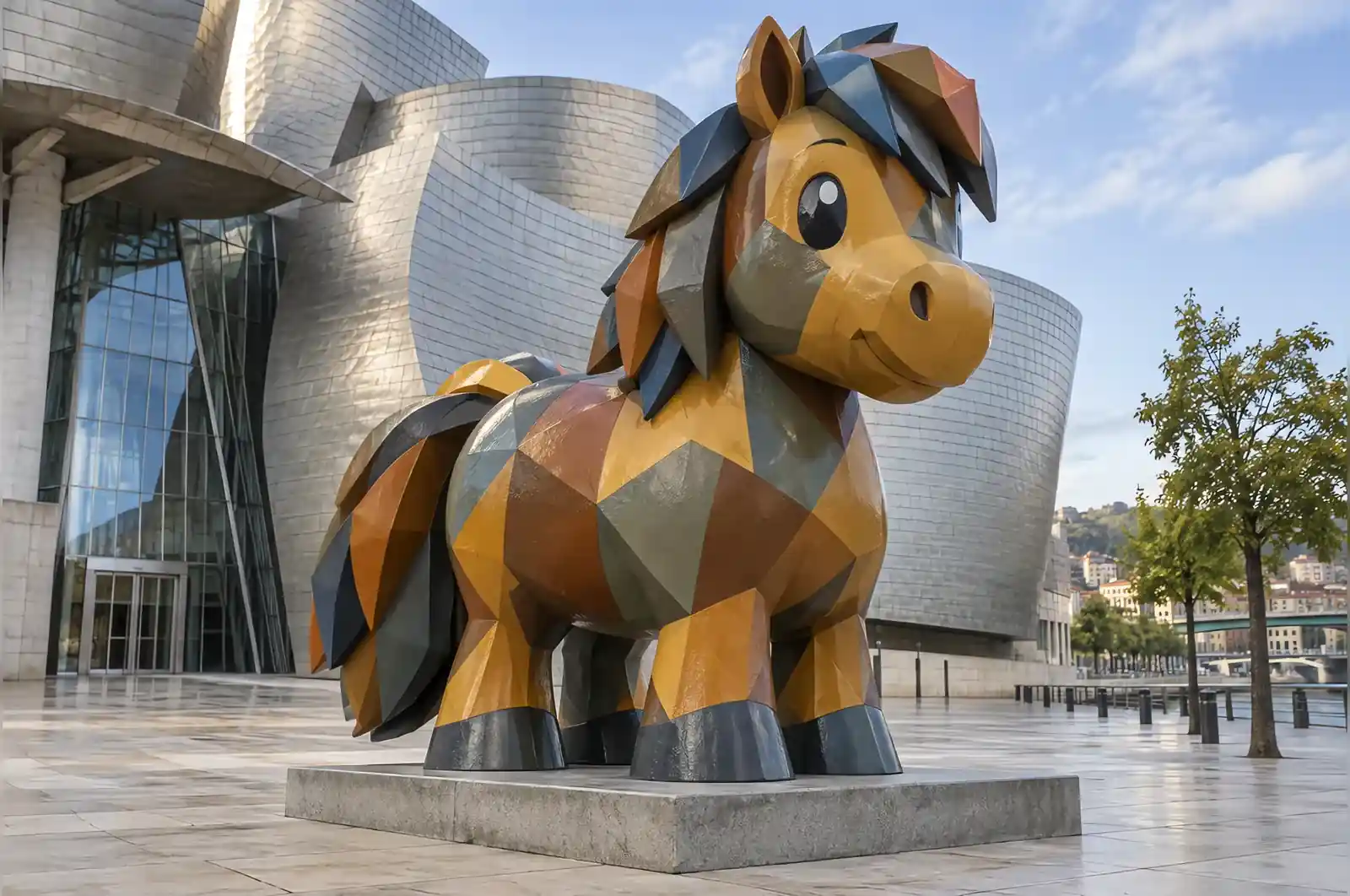
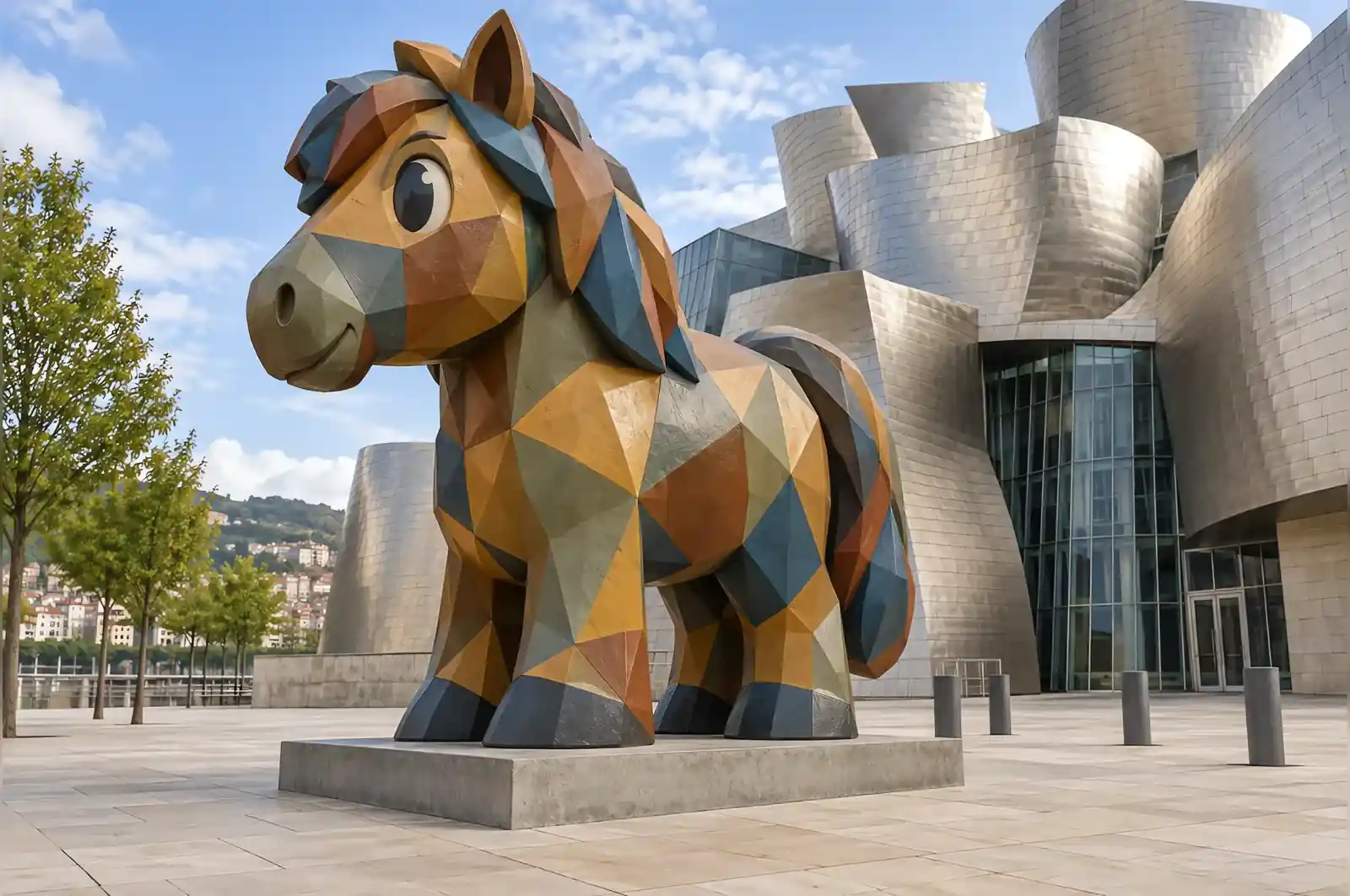
The museum asked whether a cartoon could be built the way a cubist painting is built. We said we did not know, which was the honest answer, and then spent four months finding out.
The rules we set ourselves
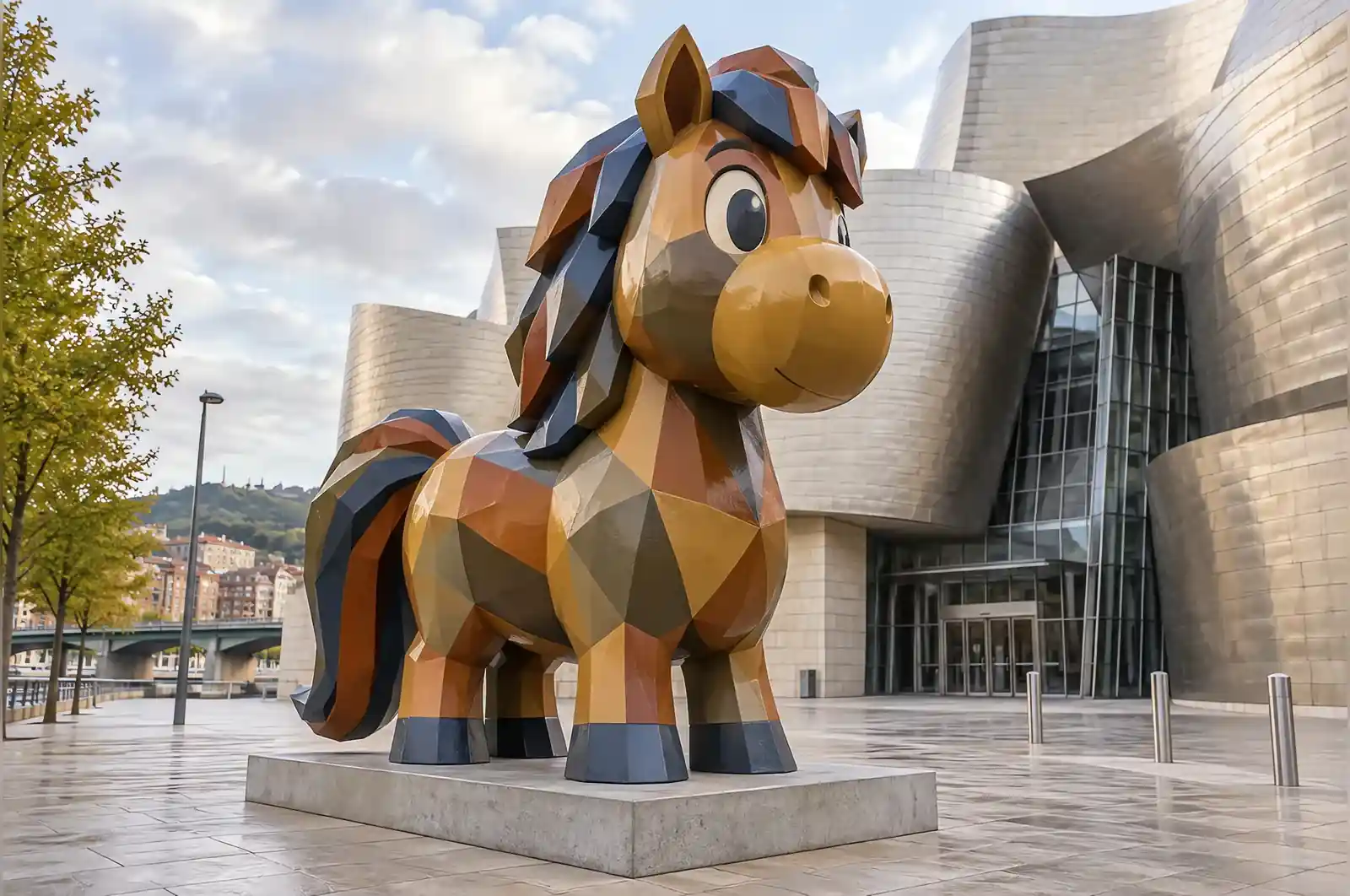
No curve anywhere. The whole animal had to be constructed from flat planes, with a hard edge wherever two planes meet. A cartoon usually lives in its curves, so removing them is a genuine risk: take the roundness out and you can end up with a piece of furniture.
The pony survived the treatment for one reason. We kept the head at almost half the total height and kept the legs very short. Those two proportions are so exaggerated that the piece stays a character even when every surface is flat.
Where the planes go
Sixty-one planes. The body is a stack of seven large quadrilaterals that step around the barrel; the neck is a single long plane folded twice; the mane is resolved as five flat triangles along the crest; the head is eleven planes meeting at a blunt muzzle. Nothing is chamfered and nothing is rounded. Where a real sculpture would soften an edge, we sharpened it further and then painted it a different colour on each side.
The colour does the rest. Ochre, umber, olive grey, a dull slate blue and one warmer rust, assigned so that no two adjacent planes share a tone. In flattened light the piece goes almost graphic, and in raking light the edges reappear as drawn lines.
Building flat
Flat planes are unforgiving. A curved shell can be sanded into agreement with itself; a flat panel cannot, because a viewer sees the whole plane at once. Each of the sixty-one surfaces was laminated as its own panel, jigged flat while it cured, then assembled over a fabricated steel core.
On the forecourt
It stands off-axis, in the corner of the forecourt where the building’s titanium curve meets the paving. Children run up to it and stroke the flat planes as if they were petting a real animal; the museum’s docents have learned to let them, then ask them which plane is the cheek.
The children see a pony. Our visitors see a painted solid. Both groups are getting the piece we commissioned.
A contemporary art museum in Bilbao, Spain