Ori — Origami Cartoon Horse, Station Plaza, Kyoto
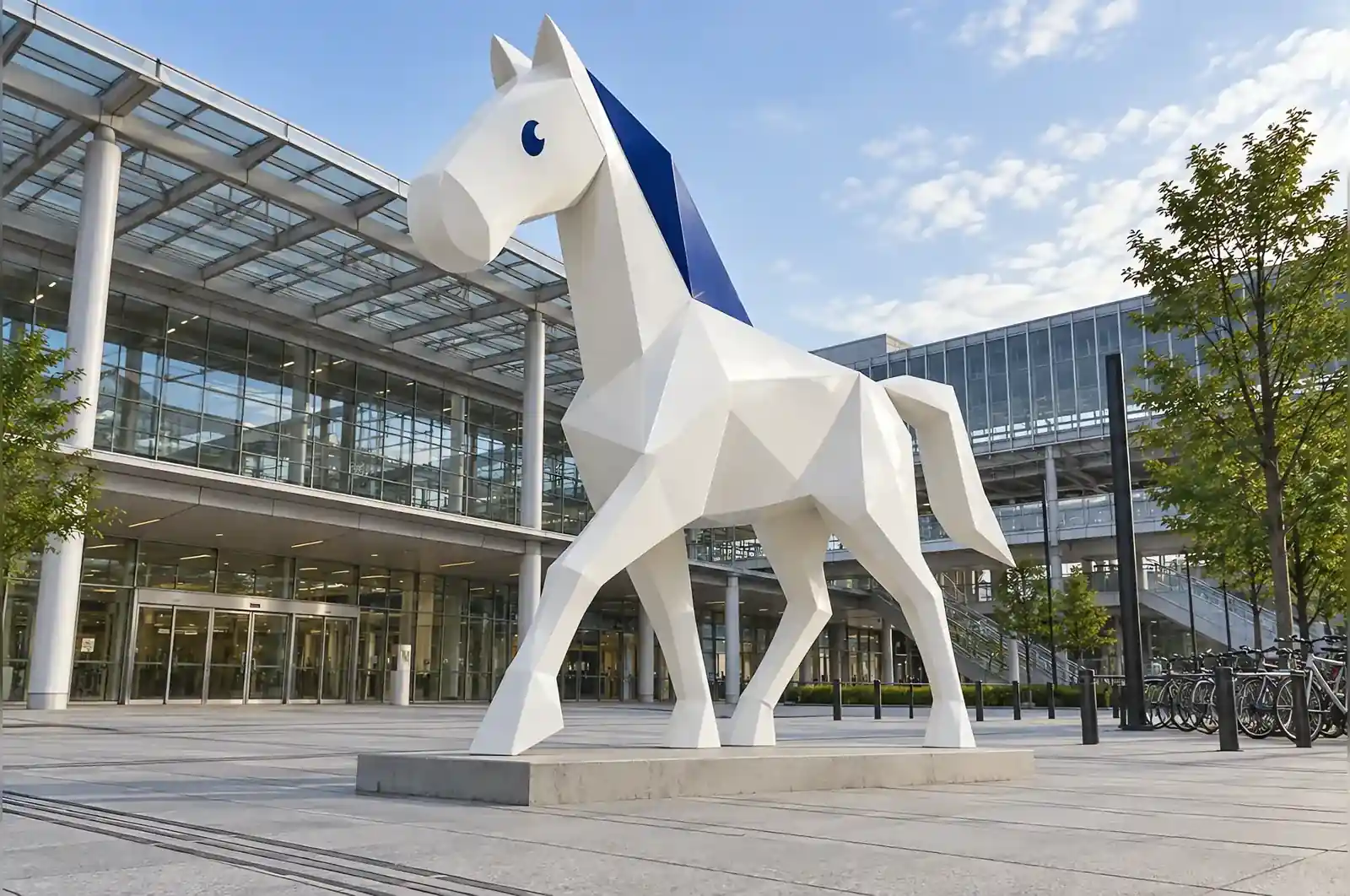
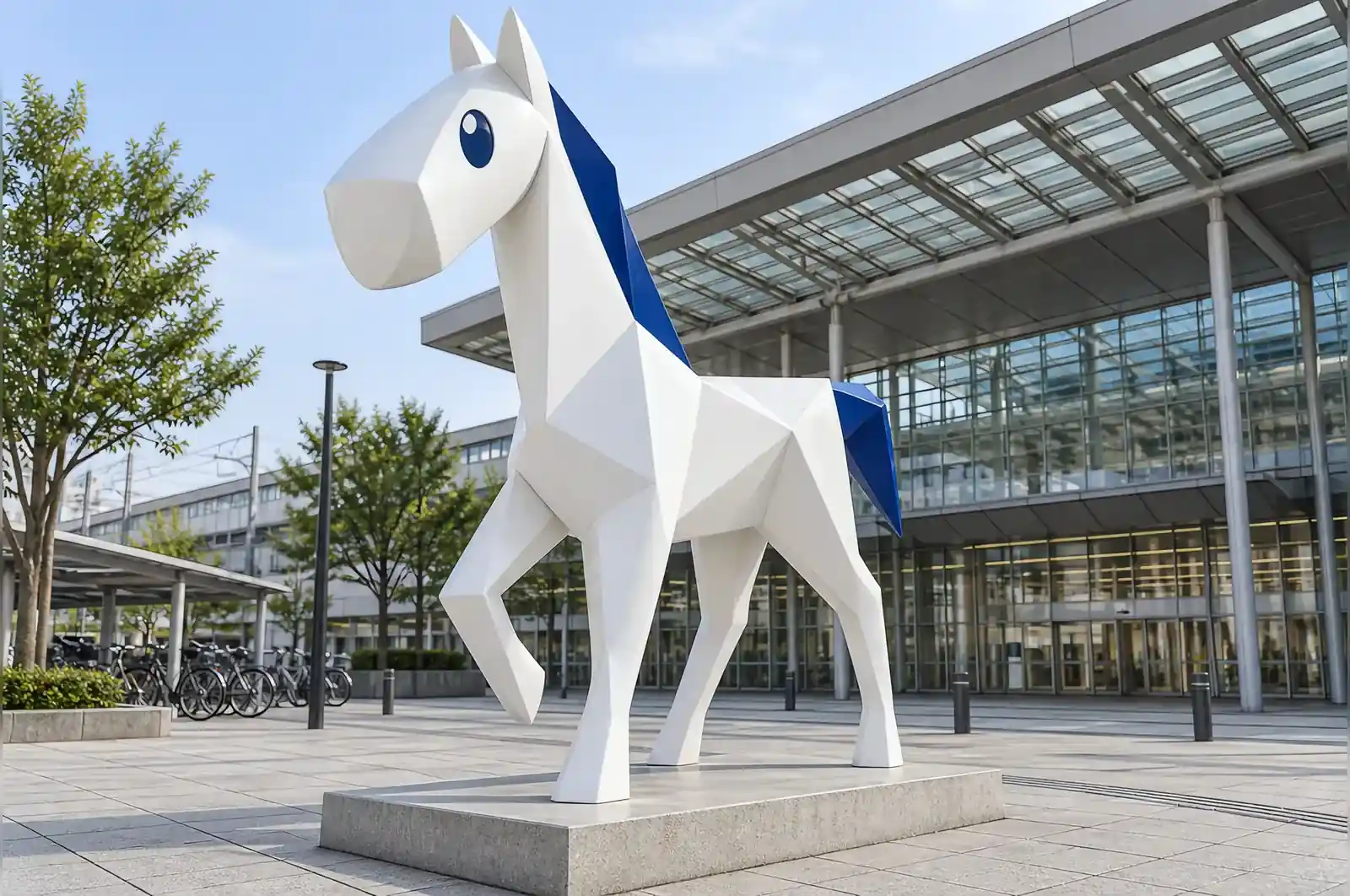
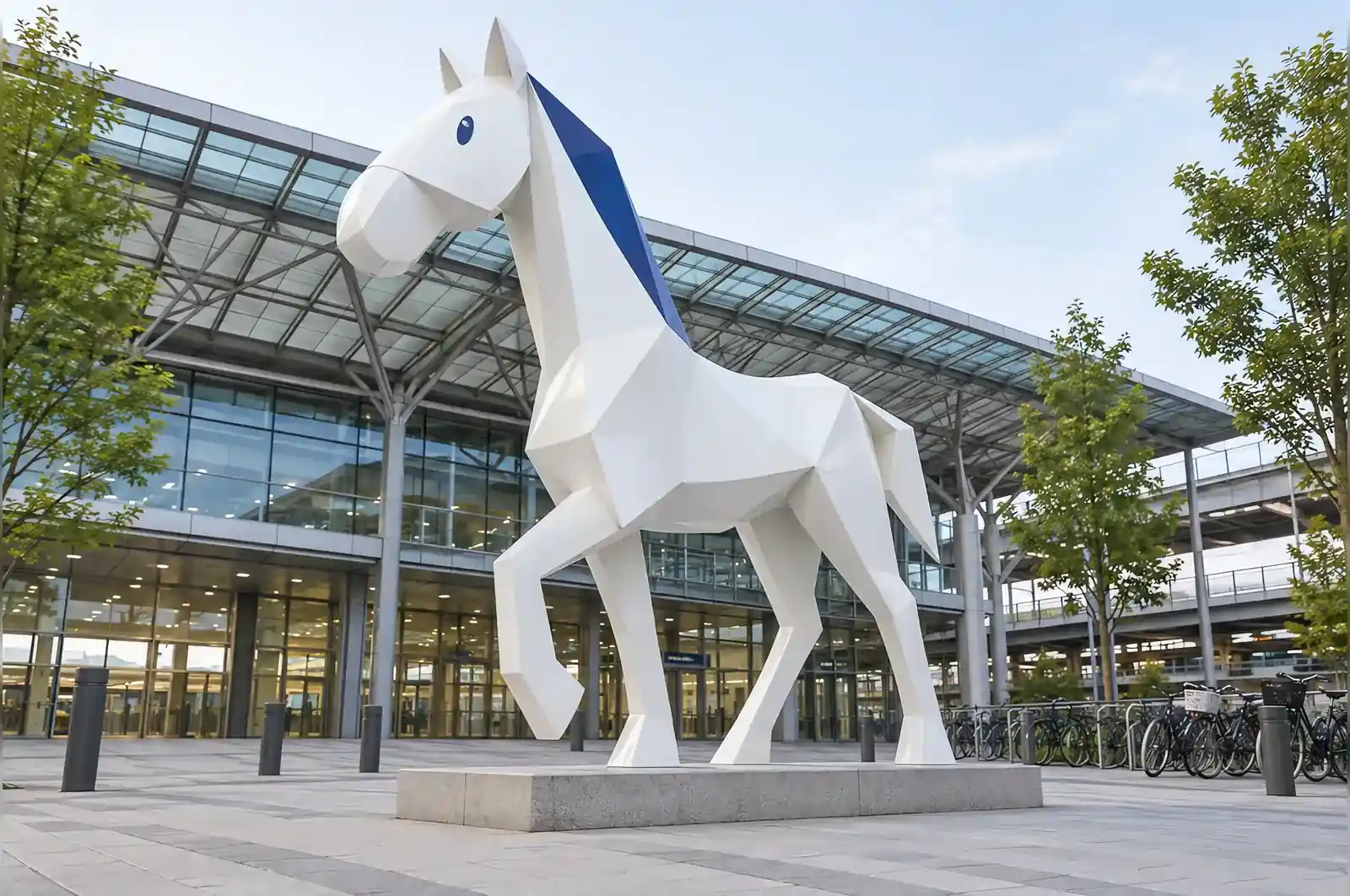
A horse folded from a single sheet of paper has a particular quality: it is instantly an animal and instantly a piece of geometry. The station authority wanted that quality at 2.5 m, and they wanted the creases to be real.
Designing by folding
We began with actual paper, not with 3D software. The design team folded roughly ninety versions over three weeks, keeping every one that produced a recognisably cartoonish animal rather than a naturalistic one. The version that went forward came from an unlucky fold: the head was too large, the legs too straight, and the result was funny in a way that a well-proportioned fold was not.
That model was then unfolded and measured, so the sculpture is not an evocation of paper folding, it is the geometry of one specific folded sheet scaled up roughly fourteen times.
Honest creases
Then the difficult part. A crease on a 2.5 m painted surface reads as a soft line unless the panel itself actually turns. Each fold in the model is a genuine dihedral angle in the sculpture, and each crease line is a slightly eased hard edge about 3 mm wide, which catches light the way a real folded paper edge does.
The facets are dead flat. Nothing is curved anywhere on the piece. The only exception is the ground contact of the hooves, which are chamfered so the horse does not appear to be standing on knife edges.
One colour, one fold
Paper-white throughout, with a single saturated indigo fold running from the shoulder along the upper neck and over the crown of the head. It is the one place the piece departs from its own logic, and it is the element every photograph of the piece includes.
At the plaza
It is positioned on the main sight line out of the ticket hall, large enough to be seen over a crowd but set far enough from the doors that nobody walks into it. The station reports that it has become the standard meeting point, which is the real test of public sculpture: does anyone use it.
The size was the fixed point
At the station three things did not move. The height had to be 2.5 m, because the piece sits on the main sight line out of the ticket hall and had to read over a crowd. The creases had to be real, because a painted line would not have been a fold. And the colour had to be paper-white, because the whole idea depends on the piece reading as a sheet of paper rather than as a horse painted to look like paper.
If any of those three had changed, the design would have gone a different way. At 1.5 m the piece would still have folded correctly, but it would not have been visible over the crowd, and the meeting-point role it now plays would have gone to something else. Moved indoors under a lower ceiling, the same 2.5 m height would have dominated the concourse, and the scale would almost certainly have come down. And if the finish had been a naturalistic palette instead of paper-white with one accent, the facets would still have been flat, but the piece would have read as a painted animal rather than a folded sheet. The fold is the subject, and every decision on this commission protected it.
A gloss shell in the open
The paint system is the part that has to be maintained, because the FRP shell is the weather barrier. The internal steel frame never sees weather, so it needs no sealing and no repainting, but the outside is a gloss-painted surface in an open plaza in Kyoto, which has humid summers and carries city dust. The gloss UV clear coat is what keeps the paper-white from yellowing and the indigo accent from fading, and it is the surface that actually needs attention.
Because the piece is dead flat and has sharp creases, it is easier to clean than a curved sculpture. There are no deep concavities for dirt to settle in, and a wash with a soft cloth and a mild detergent at low pressure is enough to keep the facets reading as paper. The chamfered hooves are the one area that gets scuffed by feet and cleaning equipment; a touch-up of the same gloss system along that line is the only repainting we would expect in the ordinary course. The accent fold is painted, not applied, so there are no separate fixings to work loose over time.
Three questions before the quote
Three questions settle most of the cost and the time on a commission like this, and they are worth deciding before you ask for a quote.
The first is scale and sight line. Does the piece need to be seen over a crowd, or is it for a quiet corner? That single question set the 2.5 m height here, and it changes the mould and the amount of FRP considerably.
The second is how real the fold has to be. A crease that is painted reads as a line; a crease that is actually turned in the panel reads as a fold. This piece has every crease genuinely folded, which is more work in the mould and in the finishing, and it is the difference between a sculpture of paper and a paper sculpture.
The third is where it will live and how it will be cleaned. A piece in a station plaza is seen by thousands and cleaned by contract; a piece indoors under a lower ceiling asks a different scale question and far less of the paint system.
Settle those three and the brief writes itself. The 14-week lead time from 3D approval is the other thing to plan around, because the folding and the moulding run in sequence and neither can be rushed if the creases are to stay sharp.
It is a folded piece of paper the size of a bus shelter. Travellers stop, which is precisely what a station plaza needs them to do.
A railway station redevelopment in Kyoto, Japan