
Tally — Stencil Cartoon Horse, Street-Art Quarter, London
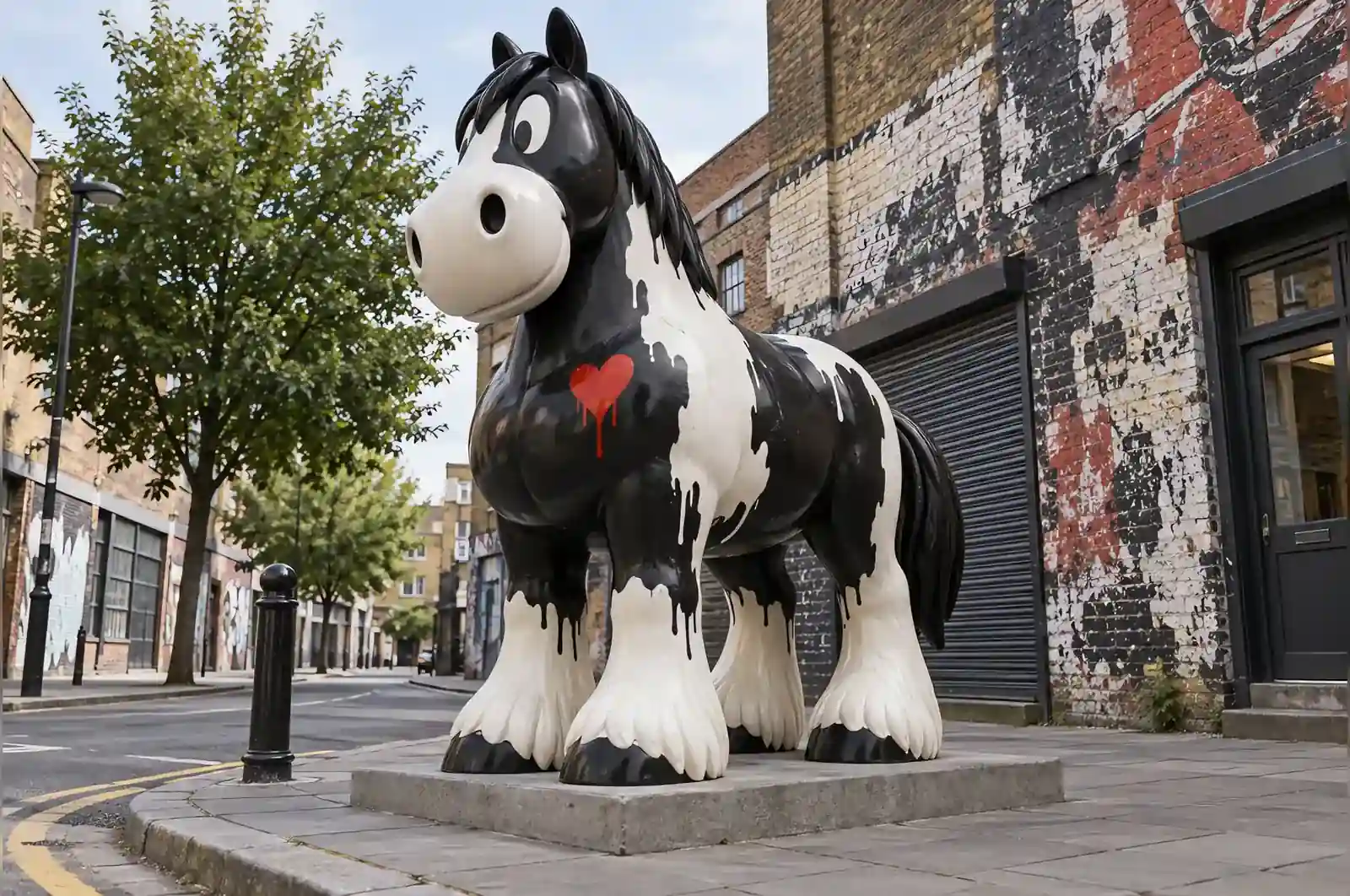
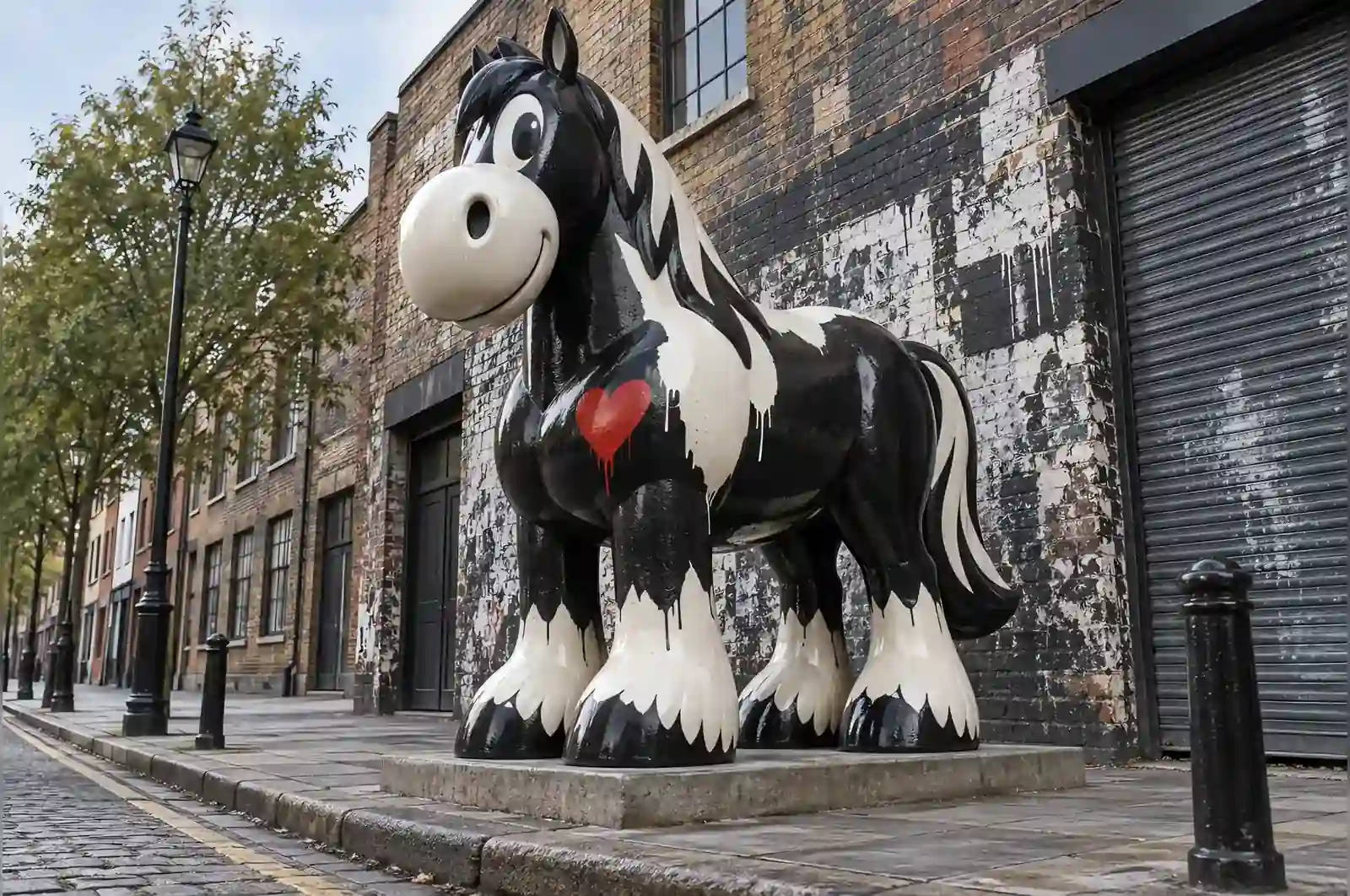

The building is a former stable block on a Shoreditch corner, and the landlord wanted a horse. He also wanted it to survive being painted on, which is a different and more interesting problem.
Designing something that expects to be vandalised
A finely finished sculpture on a street corner in that neighbourhood is asking for trouble. Our view was that the piece should be designed in the visual language that was going to be applied to it anyway.
So Tally is a stencil. Flat black and off-white, hard stencil edges, a halo of spray where the stencil lifted, a few deliberate drips, and exactly one red accent on the horse’s browband. There is no lettering anywhere on it, which was a condition: a horse that appears to be advertising something is a horse nobody likes.
Why a draft horse
Stencil works with mass, not with elegance. The heavier and blockier the silhouette, the better the treatment reads from across a road. A draft horse gives us a thick neck, a big barrel and feathered legs, and we exaggerated all three.
The eyes are the only soft element on the whole piece. Everything else has a hard edge, so two simple stencil-cut eye shapes read almost photographically by contrast, which is the effect the whole piece is organised around.
Making drips on purpose
Genuine drips are impossible to fake convincingly in paint, because real ones have a thickness at the bottom. Each of the eleven drips was modelled into the surface as a small raised teardrop, then painted, so the light catches them the way it catches a real run of wet paint.
Two years on the corner
It has been tagged twice. Both times the writers worked on the black side and both times they left the eye alone, which the landlord reads as professional respect. The tags were cleaned off with solvent; the original finish underneath was undamaged, because the clear coat is doing exactly what we designed it to do.
What the corner made non-negotiable
The piece was always going to live on this frontage, and the placement set three conditions that were not open to negotiation. It had to be readable from across the road, so the silhouette had to carry at distance and the two-tone treatment had to be large enough to hold that read. It had to carry no lettering, which was a written condition from the landlord. And it had to survive being painted on, because a finely finished piece on that corner would be tagged within months of going up.
Any one of those three could have gone a different way, and each change would have altered the whole design. Move it indoors into a lobby and the stencil stops earning its keep; a stencil is a response to street risk, and inside there is no risk, so the horse would more likely have been painted in a single deep colour with soft, blended eyes. Drop the size and the treatment collapses with it, because at half the height the halo-of-spray edges and the drips read as noise rather than intention. Change the finish to a deep gloss and you give a tagger a smoother surface to write on and a harder surface to clean without marking it.
Repainting the black side
Because the treatment is flat black and off-white over hard stencil edges, a touch-up is straightforward in a way a blended finish is not. After solvent cleaning there is no gradient, no metallic flake and no pearlescent shift to match, so re-spraying the flat colours back to the same stencil edges is an exact job. On a metallic or pearlescent surface, matching a repair after a tag would be a far more difficult proposition and would risk a visible patch.
This is worth stating plainly at 2.6 m high and 2.7 m long. The piece is hand-laminated FRP over an internal steel frame, gloss-painted, and then given a satin UV clear coat that sits over both colours. That clear coat is the sacrificial layer: it takes the solvent when a tag is cleaned off, and it is what stops London rain and UV from reaching the paint underneath. When it eventually wears thin it can be re-sprayed without stripping the artwork, which keeps the two-tone stencil intact for the life of the piece.
The frame matters as much as the paint on a piece this length. The internal steel frame is what lets a 2.7 m-long horse stand on a street frontage without a plinth or a wall fixing, and it carries the whole weight down to a small ground footprint. That frame is sealed inside the hand-laminated shell, so rain and road dirt never reach the steel. For a buyer the practical consequence is that there is no annual maintenance chore beyond cleaning; the structure is not something you inspect or re-treat.
What this means for your own brief
Before asking for a quote on something similar, settle three questions. First, will it be touched? If the piece stands on public frontage where people may paint on it or lean against it, the finish needs to be a flat, repairable treatment rather than a deep gloss, because the first is cheap to restore and the second is not. Second, how far away will it be read? The stencil language depends on the silhouette carrying across a road, which works at this size on a corner, but at garden scale the same treatment needs rethinking before it is committed. Third, what does the site itself allow? Street frontage, any permission from the local authority, and a landlord’s restrictions on lettering all shape the design before modelling starts, and they are cheaper to settle in a conversation than to discover after a 3D approval.
It has been tagged twice by actual writers and both times they used the black side. That is the review I care about.
A landlord in Shoreditch, London