Twist — Balloon-Animal Cartoon Horse, Toy Museum, Nuremberg
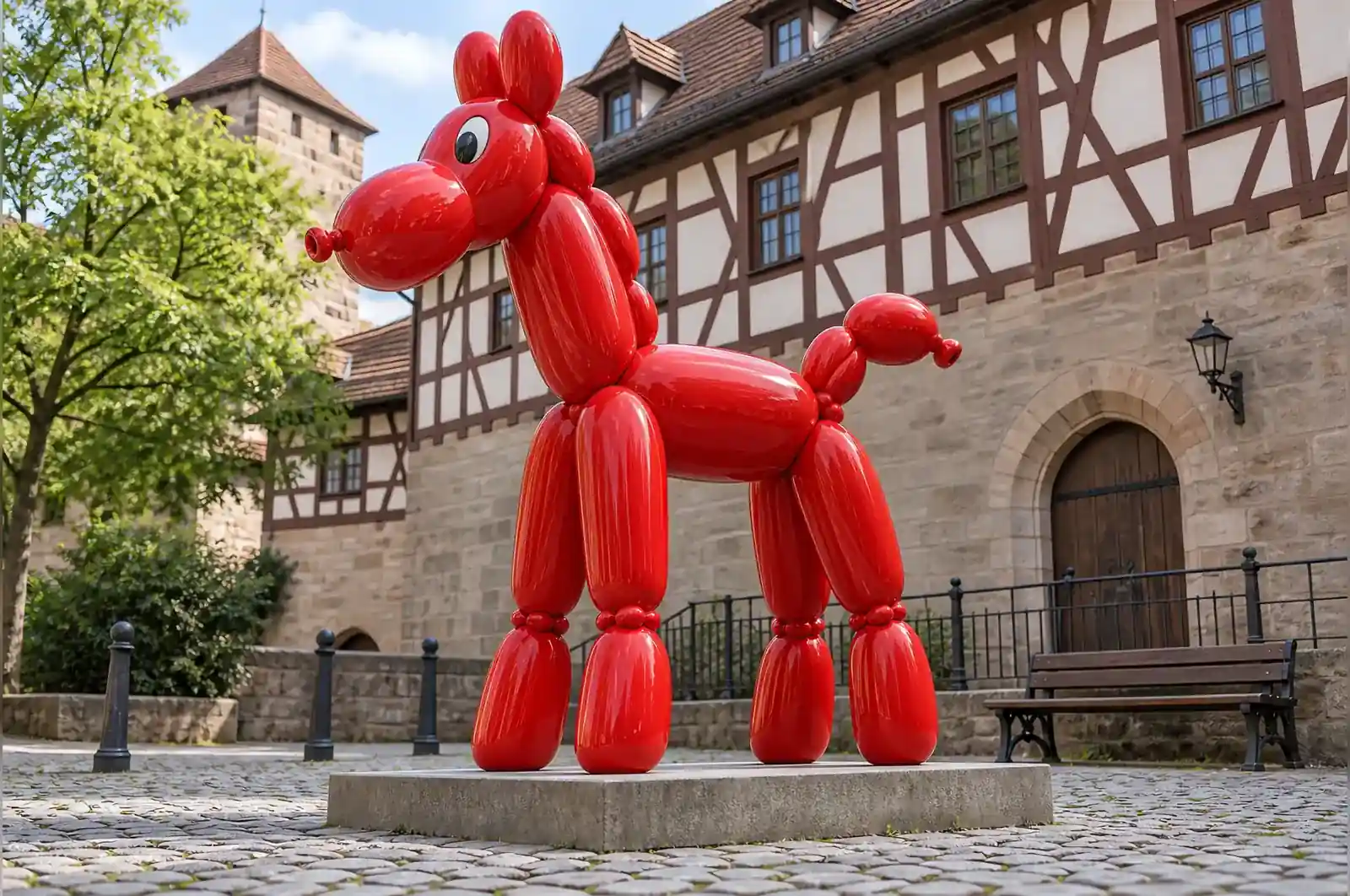
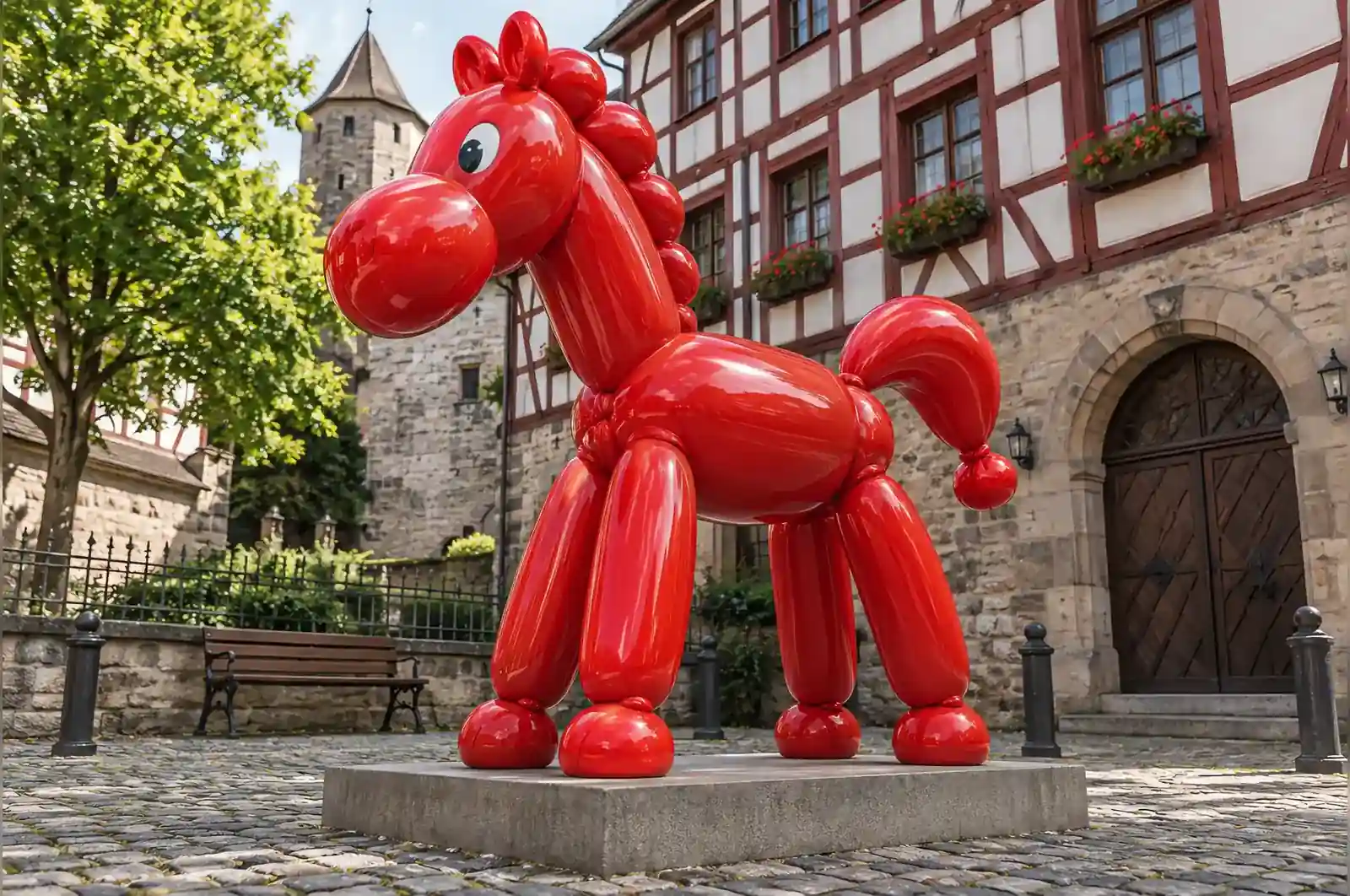
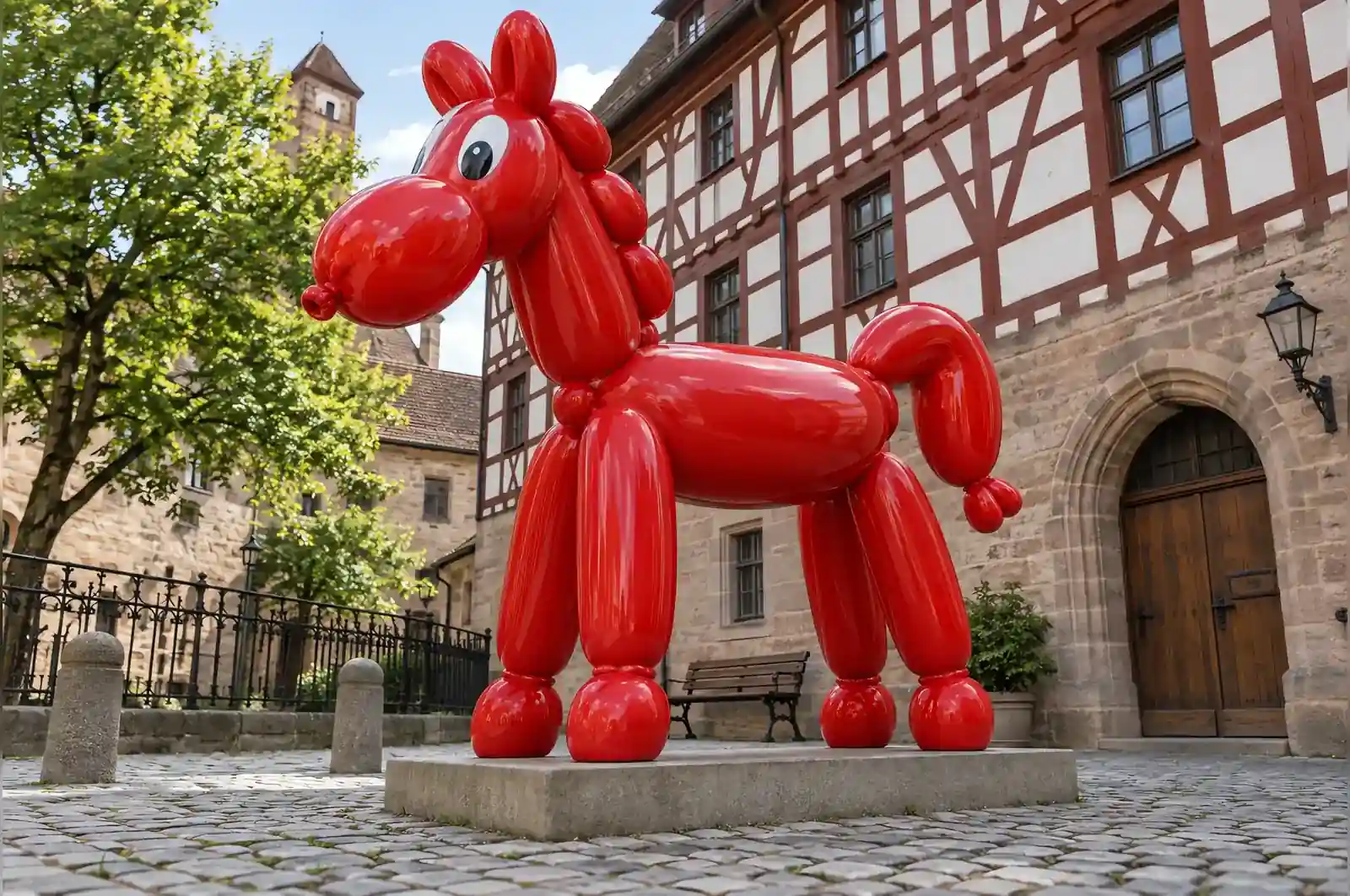
Every child who has ever been to a party has seen a balloon horse. Almost none of them survive the week. The toy museum’s proposal was to make one that would last fifty years, and to be honest about what it is.
The brief
A horse built the way a balloon twister builds one: cylinders, pinch points, knots. About 2 m. It had to be glossy and taut like an inflated balloon, and it had to be obviously a cartoon, because a realistic horse made of balloons would be horrifying.
What the brief would not give up
Three things were not negotiable. The horse had to read as a balloon animal rather than a realistic horse painted in balloon colours, because a lifelike horse with inflated legs would be unsettling rather than charming. It had to be a cartoon, for the same reason. And it had to stand in the courtyard, at a height a child could walk under, because the walk-under is not a decoration; it is the point of the piece.
If the size had been dropped, that third requirement collapses. At 2.0 m high and 1.8 m wide the neck sits just above a child’s head, and the horse is something you pass beneath. At 1.2 m it becomes a display object, and the courtyard becomes merely a place where a sculpture happens to stand. Depth matters as much as height. The form is deliberately thin — 0.5 m deep — so it reads as a flat cartoon drawn in three dimensions rather than as a solid animal, and that thinness is what makes the walk-under believable.
If the finish had been changed, the balloon reading would go with it. Satin or matte is how you signal fibreglass or painted resin. The high-gloss clear coat is what tells the eye that the surface is under tension, and that one decision is what makes the piece read as inflated rather than carved. It is not a coating preference; it is the argument of the sculpture.
Learning the vocabulary
We spent a day with a professional balloon twister and photographed the construction of eleven horses. Balloon horses are not modelled, they are folded, and the whole charm lies in the fact that the form is locked into a fixed number of sealed segments.
So the sculpture is built as segments. The neck is one twisted cylinder, the body another, each leg one each, the tail one more, and the head is a single rounded segment with two small pinches for the ears. Nothing is anatomically modelled. If a real balloon horse would have to bend there, our horse bends there.
Making fibreglass look airtight
The character of an inflated object is that its surface is under tension, and that shows as a very even, very tense gloss with slightly softened edges. We achieved it by keeping the wall thickness even, radius every twist point to a precise 18 mm, and building up the clear coat so that it reads as a skin rather than a finish.
The knotted ends at the tail and the ear pinches are actual knots, modelled from photographs of real ones, with the creases and the small tail of loose balloon reproduced exactly.
Frame, footing and winter
The piece is 2.0 m high and only 0.5 m deep, and it stands in an open courtyard, so the internal steel frame does real work. A tall, thin, glossy form catches wind, and a form that is deep enough to feel solid but thin enough to be caught by a cross-draught has to be bolted into a concrete footing rather than weighted or ballasted. The steel is hand-laminated into the fibreglass as the shell is built, so the frame and the skin move as one; there is no gap for the surface to flex against the steel and no seam for water to sit in.
Nuremberg winters put frost and UV on the surface, so the clear coat is built up and rated for outdoor use. The gloss also shows smears more readily than a satin finish, and because there is no barrier the piece is touched, which is why the museum’s twice-weekly wipe is a safe routine rather than a risk to the surface — the coat is hard enough to take a cloth without micro-scratching. The creases at the knotted ends are the spots that collect dirt, and those are what the wipe has to reach.
In the courtyard
It stands beside the museum’s bench, at a height where a child can walk under the neck. There is no barrier and the museum has no plans to add one. The paint has been wiped clean twice a week since it was installed, and the surface is holding up better than anything else in the collection that spends its life outdoors.
What this means for your own brief
Three questions decide most of the work before a quote is asked.
First, does the piece need to be recognisably a balloon animal, or simply smooth and glossy? The balloon grammar — segments, pinch points, knots — drives the construction. If you drop it, you are building a plain cartoon horse and the build is simpler. If you keep it, the twist points and knotted ends are modelled from photographs of real ones, and each has to be built as a sealed segment.
Second, who is going to touch it? A piece with no barrier, at walk-under height, sets a different bar than one on a plinth in a lobby. The interactive version needs a tougher clear coat, a frame that can take a child leaning on it, and a cleaning routine agreed with the venue. The display version needs none of that.
Third, is the size flexible? At 2.0 m the neck clears a child’s head and the piece holds a courtyard. If your site needs a different footprint, the depth matters more than the height: a deeper form carries its own weight and needs less frame, while a thin form like this one is the one that needs the footing and the wind calculation.
Children understand it instantly and adults take a moment, which is the right way round for a toy museum.
A toy museum in Nuremberg, Germany