Dazzle — Metal-Flake Cartoon Horse, Racecourse, Newmarket
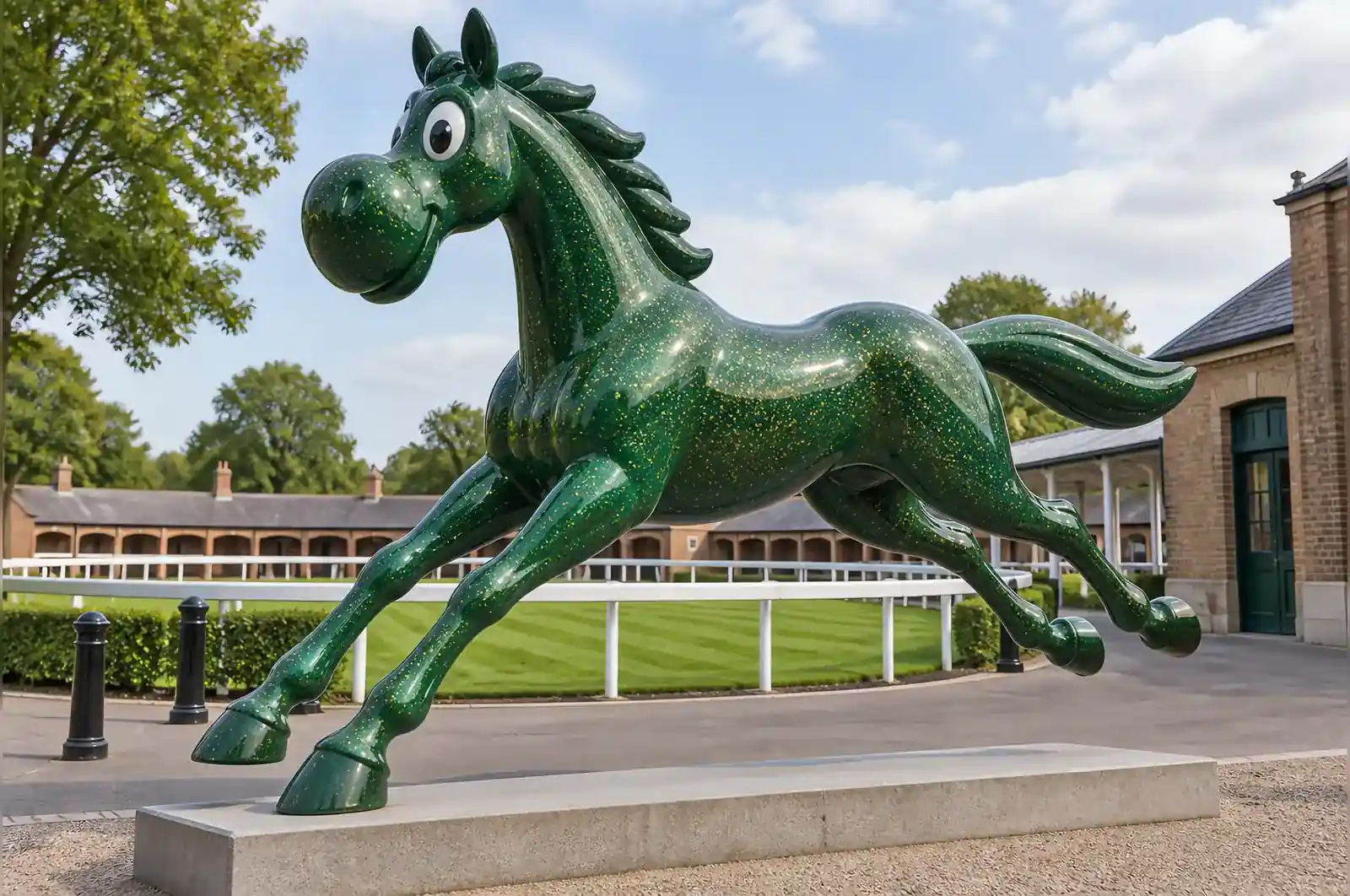
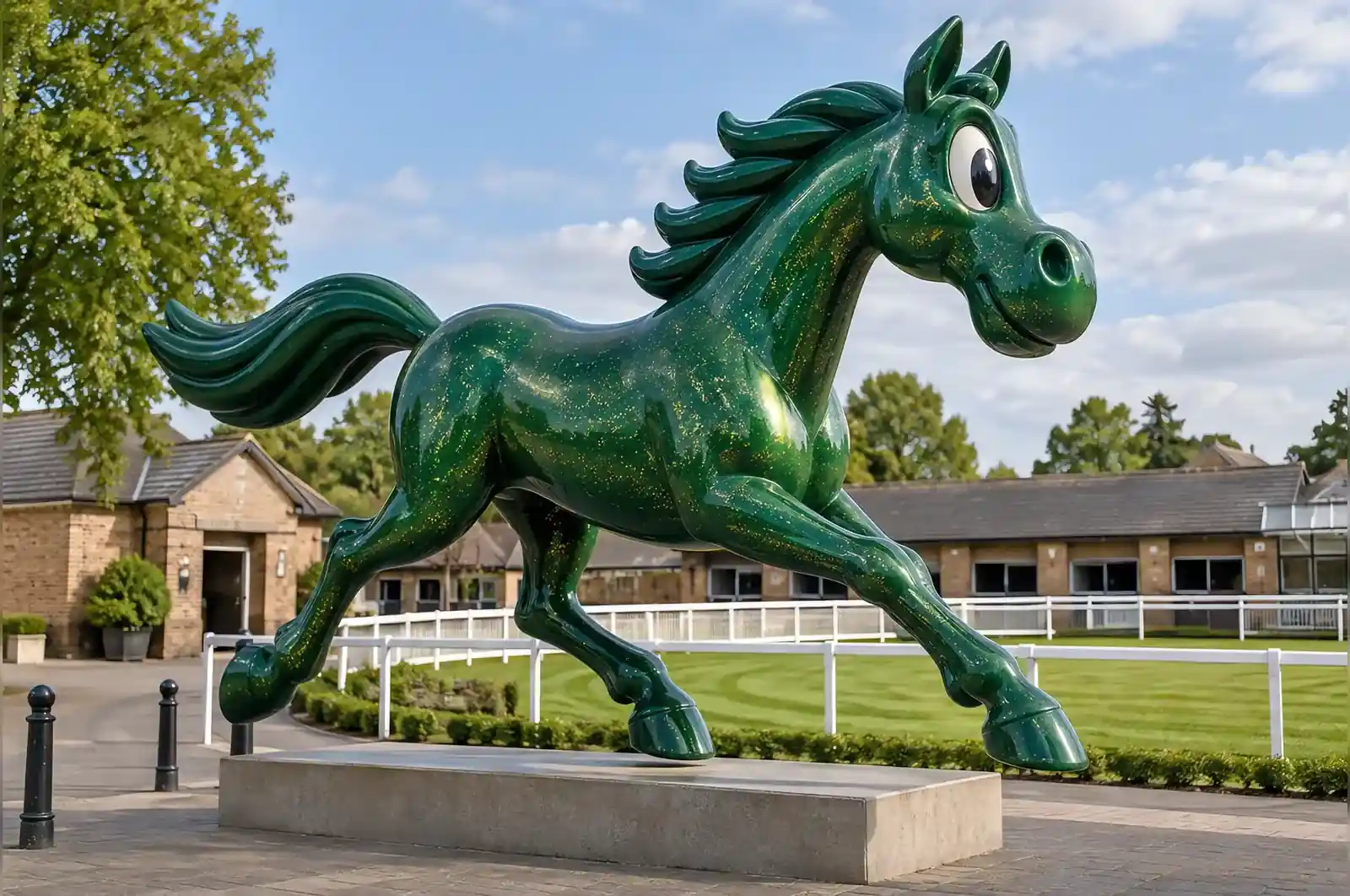
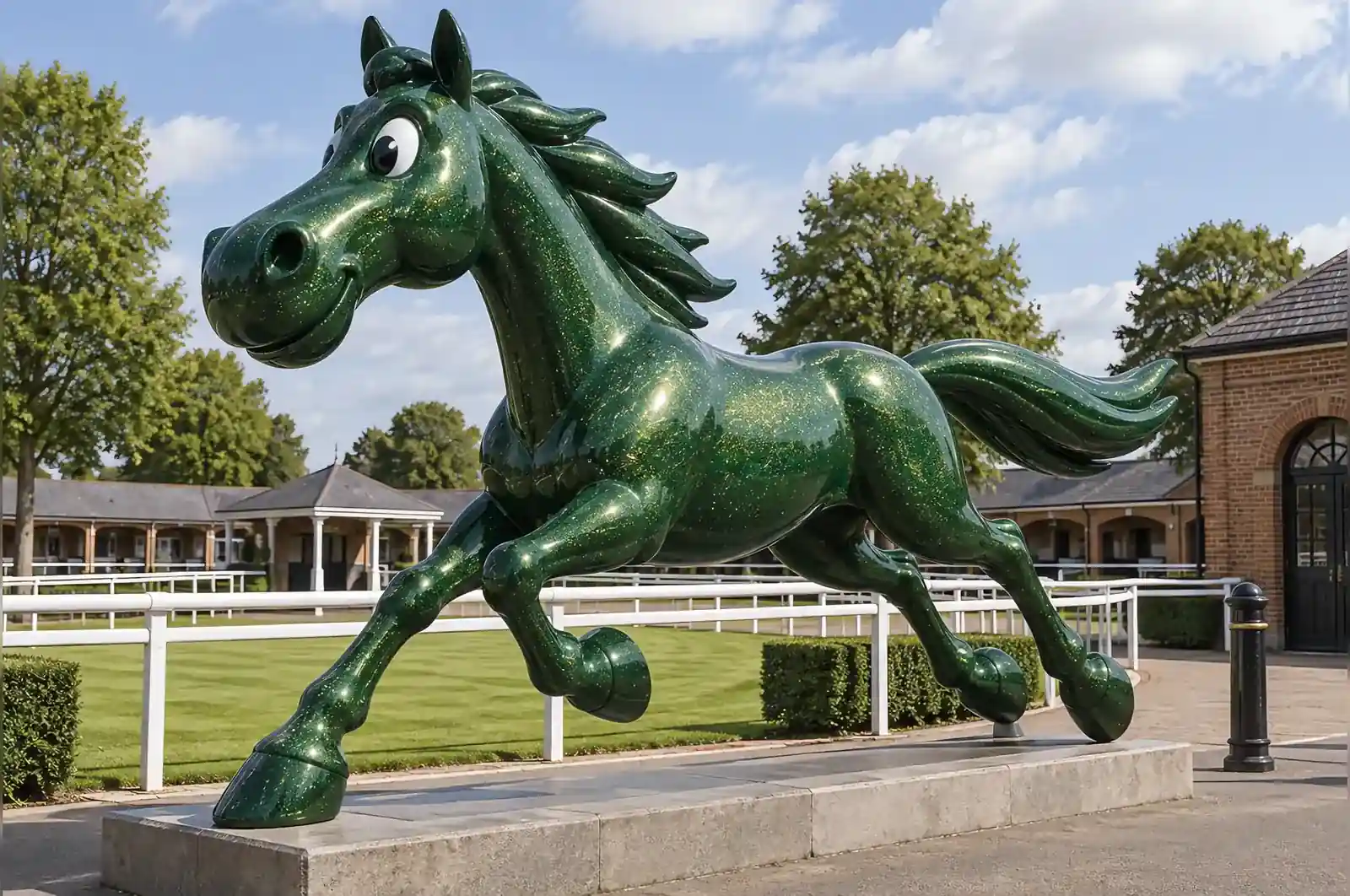
Racecourse members are not a sentimental audience. They know exactly what a horse looks like, they spend their lives looking at them, and they have seen every monument ever cast. That is what made this commission interesting.
The brief
A cartoon horse at the parade ring, about 2.3 m, that would not look like a trophy. The aesthetic reference the client gave us was not sculpture at all. It was the paint on a well-kept vintage racing car.
Cartoon proportions on a racing animal
A racehorse in full stretch is a collection of straight lines, which is the opposite of what a cartoon wants. So we kept the stretch and changed the joints. The neck is longer and deeper than it could be, the head is oversized, and the legs are extended further than the stride would actually reach.
The effect is a horse at a moment that never quite arrives. Standing next to it you can feel the pose asking to complete itself, which is why people walk around it rather than stopping in front of it.
The paint, which was the whole job
Candy metal-flake is a three-stage system: a metallic base, a translucent coloured coat over it, then clear. The flake has to lie flat and evenly, which means the flake coat has to be sprayed wet enough to flow and dry enough not to sag, in a booth with no contamination at all. We sprayed eleven test panels before we touched the sculpture.
The result is a surface that changes as you move. From the members’ stand the piece is a solid deep racing green, and the gold flake only appears when the light hits it at a shallow angle, which on a racecourse is most of the afternoon.
In the ring
It stands at the entrance to the parade ring rather than in the middle, so members pass it on the way to look at the real animals. The obvious joke has been made several hundred times by now, and the racecourse says it has not stopped being funny.
Why the finish was the brief
The one thing that was not negotiable was the paint. The client’s reference was a well-kept vintage racing car, and every other decision in the commission served that. It is worth being clear about what that decision carried with it, because it is the kind of thing that is easy to miss when the brief is a single reference image. If the finish had not been the point, the size would almost certainly have come down. At 2.3 m high and 2.4 m long the surface area is large, and a three-stage candy system has to be laid down in one clean pass across every panel, so the larger the piece the more surface there is to get wrong. A smaller horse would have been a faster and cheaper way to make the same point.
The placement followed from the finish rather than the other way round. The gold flake only reads when the light strikes it at a shallow angle, which is why the piece stands in the open at the parade ring rather than under cover. Under a roof, or inside a stand, the whole effect would have gone flat by mid-morning and the horse would have read as a plain green shape. The finish is what makes it a monument, and the open-air placement is what makes the finish work.
The frame, the legs and the English winter
The pose is what makes the structure interesting. In full stretch the horse stands on two legs, and those legs are extended further than the stride would actually reach, so the load runs down the front leg, through the body and out the rear leg to the ground. That is a long cantilever with no support in the middle. The internal steel frame does that work. It is welded to follow the pose, and the FRP is hand-laminated over it in shells. That is why the surface can hold the smooth double curves of a cartoon while the frame underneath carries the real load.
The finish then has to hold up outdoors. The piece stands in the open at the parade ring, and it is there through every English winter. The high-gloss clear coat is what carries that. It seals the flake and the metallic base so the gold does not dull, and because it is a hard automotive clear it takes a wash rather than a polish. The maintenance ask is a rinse with clean water and a soft mitt, plus an inspection of the clear coat for chips, because a chip at ground level is the one thing that would let moisture in and lift the flake beneath it. There is no polish routine, and no product to buy; the clear coat is the maintenance plan.
What to settle before you ask for a quote
Three questions are worth settling before you ask for a quote on something similar.
First, is the finish the point, or is the form? Here the answer was the finish, and it drove the timetable: twelve weeks from 3D approval, with eleven test panels sprayed before the first coat went anywhere near the sculpture. If the paint is incidental, a solid automotive colour gets you most of the way there in a fraction of that time. Say which it is before anyone quotes, not after.
Second, where will people see it, and at what time of day? The metal-flake only reads at a shallow angle to the sun. If your site is under cover, in shade for most of the day, or lit only by a ceiling light, the flake will not do the work it does here in the open. Tell us what the light is doing before the finish is chosen.
Third, will anyone touch it? This piece stands at a parade ring entrance, within reach of people and of horses, and it is washed rather than polished for that reason. If yours sits in a children’s area or a busy thoroughfare, the clear coat and the cleaning routine need to be part of the conversation, not an afterthought.
It shimmers like a freshly polished car and it is shaped like a cartoon. Our members cannot decide which half they like more.
A racecourse in Newmarket, England