Dala — Folk-Painted Cartoon Horse, Town Square, Sweden
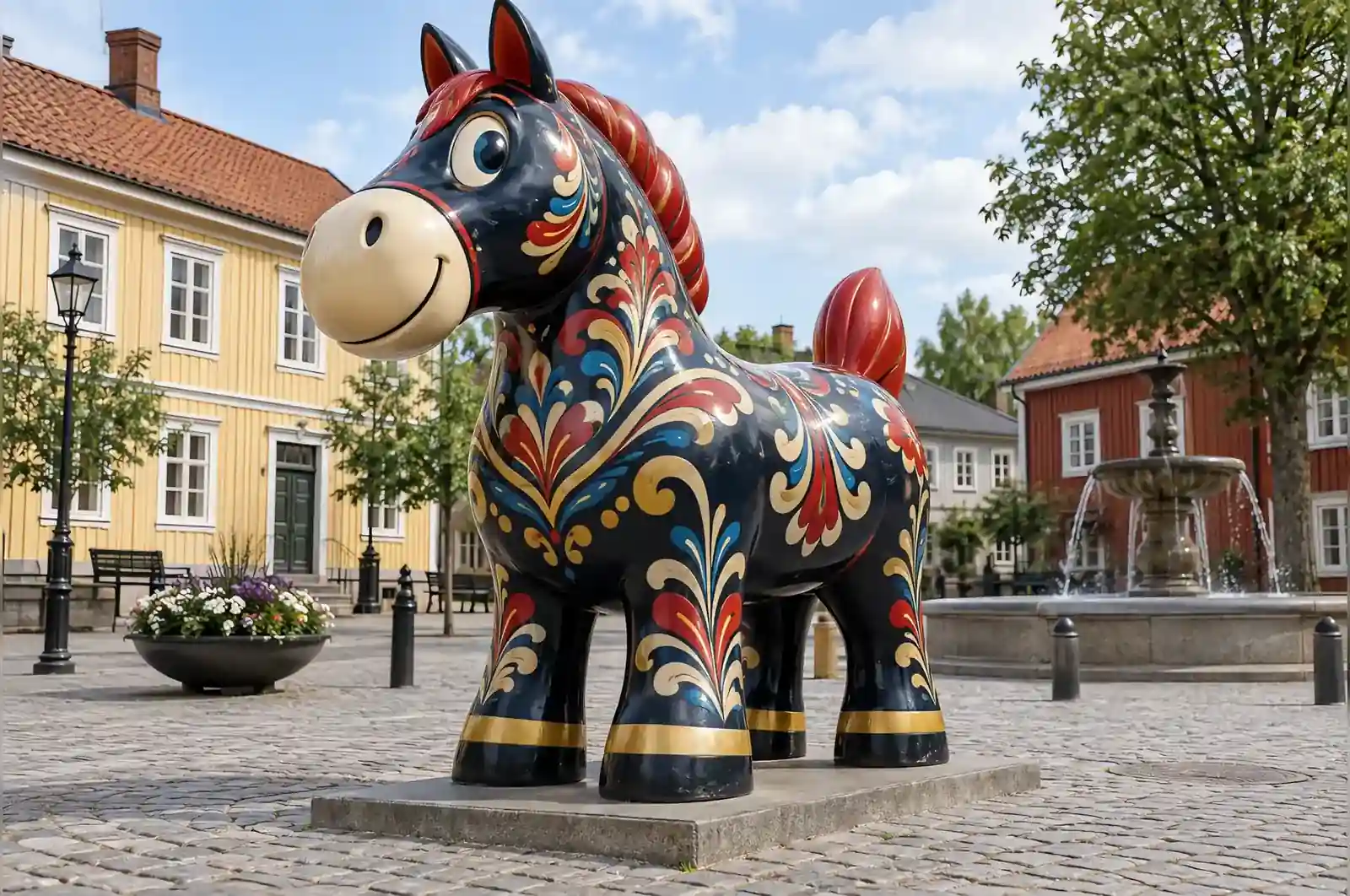
In Dalarna they have been carving and painting the same horse for about two hundred years. That is a hard thing to be asked to follow, and the town council knew it. Their brief opened with what they did not want: a giant replica.
The actual request
Something that belonged to the tradition without being a copy of it. It had to be a cartoon in its proportions, and it had to be painted by hand in the local manner, in a spot where a real kurbits painter would recognise the vocabulary.
Loosening the horse
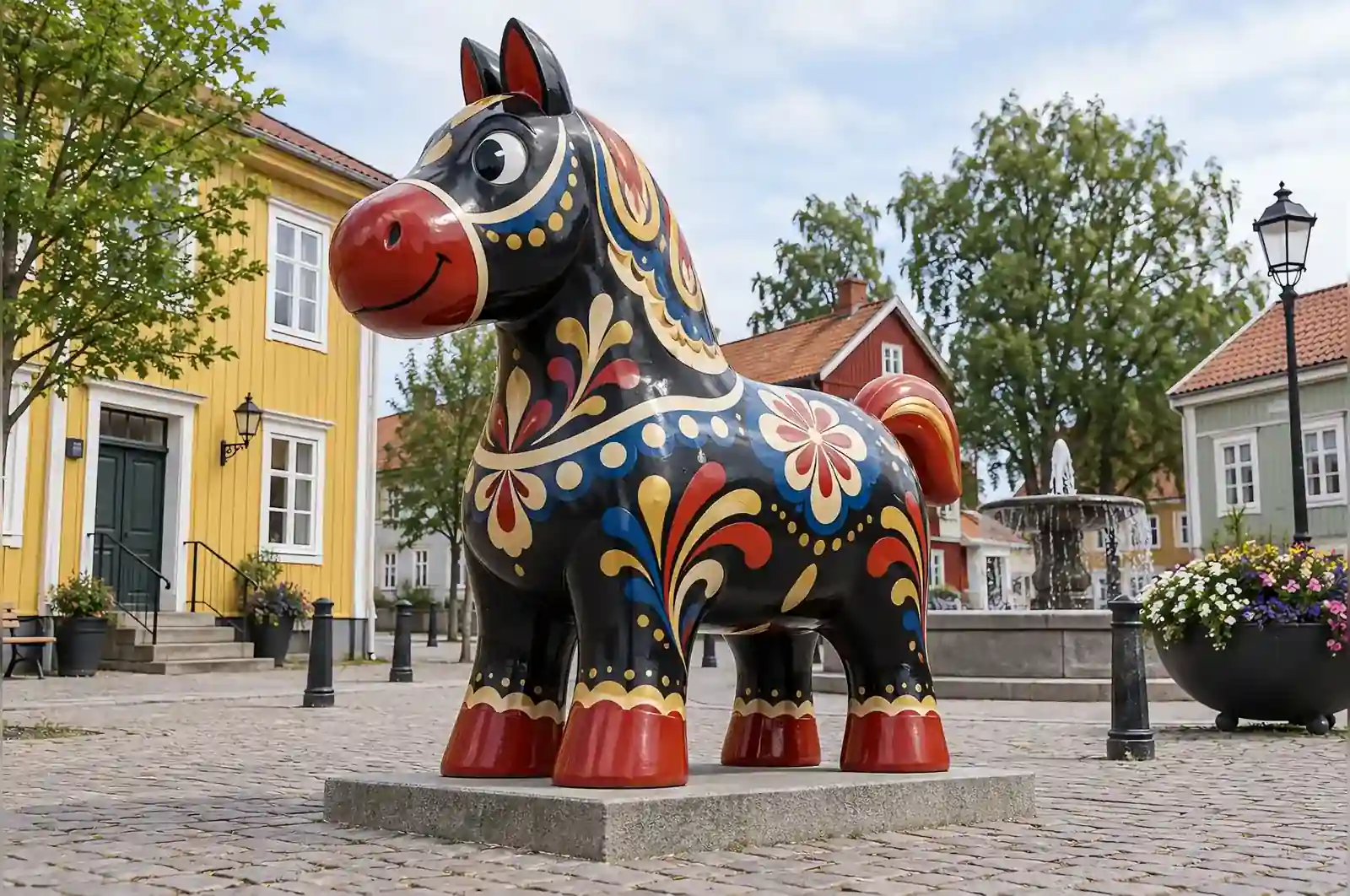
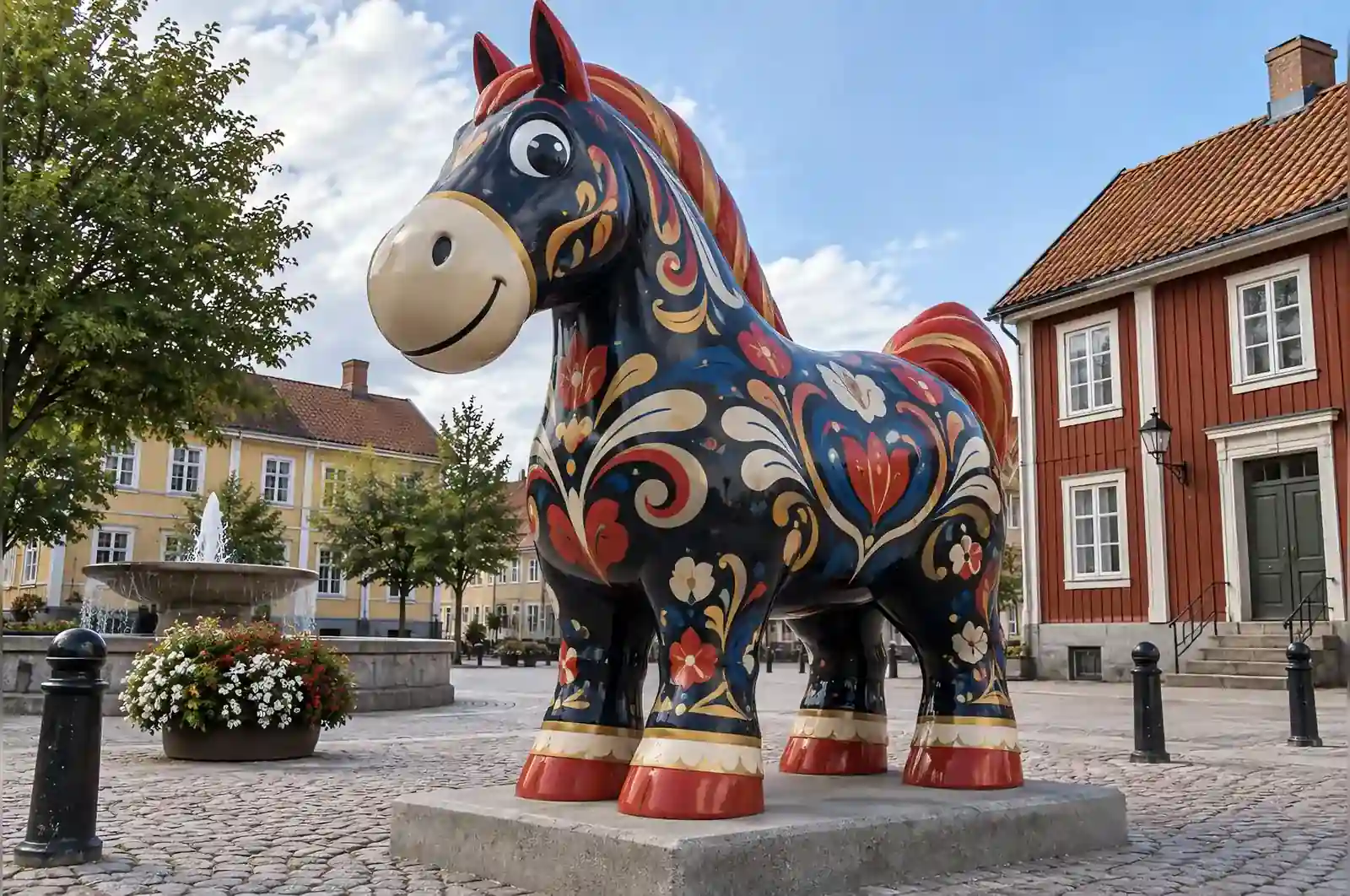
The traditional carved horse is already an abstraction, so we had room. Our version exaggerates in the opposite direction from the carving: a bigger head, a shorter and much thicker neck, and a body that is closer to a sphere than a barrel. The legs are stumpy enough to be almost comic, and the hooves are two flat cylinders with no detail at all.
Critically, we made it shorter in the leg and longer in the muzzle than the traditional model. That single change is what stops the piece being a replica and turns it into a character standing in the same family.
Painting it properly
We engaged a kurbits painter from the region and she worked on the piece for nine days. Every motif is freehand: scrolling vines up the neck, a crown of petals and dots across the chest, leaf pairs along the flanks, a band of small circles around the hooves. The palette is the traditional one — deep red, a dense blue, cream and gold leaf on a dark ground.
The one instruction we gave her was to let the pattern expand. Traditional decoration covers a small wooden horse tightly; at 2.2 m the same density would have gone muddy, so the motifs are roughly twice the size they would normally be, with more dark ground showing between them.
In the square
It stands where the market used to be held, facing the fountain, on a plain granite plinth that was already there. The council chose not to add a plaque. Everyone in town knows what it is, and the visitors ask.
What the council would not give up
Three things were fixed before we drew a line, and each one shaped the rest of the job. The proportions had to be a cartoon, not a replica — that was the whole point of the commission, and it is why the leg and muzzle changes above were never open to negotiation. The finish had to be hand-painted in the kurbits manner by someone who knew the vocabulary, because a printed or decal surface would have turned a piece of local heritage into a roadside novelty. And it had to stand outdoors in the square at roughly the size you now see, because a smaller figure would have read as a garden ornament rather than a landmark for the town.
Had any one of those three been relaxed, the piece would be a different animal. Dropping the size to, say, 1.2 m would have lost the head enlargement and the expanded pattern — at that scale the same motifs would have gone muddy within a few seasons of viewing distance. Keeping the 2.2 m but moving it indoors would have let us drop the UV-stable clear coat, but it would also have removed it from the one place the council needed it: the square where the market used to be held. The material itself was never really a choice. At 2.2 m, a solid carved horse would check and split across a Swedish winter, so the FRP shell over the internal steel frame was the only build that would survive the placement.
Build and the square’s weather
At 2.2 m high by 0.9 m wide by 0.8 m deep, the shell is hand-laminated FRP over a welded internal steel armature that follows the 3D model. The sections are laminated in place, the seams faired, and the whole surface gloss-painted before the decoration goes on. The steel is fully sealed inside the laminate, so there is no path for rain or condensation to reach it and bleed rust through the paint — the failure you would expect if the armature were merely trapped in a hollow shell.
The square is open, which matters twice. The piece carries its own weight plus wind load across that footprint, and it sits through freezethaw and standing snow. Two things carry that load. First, the plinth lifts the hooves off the ground, so snow and meltwater never sit against the base where the laminate meets the stone. Second, the gloss UV clear coat is what the hand-painted work depends on: it shields the reds, blues and gold leaf from UV fading and keeps rain off the paint film. Aftercare is therefore deliberately light. A soft cloth and mild soap for a wash, an inspection of the clear coat each spring, and a re-coat when it dulls — no abrasive, no polish, no repainting of the motifs unless the coat is breached.
What this means for your own brief
If you are asking for something in the same family, settle these three before you ask for a quote. First, how much tradition and how much character? The replica-versus-cartoon call is the single decision that decides everything downstream, and it has to be made before any 3D modelling, because the leg and muzzle proportions are what carry it. Second, is it indoors or outdoors, and what is the climate? That decides the material, whether the armature needs to be sealed inside the laminate, and whether the finish needs a UV-stable clear coat at all — a lobby piece and a town-square piece are different builds. Third, how far away will people read it? The pattern density and the size of the head enlargement are set by viewing distance, and getting that wrong at 2.2 m is why the motifs above are roughly twice their traditional size.
Our whole valley is famous for one wooden horse. We now have one that will still be here in fifty years, and it is not a copy of the old one.
A town council in Dalarna, Sweden