
Fresco Cartoon Veteran — Memorial Garden, Hexham
A town council wanted a figure for a memorial garden that is also a public garden: the kind of place where people eat lunch and children run through, and where a traditional memorial would be in the way.
What the garden fixed
A memorial garden that is also a public garden fixes two things before a design is chosen, and both of them follow from the site rather than from the figure.
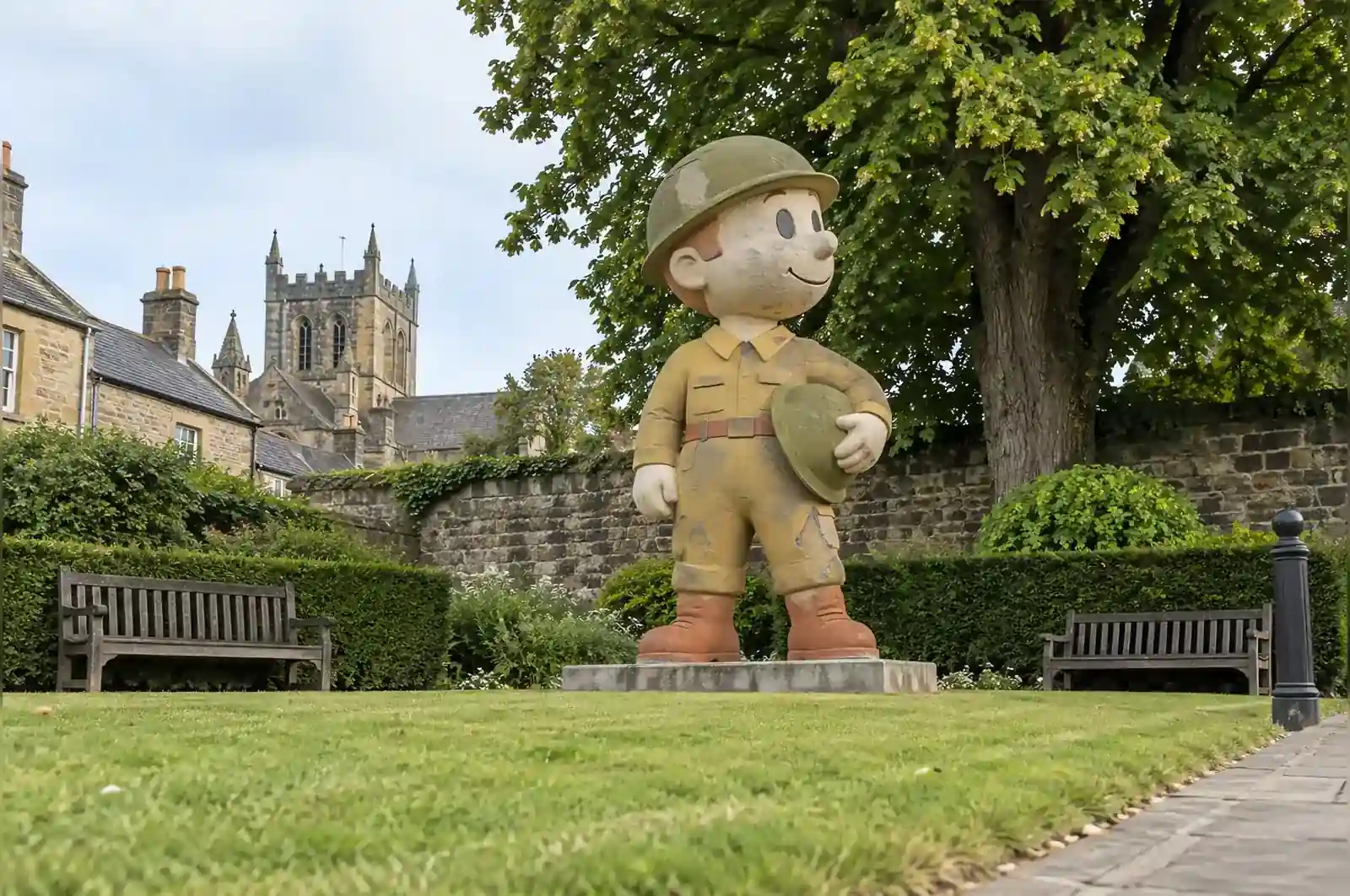
The size was set at 1.8 m because that is close to the veteran’s standing height. Below about 1.6 m the piece starts to read as a garden ornament: it sits at knee height and the proportions shift. Above about 2 m it starts to read as a monument, and a monument is the one thing this garden does not want. At 1.8 m, standing at the far end of the lawn past the benches, the figure holds its own against the trees without taking the space over.
The finish was the second constraint. A gloss-painted figure that is brand new looks placed — it looks as though it arrived rather than as though it belonged. In a memorial garden that reads wrong. The weathered fresco is what lets the piece sit on open lawn. Without it, the figure would have had to go behind planting to soften the effect, and the council did not want that. The finish and the placement are one decision, not two.
If the figure had been moved indoors, the finish would have had to change with the site rather than stay as it is. Indoors there is no rain, no frost and no UV, and a weathered treatment with flaked losses reads as damage rather than as age, because nothing else in the room has aged alongside it. The losses only read as exposed ground when the piece is among other weathered things. So this finish and this site are chosen together; change one and the other has to change too.
A painting that stayed outdoors
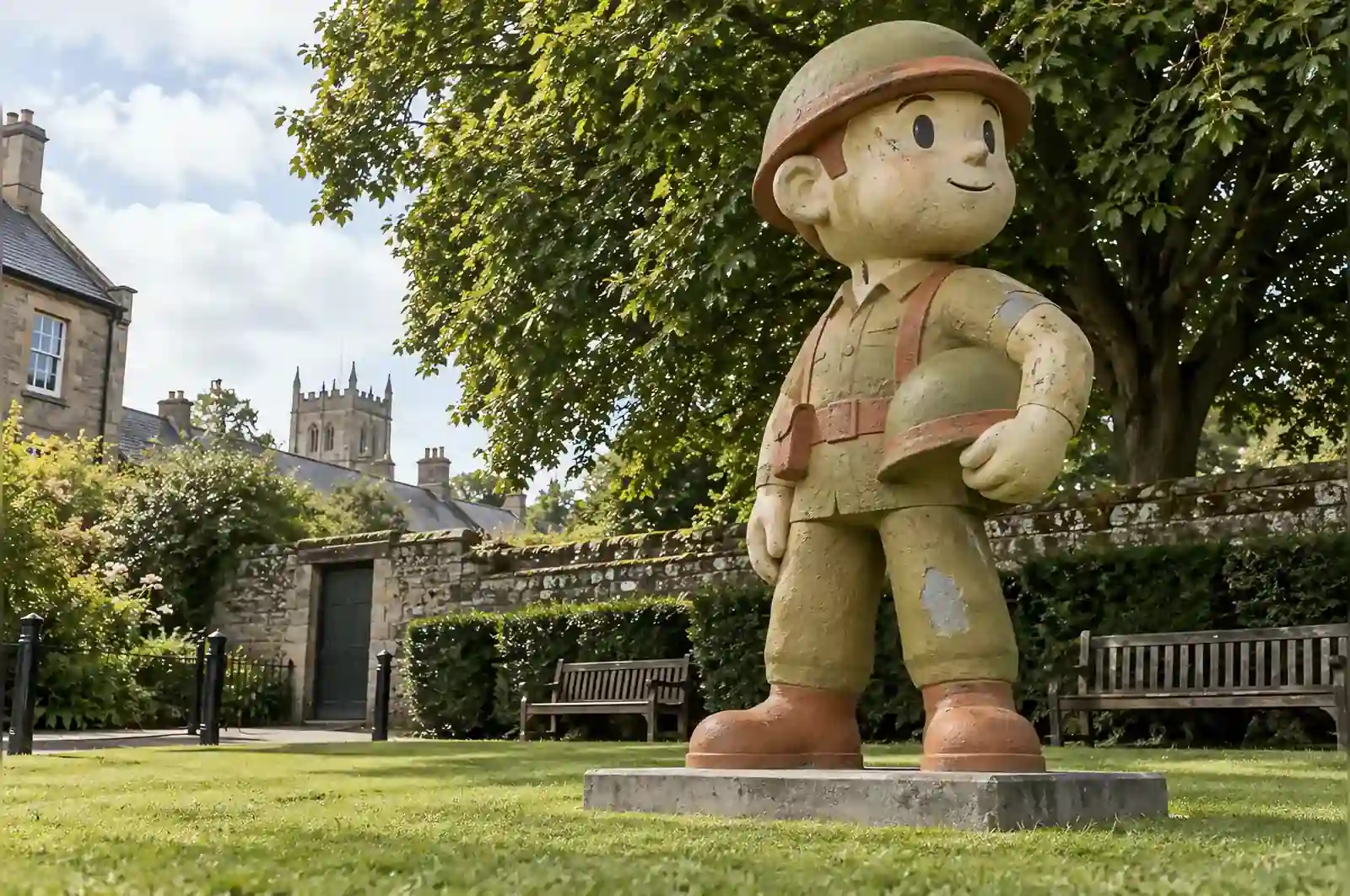
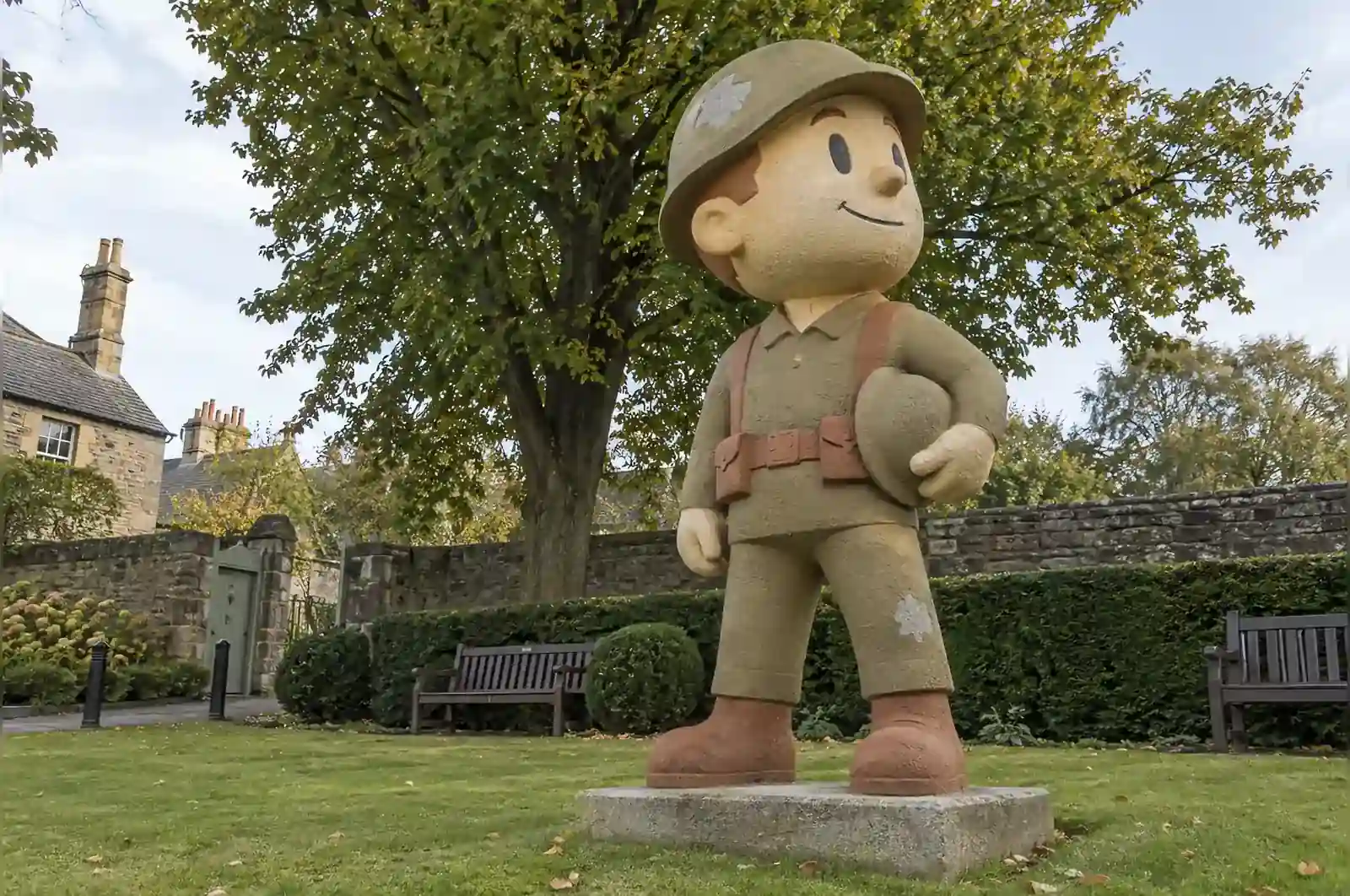
The finish is a weathered wall fresco: a pale lime-plaster ground with flat unshaded areas of ochre, terracotta and olive with slightly irregular boundaries and no modelling inside them, and a scatter of flaked losses where the pale ground shows through. The figure is the veteran at 1.8 m, in a simplified field uniform with the helmet under one hand.
Making paint look like it is going
A fresco looks old because the pigment has bonded with the lime and then been partly lost, and because the plaster has come away in irregular islands around the edges of the picture. Those losses are the hard part. Each loss was routed as a shallow area about 1.2 mm deep with an irregular boundary, primed in pale grey and flatted matte, so that it reads as exposed ground rather than as a hole. Read as a hole and the piece looks damaged; read as bare ground and it looks old, and the difference is entirely in whether the edge casts a shadow.
Why it is not sombre
The palette is warm and the figure is standing easily, one hand on the helmet at the hip, looking off to the side rather than down. The council’s brief was that children should run past it without being told to be quiet, and the only way to achieve that is to make the piece worth looking at for reasons that have nothing to do with what it commemorates.
In the garden
It stands at 1.8 m at the far end of the lawn, past the benches, where it is found rather than placed on the way in. The council’s note on the first summer is in the panel above.
Looking after a weathered finish
The surface is small, 1.8 m high by 0.8 m wide by 0.6 m deep, but it is the flaked-loss treatment that needs watching. Each loss was routed about 1.2 mm deep and primed in pale grey, so the exposed ground sits below the level of the paint around it. In Hexham’s damp, temperate climate those shallow recesses are where water will collect if they are left alone.
The matte UV clear coat is what keeps them dry. It seals the routed edges so that rain runs off rather than soaking in, and it holds the ochre, terracotta and olive from fading in the sun. The coat is deliberately matte. A gloss coat would catch the light and give the losses a wet, freshly repaired look, which is exactly what the finish is meant to avoid.
Aftercare is a yearly wash and a close look at the loss edges. Because the recesses are only 1.2 mm deep there is no pocket for algae or dirt to build up, so the check is quick. If an edge is ever knocked, the repair is a small touch-in of the pale grey primer and a re-flatten to matte; there is no need to repaint the whole figure.
What this means for your own brief
Three questions settle most of the look and much of the build of a piece like this, and they are worth settling before you ask for a quote.
Is the figure to be found or placed? A found figure, as this one is, has to read from a distance and reward a closer look, which sets the scale and the strength of the colour. A placed figure can be smaller and more detailed, because it has a spot of its own.
Should it read as new or as old? A memorial garden wants old — it wants the piece to look as though it has always been there. A bright public space or a new build often wants new. This one decision picks the finish, and the finish is the largest part of how the piece behaves in its site.
Does it have to stand up to children running past and people eating lunch? That decides the coating and how much of the surface can be left open. This piece is built to be touched and leaned on, and the brief was written for that.
Children run straight past it on the way to the lawn and stop on the way back. That was the entire brief.
A town council memorial garden in Hexham, United Kingdom