
Kintsugi Cartoon Veteran — Veterans’ Home Garden, York


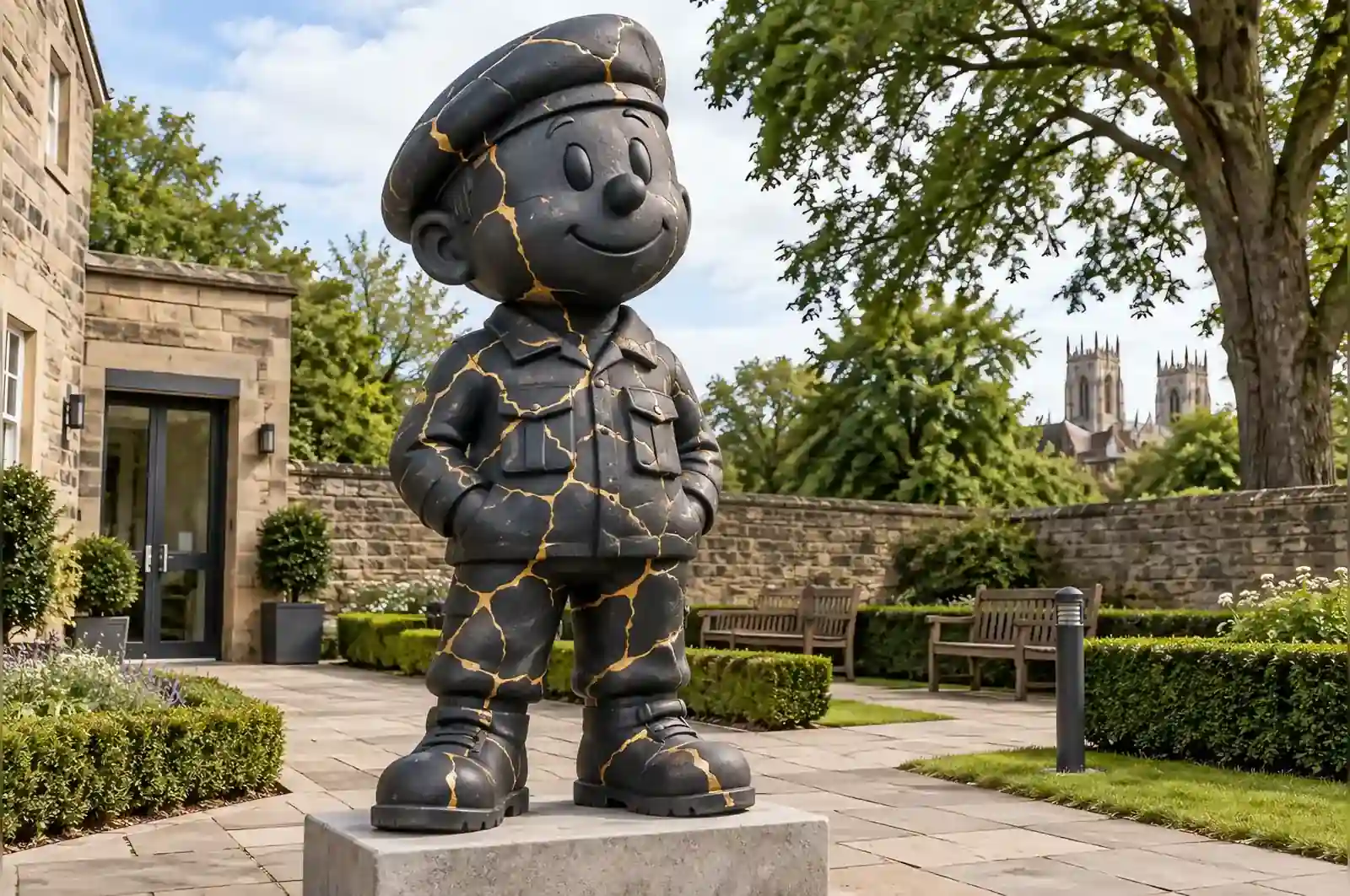
The Trust asked for a figure that would not be a monument. The man it commemorates spent four years in a wheelchair at the home and another eleven as the person who met everybody at the door, and a plinth with a name on it was the last thing anybody there wanted.
nn
The finish, and why it is the whole brief
n
The figure is finished as kintsugi: a deep matte charcoal ground broken into irregular plates by fracture lines, with every crack filled by a raised seam of gold. It is a Japanese repair technique, and it works on the premise that the break is part of the history of the object rather than something to be hidden. It was the family’s idea. The fractures do not follow the body’s anatomy; they run across it, through the shoulder and through the knee, because that is how damage actually arrives.
nn
Building a fracture honestly
n
There are 41 fracture lines. Each one is a real 3 mm groove cut into the shell along a path traced from a photograph of cracked terracotta, then filled slightly proud with gold laid over a red bole. Because the seams are raised they catch light at every angle, and the piece reads as repaired from fifty metres, which is the distance that matters on the approach path.
nn
The pose
n
Standing, hands in pockets, head slightly turned: the way somebody stands when they have stopped being in a hurry. The uniform is reduced to its silhouette, the beret and the jump smock and the boots, with no insignia, no medals and no rank, because the family asked for none and because the piece is not about the rank.
nn
Gold seams instead of a plaque
A plaque names a person and tells you when they lived; it does not tell you what they were like. The Trust had already decided against one, which left the question of what a resident would actually notice on the way to breakfast. Gold seams get touched. They sit at hand height on the shoulder and the knee, they are warm against a matte charcoal ground, and a visitor who has no idea what kintsugi is will still put a hand on one. That is the whole design argument for the finish: it invites the contact that a plaque forbids.
Keeping gold outdoors in Yorkshire
Gold leaf over red bole is a stable finish, but a raised seam is an edge, and an edge outdoors collects water. Each seam is sealed under the same UV-stable clear coat as the rest of the figure, and the coat is the thing on the maintenance schedule rather than the leaf. Winter here means wet and then frost, so the annual inspection is done in early spring: any seam where the coat has dulled is re-coated before the leaf can lift, and a lifted seam is touched in with leaf rather than with gold paint, because paint on a raised edge reads as brass within a season. This is a piece that will be maintained rather than replaced.
Why the cracks run through the shoulder and the knee
The pattern was traced from a photograph of cracked terracotta, and the tracing was then rotated until the longest fractures crossed the body rather than following it. Fractures that follow anatomy look decorative; fractures that cut across it look like damage that was survived, which is the point. There are 41 lines and each is a real 3 mm groove cut into the shell, filled slightly proud rather than flush, because a flush seam stops catching light at about ten metres and this piece is first seen from the far path. The count is not symbolic. It is what the traced image produced at 1.9 m.
Commissioning a memorial that is not a monument
The useful question is not what the piece should say but who will touch it. A memorial in a home is passed twice a day by the same thirty people, so it has to survive repeat viewing without becoming furniture, and it has to offer something at hand height. Invite the family into the finish decision rather than only the likeness — the gold was their idea here and it is the reason residents use the piece at all. And settle the maintenance before the unveiling, because a memorial that needs re-gilding every second year is a promise the Trust has to keep long after the commissioning officer has moved on.
One last thing worth writing into the brief: what the piece is allowed to look like in ten years. A matte ground outdoors will lose some depth, and a gold seam will dull between coats. If the Trust expects it to look on year ten exactly as it did on the day it went in, the honest answer is to budget for a recoat every three to four years and say so up front. If it is allowed to age — and the kintsugi idea is built on the premise that it is — then the maintenance schedule is a choice rather than a failure, and the family can be told what to expect at the same time they are told what it will look like.
In the garden
n
It stands at 1.9 m where the home’s two paths meet, so that it is passed rather than visited. Residents touch the gold seams on the way by, and a few have started to do it deliberately. What the home says about it is in the panel above.
nn
Residents touch the gold as they walk past. Nobody was asked to, and it is the only maintenance the piece has needed.
A veterans’ care home in York, United Kingdom