Loop — Knitted Cartoon Abstract Character, Children’s Library, Gothenburg
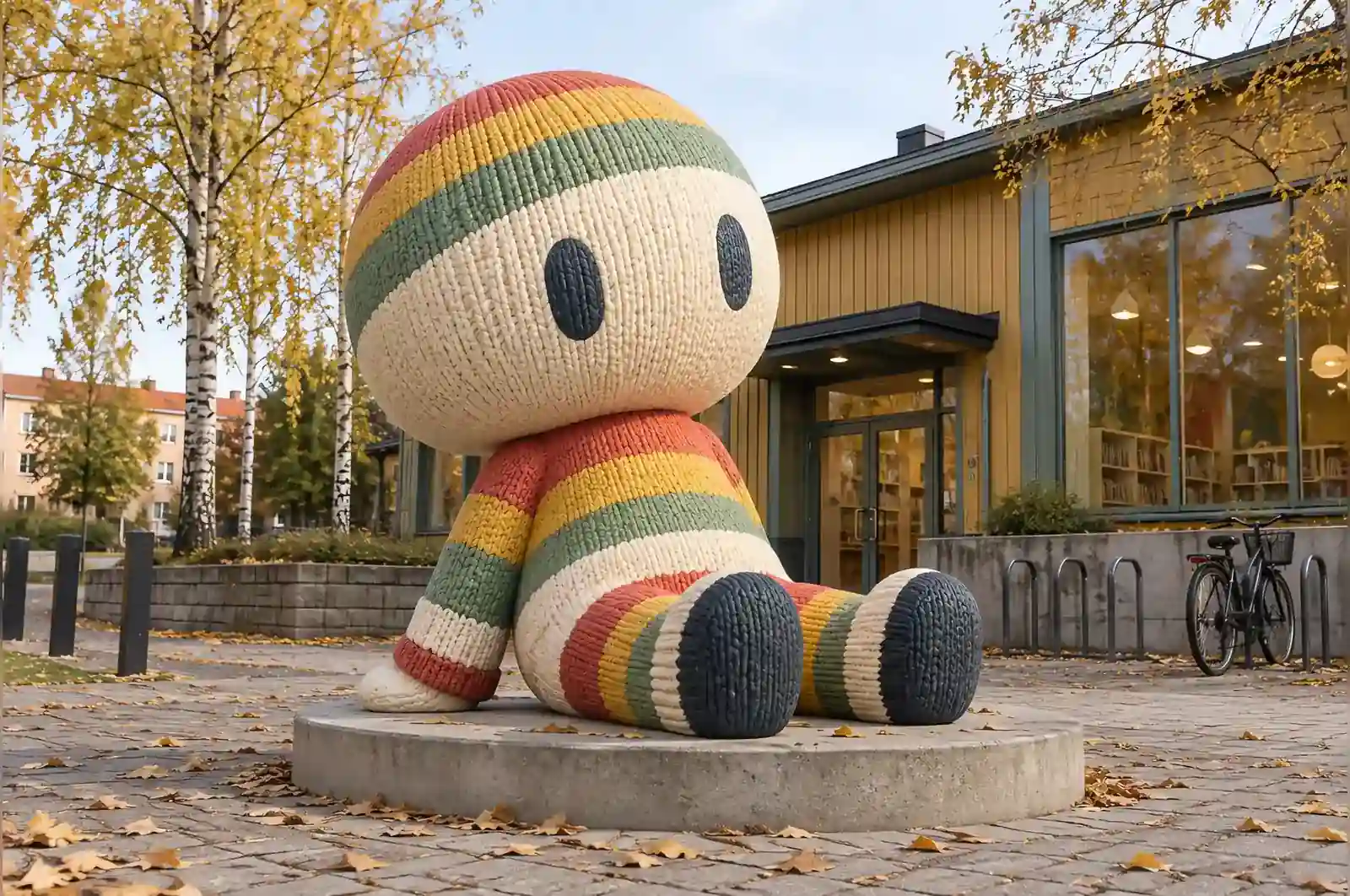
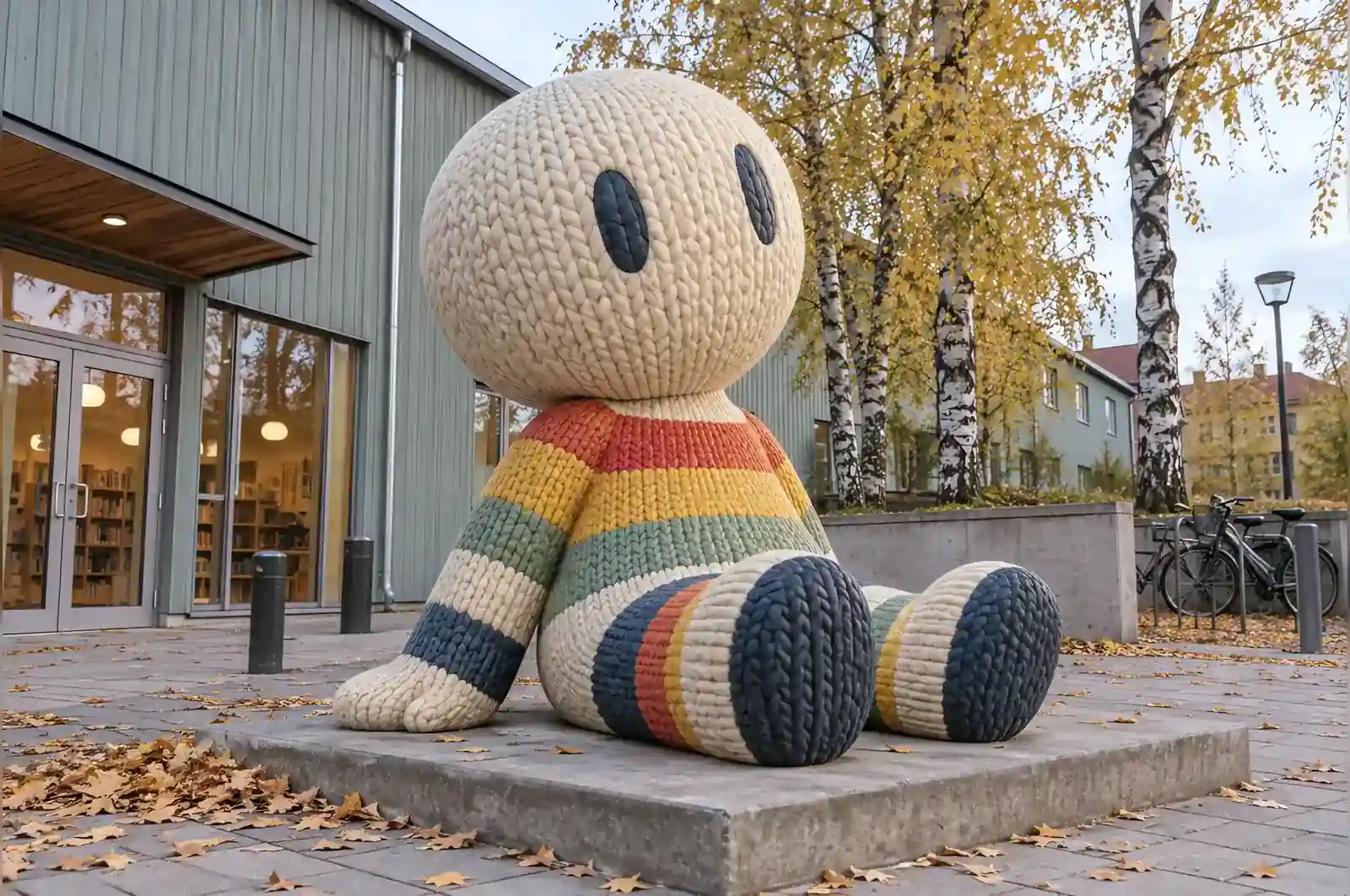
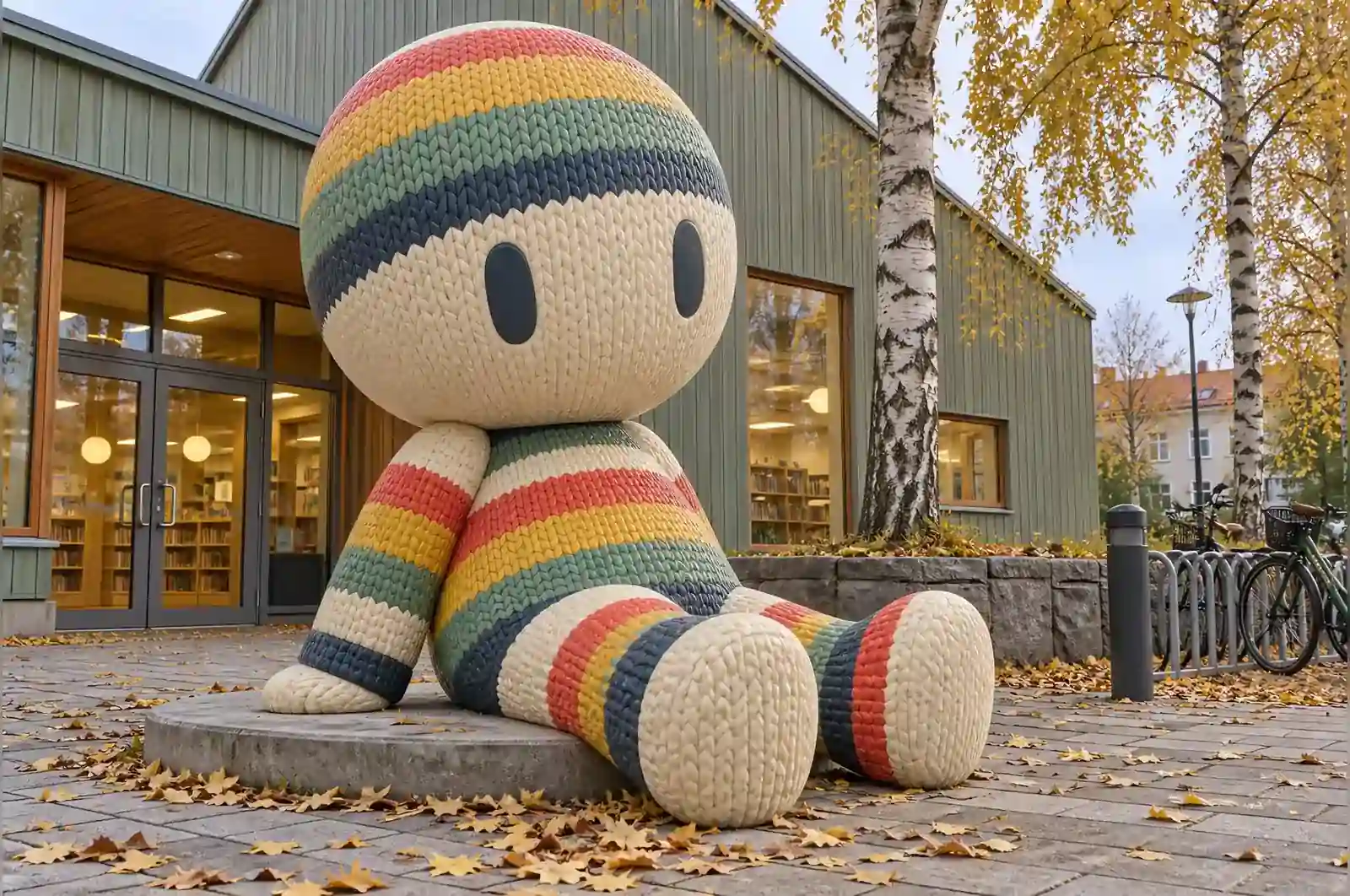
The library runs a reading hour for under-fives and a knitting group for their grandparents, and at some point somebody noticed that the same families were doing both.
The brief
A character, about 2.2 m, no identity, seated on the ground so that a small child stands level with its face. And it had to look knitted, because the knitting group was involved in the commission and there was no version of this conversation in which it did not.
Sixty thousand stitches
A knitted surface has a structure: courses and wales, the horizontal and vertical lines of the stitches, and the way any pattern is bounded by them. We modelled roughly 60,000 individual stitch shapes across the piece, each about 45 mm wide at this scale, deliberately slightly irregular because a hand-knitted stitch never repeats exactly.
The stripe pattern was chosen by the knitting group out of nine proposals, and the proportions are theirs: a wide charcoal blue band, then mustard, then a narrow coral line, repeated with the widths decreasing as the band climbs.
Ribbing, which is what makes it work
Every wrist and ankle is finished in ribbing: a band of raised alternating vertical ridges with a tighter, softer profile than the body stitch. Without it the piece reads as a decorated object. With it, the eye accepts the whole thing as clothing, which is the entire trick.
There is one place we broke our own rule. The eyes are not stitches. They are two flat smooth inlaid ovals, slightly recessed, because 45 mm stitches cannot describe an eye and the character has to survive the surface.
Seated, at child height
It sits at 2.2 m overall with its head at about 1.1 m, which puts the face level with a five-year-old. The library reports that children touch it expecting wool, look briefly baffled, and then sit down next to it, which is the behaviour the piece was commissioned to produce.
What was fixed, and what would have changed
The knitted surface was non-negotiable. The knitting group was part of the commission, and there was no version of this conversation in which the character arrived smooth. That single decision drove more of the work than any other: roughly 60,000 stitch shapes had to be modelled rather than painted, which is the difference between a surface finish and a surface geometry.
The other two constraints were the placement and the height. It had to sit on the ground, outdoors, on a forecourt in a maritime city, at a height where a five-year-old meets its face. Relax any one of the three and the piece changes in a predictable way. Drop the size below about 1.5 m and the 45 mm stitches stop reading — they become a texture rather than a knit, and the whole illusion collapses. Move it indoors and the steel frame no longer has to resist wind loading, so the armature can be lighter and the lead time shortens. Change the finish to a smooth gloss and the modelling time disappears almost entirely; what remains is a painted figure.
The commission worked because the three were taken together, not one at a time.
Build and aftercare: the frame behind the stitches
The piece is an FRP shell hand-laminated over an internal steel frame, which is how a sculpture at this size is normally put together. At 2.2 m by 1.7 m by 1.2 m the shell is skin, not structure — the steel takes the load, including wind across an open forecourt and the weight of children leaning on it. That division of labour is worth stating plainly, because it is why the piece can sit on the ground rather than being bolted to a plinth.
Gothenburg is a damp, coastal city with freeze-thaw winters. Rain settles in the valleys between the raised stitches instead of running straight off a smooth surface, so the laminate has to be watertight and the frame sealed against moisture getting in through any joint. The practical effect is that the joints, the underside and the contact line with the ground get the same treatment as the face.
The matte wool-like finish is soft to the eye and shows scuffs more readily than a gloss would. Cleaning is a hand-wash with a mild detergent and a soft cloth, no solvents and no abrasive pads, which would cut the matte surface and leave a mark that cannot be polished out. A touch-up on the colour bands is straightforward because the pattern is bounded by the stitches: you repaint inside a course, not across an area.
Three questions to settle in your own brief
Three questions settle most of a brief like this before a quote is requested.
First, is the look a surface finish or a surface geometry? Here the knit had to be geometry — modelled stitches, not a texture applied on top. If what you want is a pattern you can paint, the work is considerably cheaper and faster than a relief you have to sculpt. Knowing which one you actually need is the single biggest factor in the work a commission of this kind involves.
Second, at what scale will it be seen? The stitches were sized to read at arm’s length from a seated child, which is why 45 mm worked. A look that works at 45 mm does not survive at 5 mm, and a piece meant to be admired from across a plaza needs a different resolution entirely.
Third, who is going to touch it, and where does it live? An outdoor piece at child height has to survive weather, leaning and the occasional climb, and it has to be cleaned in a way that suits its finish. Settle those three and a quote can be built around them rather than around a guess.
Children put their palms flat on it before they say anything. They are checking whether it is soft, and they are always disappointed and always come back.
A children's library in Gothenburg, Sweden