Seed — Mosaic Cartoon Abstract Character, Design School, Helsinki
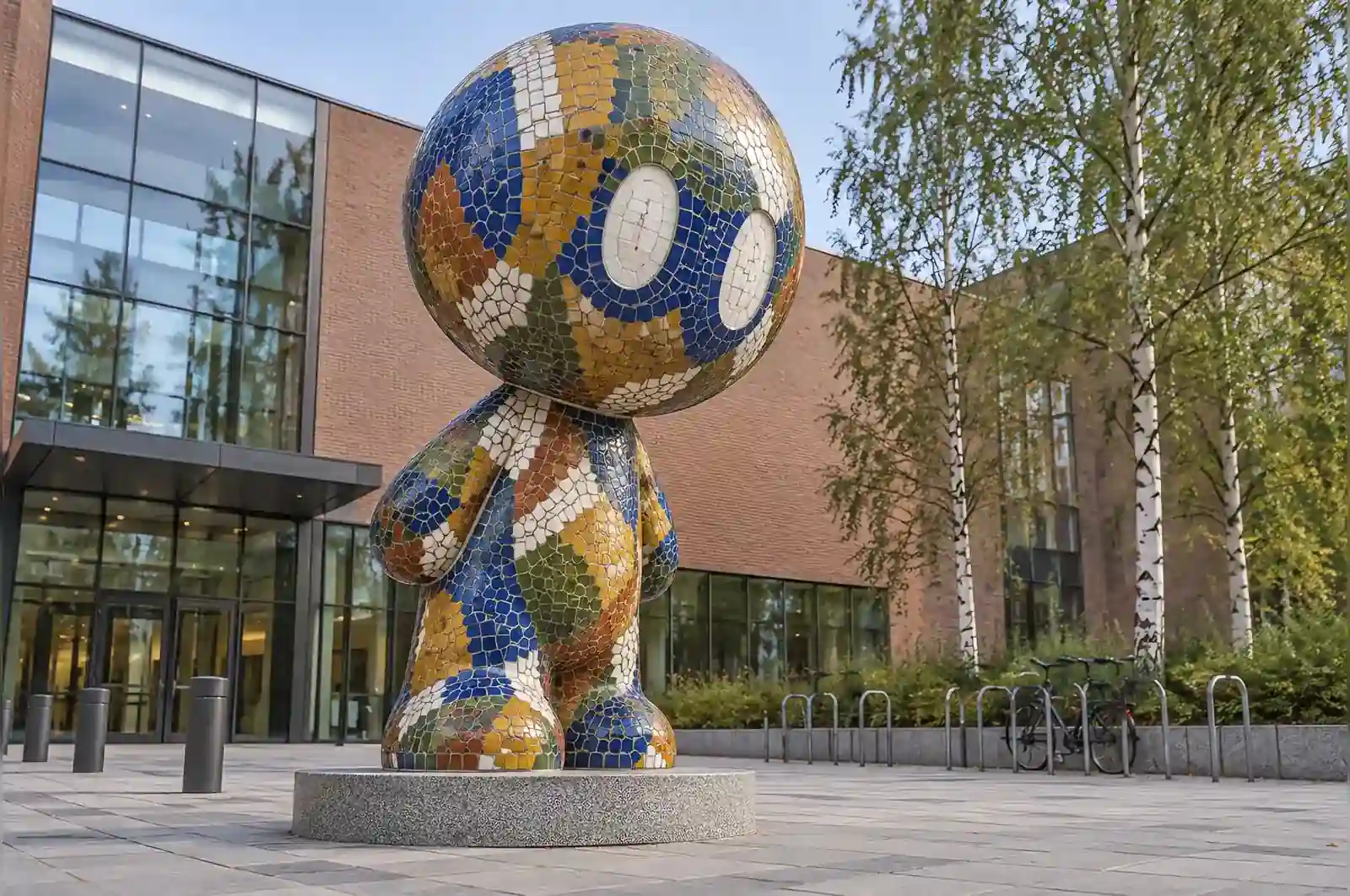
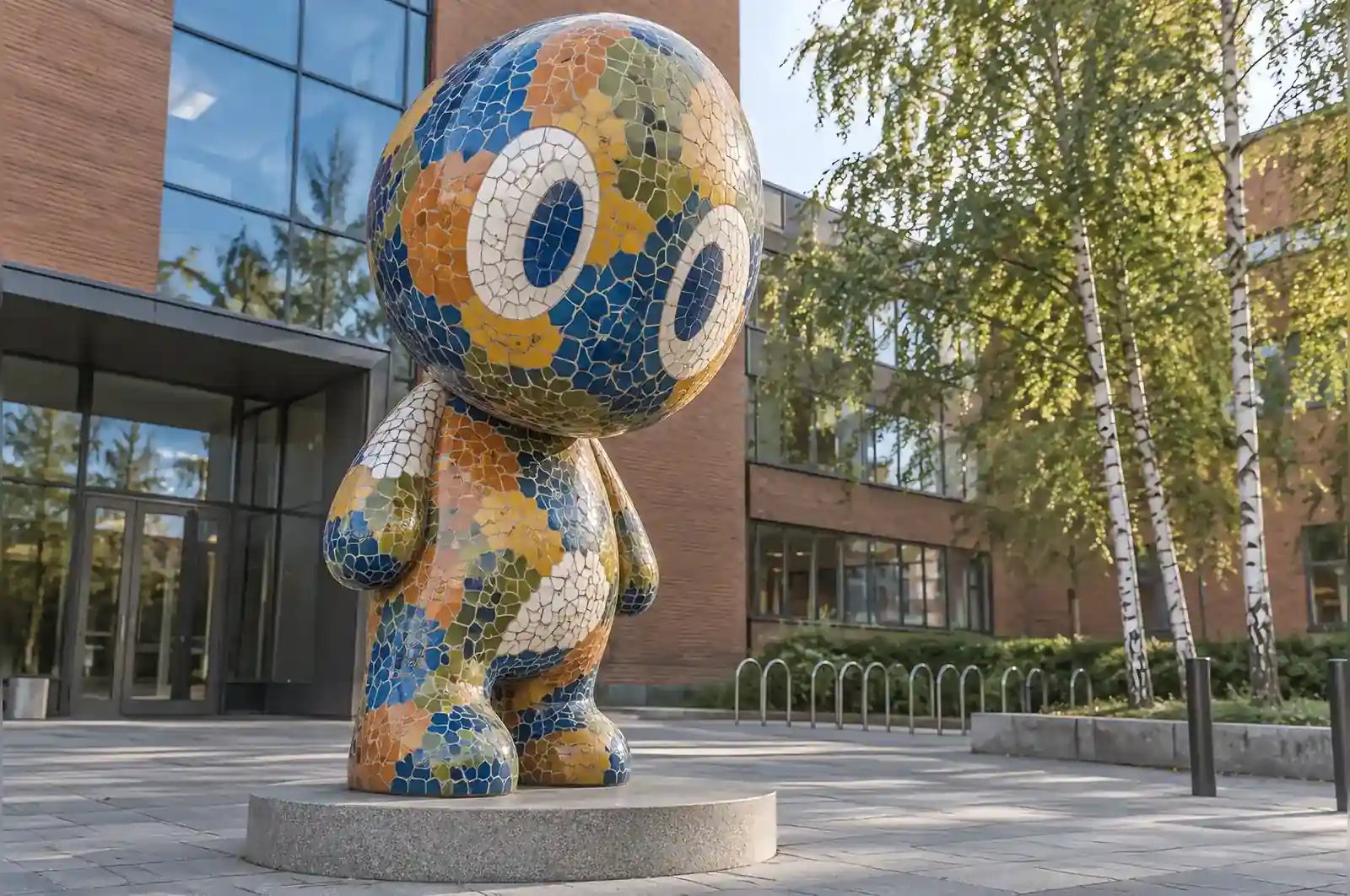
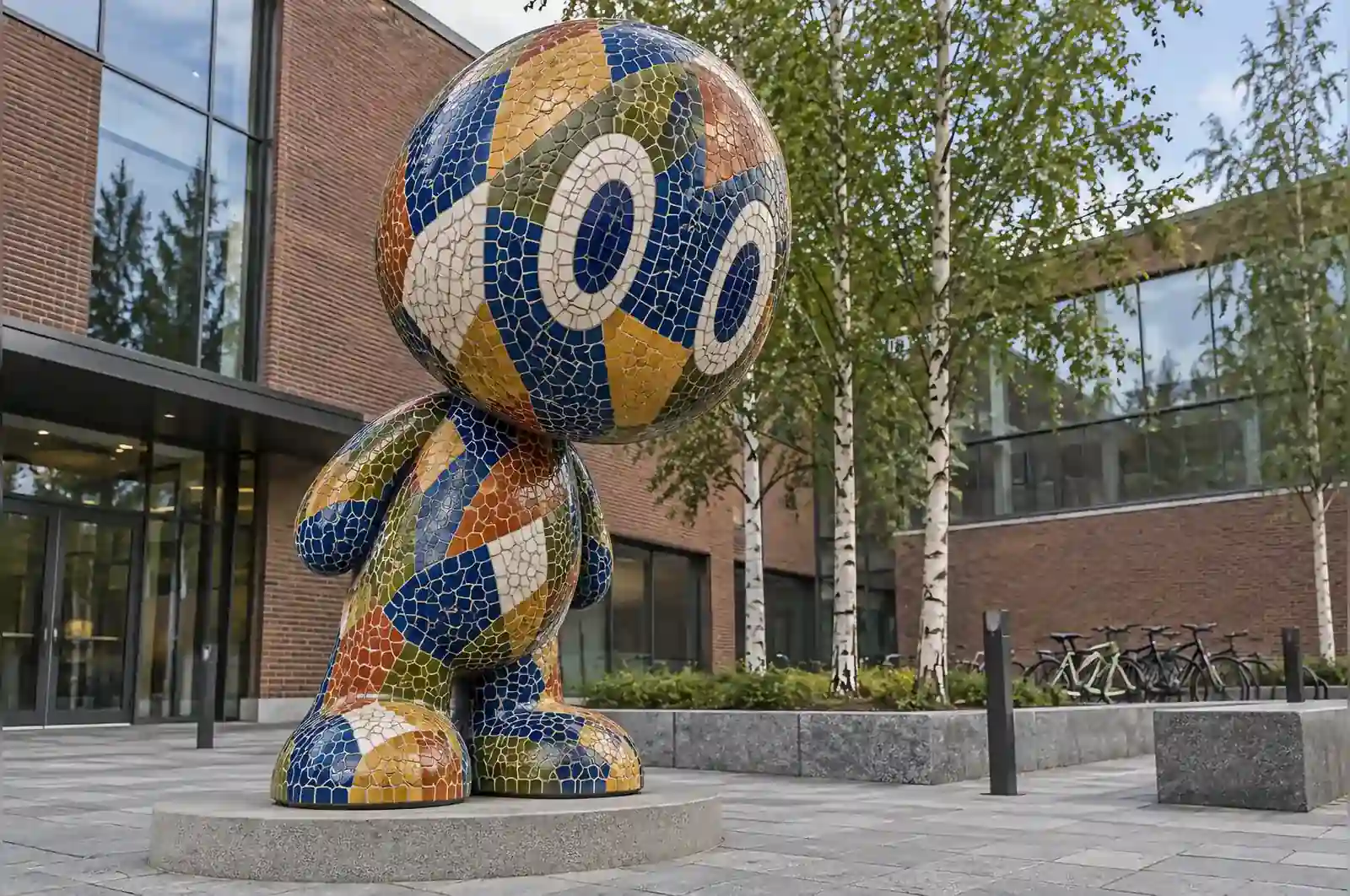
The school teaches three hundred students a year how to make things, and they wanted a sculpture that would argue a position rather than decorate a courtyard. Their position: that a form is not finished until somebody else has read something into it.
The brief
A character, about 2.6 m, with no identity. Two eyes and a posture, and nothing else that could be named. Then the surface had to be a mosaic, and the mosaic had to be assembled from pieces no two of which matched.
Why mosaic is the right material for this argument
A mosaic is made of differences. Every tessera is cut by hand, so every one is a different shape, a slightly different colour and set at a slightly different angle. The image that emerges is a consensus between thousands of imperfect pieces, which is more or less exactly what a school is.
Roughly 4,100 pieces across the piece, cut into quadrilaterals between 30 and 50 mm at this scale, laid with a consistent 4 mm gap and each one rotated a few degrees off the local grid. Nothing on the surface lines up with anything else.
The character, and where it stops
Two eyes, an egg-shaped head, one rounded body, two stubby arms, a slight forward lean. That is the entire specification, and we held to it through eight rounds of review because the temptation to add a nose, a mouth or a hat was constant.
The lean is what makes it a character rather than an object. It is four degrees off vertical, forward and very slightly to the left, and it reads as attention.
What the tessera cannot do is resolve small features, so the two eyes are the only places on the whole piece where the mosaic grid is broken: each eye is a single flat inlaid shape set level with the surrounding tesserae, with no grout around it at all.
On the forecourt
It stands at 2.6 m near the main entrance, on a plain concrete base. The school runs a first-year exercise in which students draw the character from memory after seeing it once, and the drawings are displayed on the wall behind it. No two have ever been the same, which the school describes as the whole point of the piece arriving ahead of schedule.
What was non-negotiable
The brief was unusually clear on one point: the mosaic, and the argument it carried, could not be traded. The height, the finish and the site were all open to discussion in principle; the mosaic as consensus was not, because it was the reason the piece existed at all. Drop it for a flat gloss paint and the form would have read as a single clean silhouette — one reading, one author — and the school’s position would have collapsed.
Two things followed from that. First, the size had to stay at 2.6 m. Below that the 30–50 mm tesserae stop reading as a consensus and start reading as texture, and the two eyes — the only features the grid is allowed to break — would drop below the scale at which they can carry the expression. Second, the placement had to stay outdoors. Indoors there is no freeze-thaw and no UV, so the recessed grout and the gloss UV clear coat would be unnecessary weight; they are there because the piece works against a Nordic forecourt, not against a lobby wall.
Building it for a Helsinki winter
Every maintenance decision on this piece was made by the climate. The grout lines are recessed rather than flush for one reason: a flush joint would trap a film of water on the surface, and a Helsinki forecourt goes through enough freeze-thaw cycles in a season to lift tesserae off the shell. Recessed, the water sheds before it can get a purchase, and the 4 mm gaps across 4,100 pieces drain instead of pooling.
The structure is the same logic in reverse. The FRP shell is the weather barrier and the colour; the internal steel frame is the load path. The four-degree forward lean puts the centre of mass ahead of the base, so the frame is sized for that eccentricity plus coastal wind on the head, and the shell is bolted to a frost-resistant concrete base rather than bedded in it. The gloss UV clear coat is the only part the school is asked to watch: a Finnish summer is long on daylight at a low sun angle, and the coat is what keeps the ochres and greens from bleaching. An annual inspection of the grout and the coat is the whole aftercare schedule.
What this means for your own brief
Three questions settle most of the build before a quote is requested. The first is what has to survive at reading distance. Here it was two eyes and a posture; nothing else needed to resolve. If your brief needs a readable face or a named object, the tesserae either get smaller — and the piece count rises — or the form gets larger, and the two are not a free choice.
The second is where exactly it stands and what the weather does there. The recessed grout, the 4 mm gap and the UV clear coat are answers to a Nordic outdoor site; the same design in a dry indoor lobby would want a finer, flush mosaic and no clear coat at all.
The third is the one thing that cannot change. This school named it up front — the mosaic and the argument it makes — and every other decision, from the lean to the base, was made around it. Naming your own non-negotiable before the quote is what keeps the build honest, because it is the factor that sets lead time and how the piece is put together, not the image on the page.
First-year students are told to draw it. Every one of them draws a different character, which is the argument we wanted to make about our own work.
A design school in Helsinki, Finland