Surge — Tie-Dye Cartoon Abstract Character, Surf Club, Biarritz
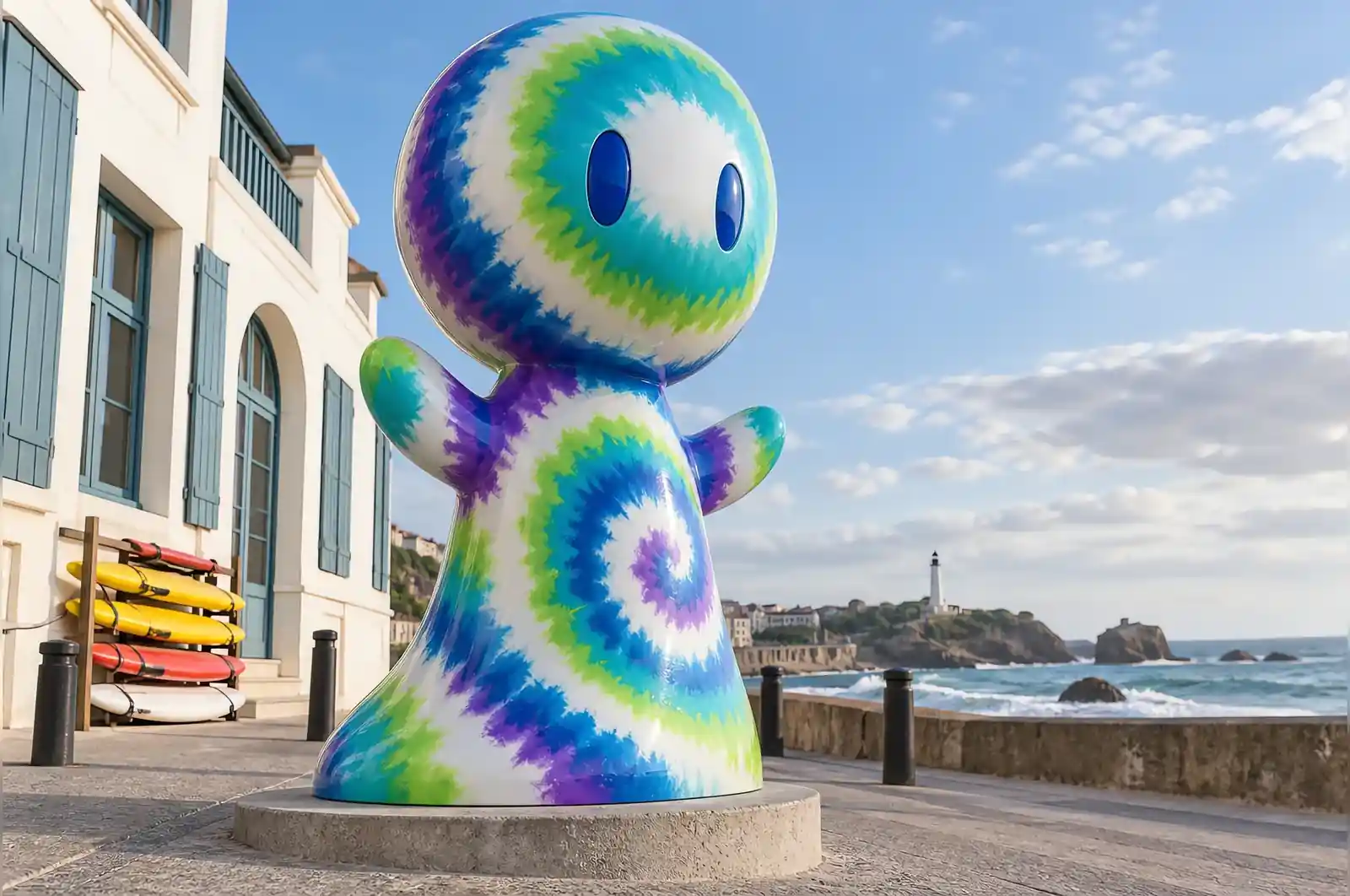
The club has eighty members, most of them under twenty-five, and a building that looks like a public toilet. They wanted something for the frontage and they wanted it to be theirs rather than the town’s.
The brief, from the members
A character, about 2.4 m, cartoon, no identity. Its body had to swell outward at the bottom. And it had to be tie-dyed, because the club’s own rash vests and its forty-year-old club flag are tie-dyed and nobody can quite explain why.
A body with no legs
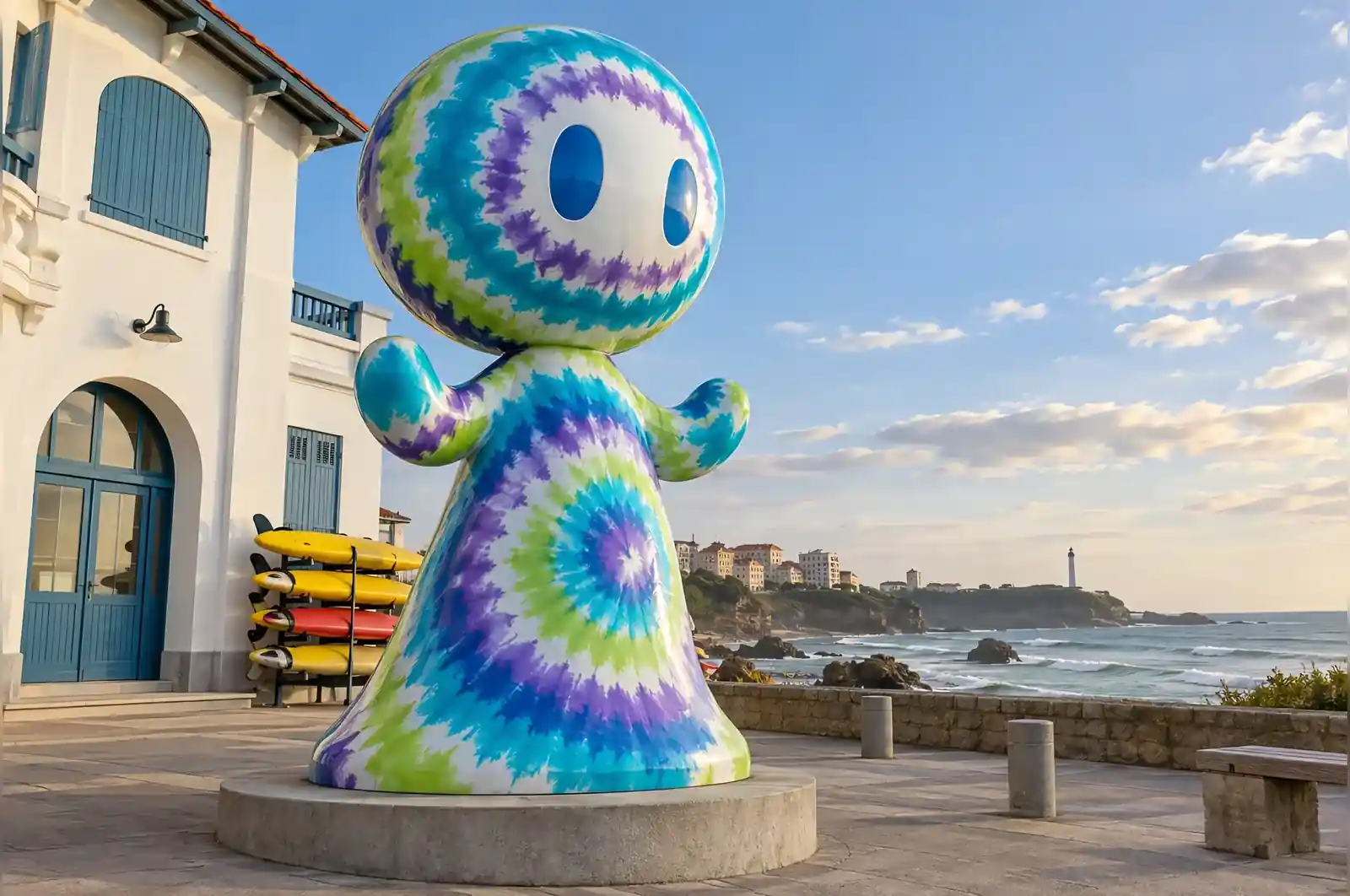
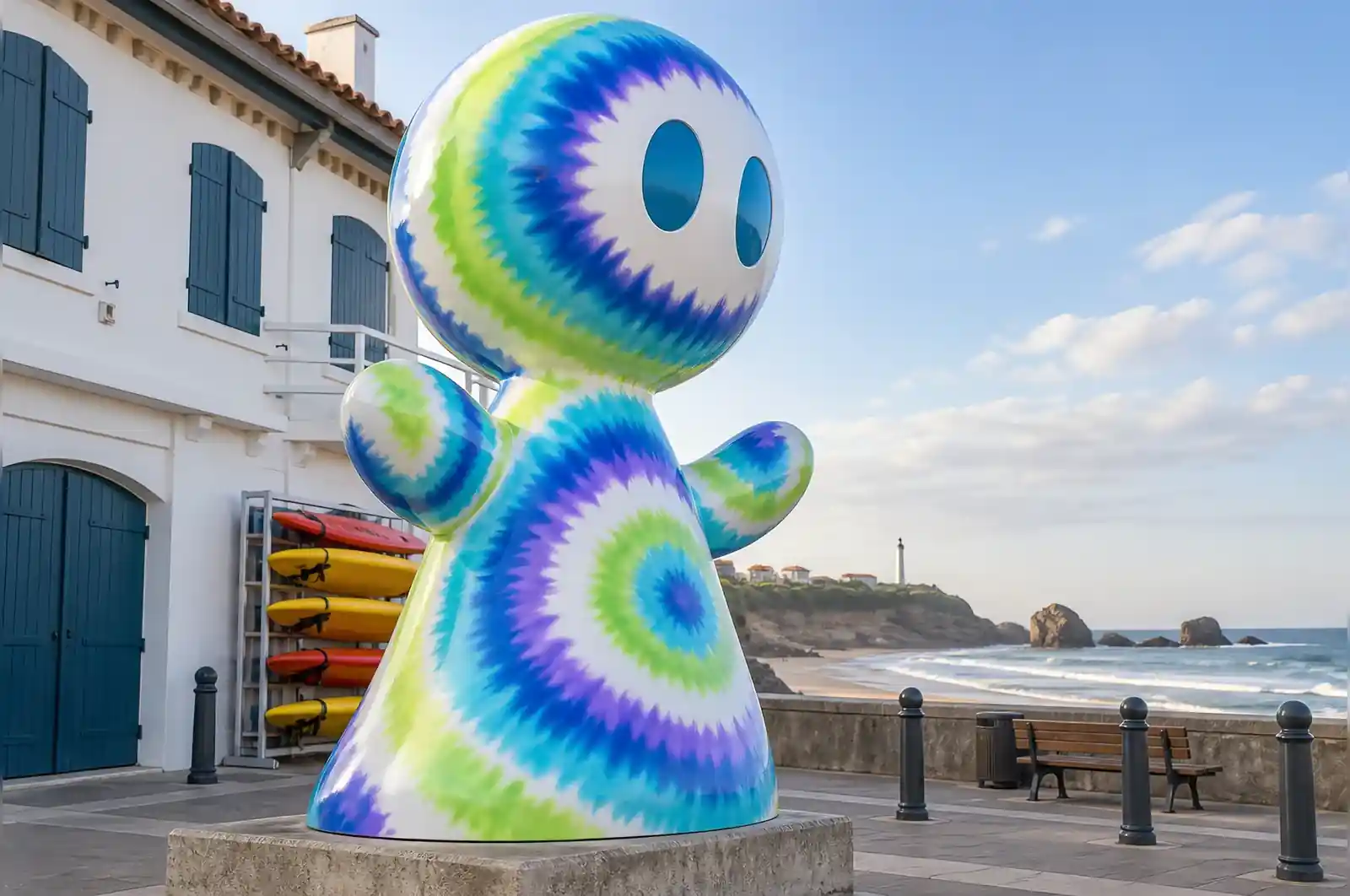
The brief did the compositional work for us. We removed the legs entirely and let the body expand downward into a broad, flared base, so the figure reads as something that has come up out of the sea and is standing on the promenade in a way that should not be possible. Two short arms lifted slightly. Head oversized and round, two simple eyes, nothing else.
A figure with no legs and no feet should look like an object. Ours does not, for one reason: the head is tilted back about six degrees, as though looking at the water. That was the last change we made and it is the only thing holding the character together.
Dye on a carved surface
Tie-dye is not a pattern; it is a record of how fabric resisted dye. The rings are never true circles, and at every boundary there is a zone where two colours have bled into each other with a raw, irregular edge.
Ours is painted in a dye sequence: white ground, then eleven concentric rings over the body in four colours, each one laid with a wet edge so it bleeds into the one inside it. Nothing on the piece has a hard outline. The rings are deliberately off-centre on the flared base, as though the garment had been bunched when it was tied.
On the promenade
It stands at 2.4 m directly outside the club doors, where the salt air reaches it every day. The finish is a two-pack system with a heavy clear coat precisely because of that, and after a full season of Atlantic weather the colour has not moved. The members wipe it with the same cloths they use on the rescue boards.
What could not be given up
Three decisions were fixed and none of them were ours. The height had to be 2.4 m: at anything smaller the figure would sit below the eye line of the members on the promenade and the frontage would read as empty. The silhouette had to be legless, because a figure with legs in front of a club door reads as a guard and a figure without them reads as something that has come ashore. And the tie-dye had to stay, because it is the only identity the club has ever had — the same pattern is on the rash vests and the forty-year-old flag.
Had the size been dropped to 1.8 m, the six-degree head tilt would have been the first thing to go, because a tilt you can only feel at full height is invisible at half of it. Had the finish been matte instead of gloss, the salt would have taken hold within a season. Had it been moved indoors, the flared base would read as a footprint rather than a wave and the whole composition would stop working.
Built to stand in salt air
The body is hand-laminated fibreglass over an internal steel frame, and the frame does the work the legs would have done. The flared base is 1.6 m wide and carries the full weight of the piece, so the steel is laid as a welded lattice inside it rather than as four posts. The laminate is built up in sections around the frame, and the joints are placed where the tie-dye rings change colour.
That is not a decorative convenience. A seam across a plain colour is visible and has to be faired and re-sprayed. A seam at a colour boundary disappears, because the raw, irregular edge of the dye is exactly what the joint looks like. The ring pattern is therefore also the joinery plan: eleven rings, four colours, and every lamination joint hidden where two colours meet.
The two-pack clear coat is what keeps the Atlantic out. It is applied thick enough that salt beads and runs off the surface before it can dry into the laminate, which is why the colour has not moved after a full season.
The piece took twelve weeks from 3D approval, and the laminate was the long pole. Each section had to be laid, cured and faired before the next could meet it, so the schedule was set by the cure time of the resin rather than by the painting. The steel lattice was welded and fitted first, and the fibreglass went on around it in the same order the dye rings would later be painted.
What to settle before you ask for a quote
Three questions decide most of the build, and they are worth settling before a quote is requested. First, how far away will people actually see it from? A 2.4 m figure reads at thirty metres; a 1.5 m figure reads at about half that distance, and the head tilt and the off-centre rings are gone before the silhouette is.
Second, what will it stand against? This figure was designed against a flat club facade and the sea behind it. The same figure against a busy mural or a glazed frontage reads as clutter, not as an object.
Third, what does the finish have to survive? Salt air, sea spray and a covered courtyard are three different specs: each changes the clear coat and the maintenance interval, and each changes the price. Settle those three and the build is mostly decided.
It looks like a wave that stood up and walked onto the promenade, and it is the only thing on this seafront nobody has ever complained about.
A surf lifesaving club in Biarritz, France