Lumen — Stained-Glass Cartoon Abstract Character, Cathedral Close, Cologne
The foundation maintains the cathedral’s stained glass and trains glaziers, and they have spent thirty years explaining to visitors that a window is not a painting made of coloured glass.
Why they commissioned a cartoon
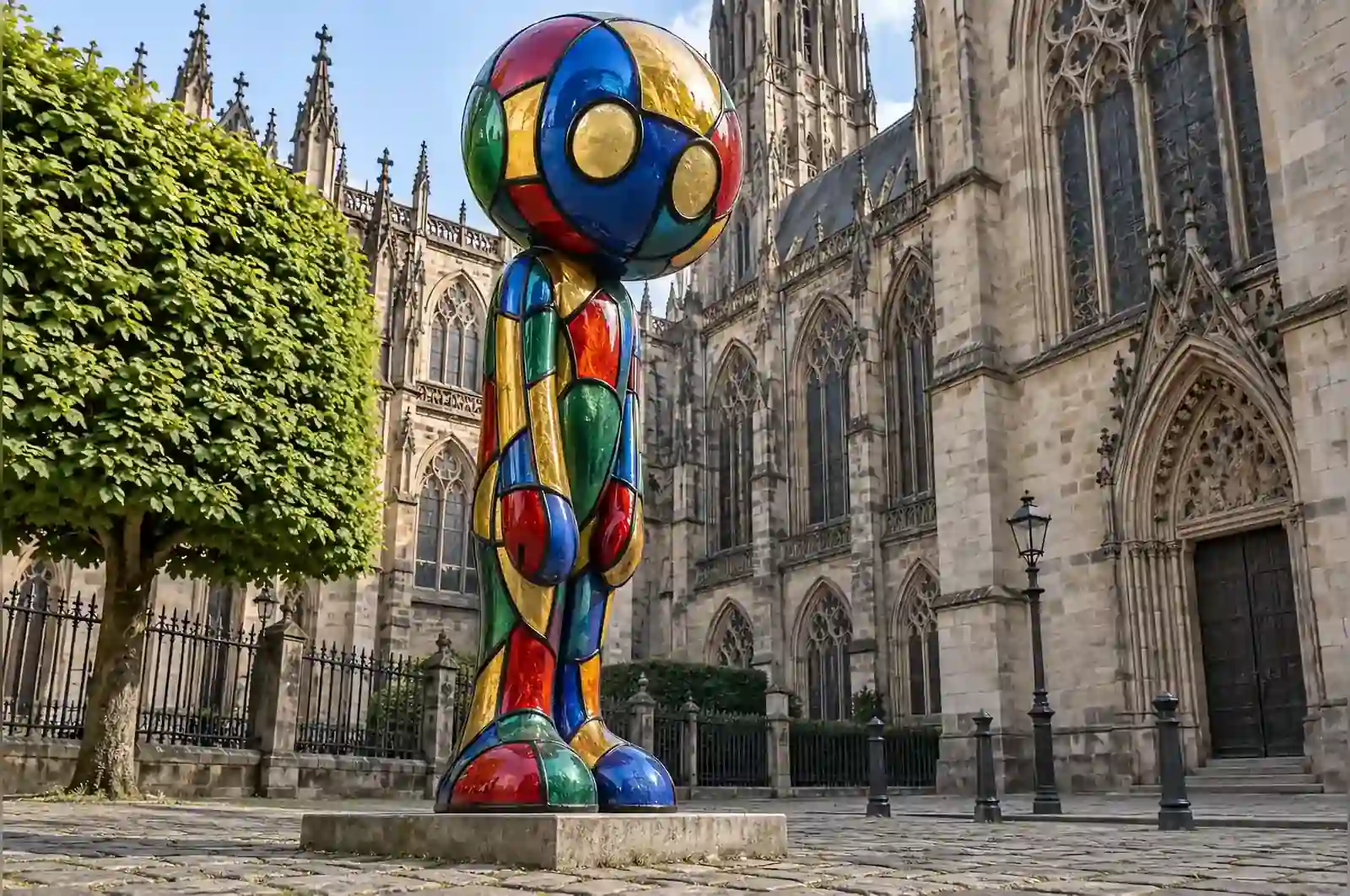
Because the demonstration is easier to accept in an object people do not already have opinions about. They asked for a character at about 2.8 m, no identity, whose whole surface would be built the way a window is built: separate flat pieces of colour, held by lead, with nothing overlapping and nothing blended.
Building it as a glazier would
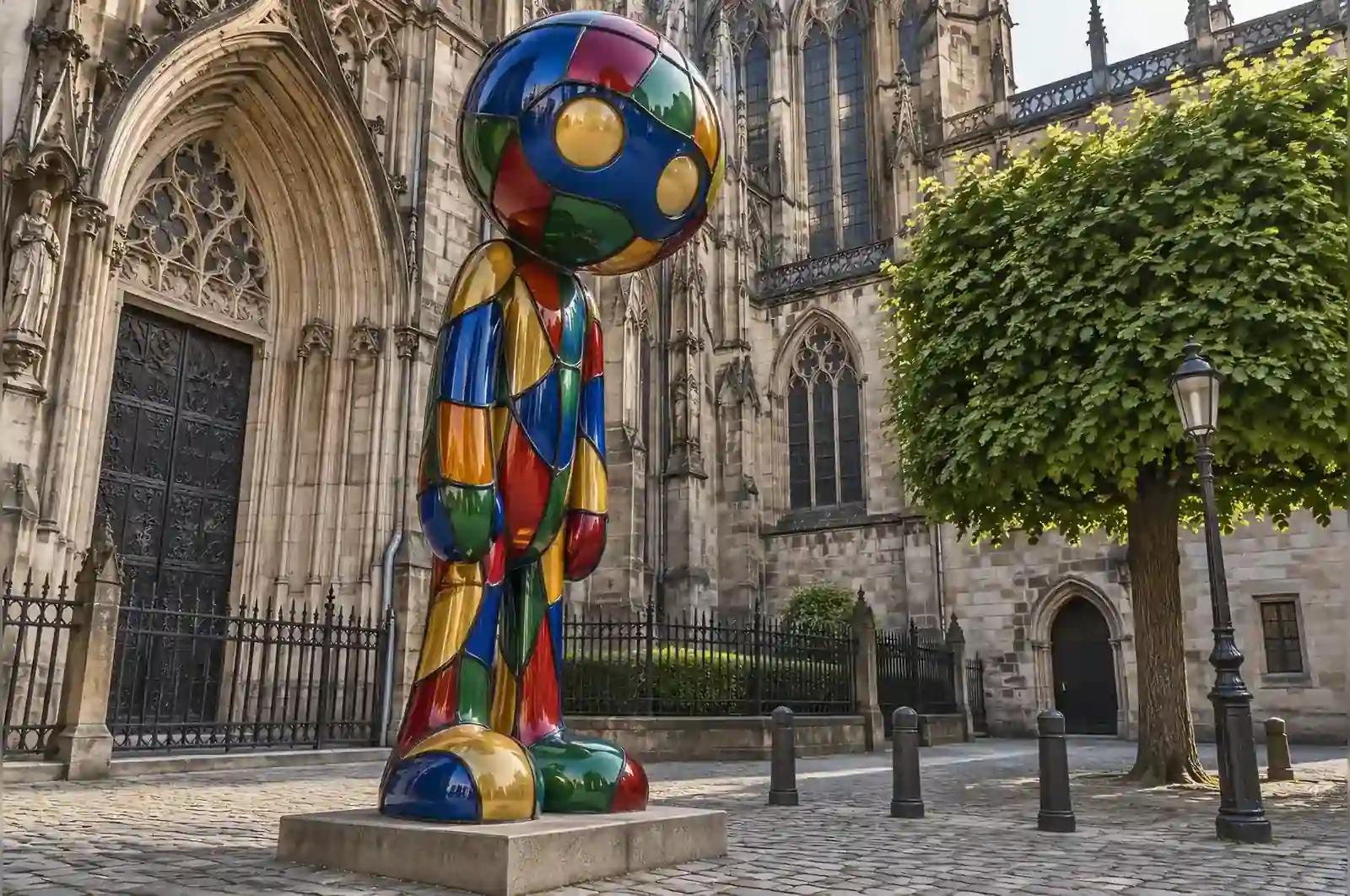
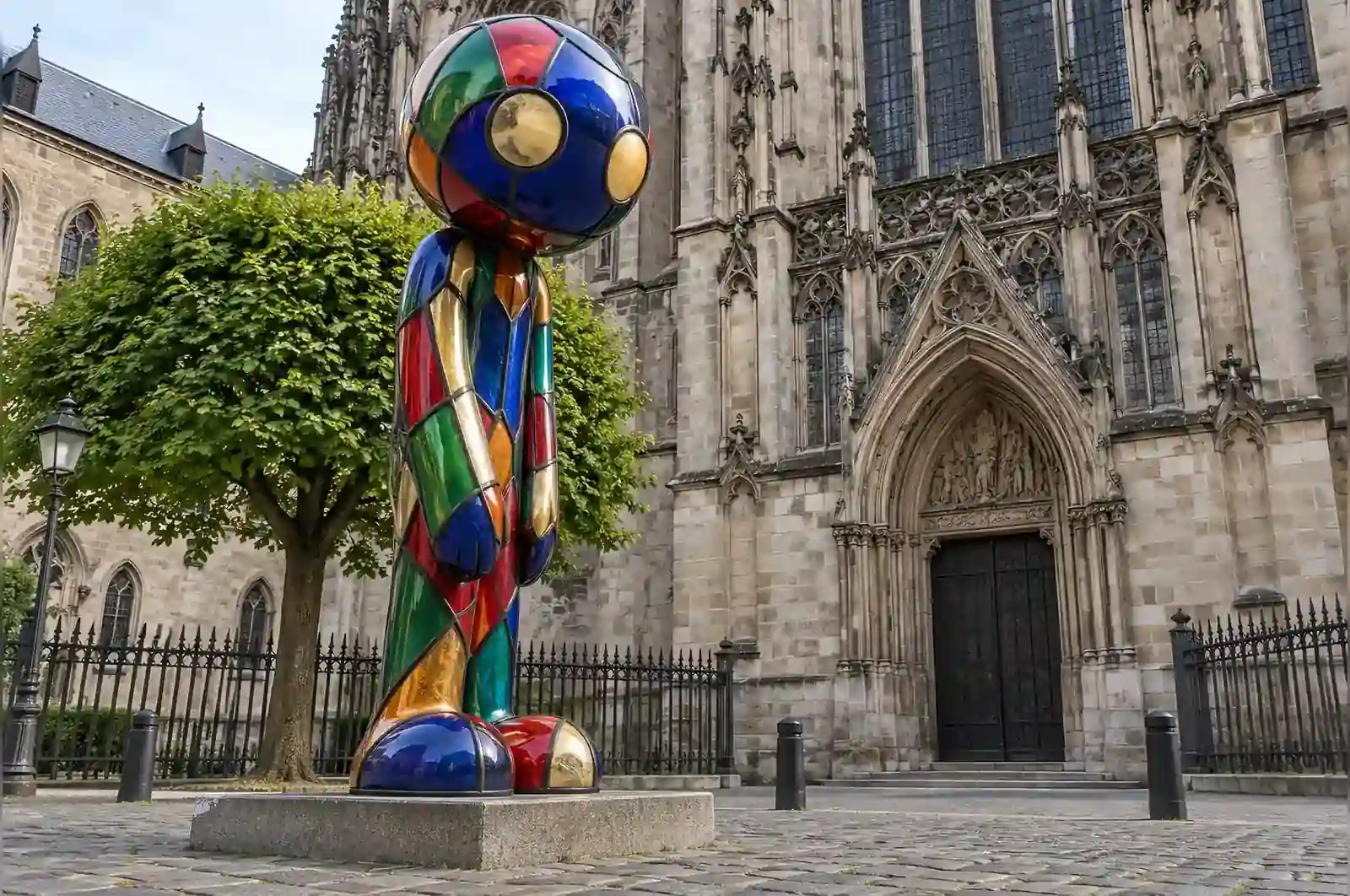
Nine hundred and forty panes. Each one a single flat colour from the foundation’s own five-colour reference: deep cobalt, ruby, emerald, amber and pale gold. No two adjacent panes share a colour, and the distribution was done as a glazier would do it, by weighing the palette as the area progresses so no colour dominates a region.
The lead is real relief. Every line between panes is a raised rounded ridge about 7 mm wide, and every pane sits in a shallow dished field, so the surface has genuine shadow and genuine depth. That is the thing most people get wrong about stained glass: the lead is in front of the glass, not behind it.
The character, in forty pieces of lead
A shape this busy will swallow a face, so the two eyes are the only panes on the piece small enough to read as a single form, and they are the only ones given a deeper recess. The result is that the eyes sit a few millimetres behind everything else, which none of us planned and all of us kept.
The forward lean of the body is what makes it a character instead of a column. Five degrees, no more.
What the glazing fixed, and what would have changed
The finish was the fixed point. The foundation’s argument is that a window is not a painting made of coloured glass, and that argument only holds if the surface is genuinely built the way a window is built: flat pieces of colour held by lead, with nothing overlapping and nothing blended. Had the lead lines been painted flat instead of raised, the piece would have been a painting after all, and the teaching session on lead cames would have had nothing real to point to.
The size was tied to the same decision. At 2.8 m high the panes and the raised lines read clearly from the close range at which the foundation wanted the piece to be examined; at a smaller scale the panes would have stopped reading as separate pieces of colour and the palette would have lost its balance. The 2.8 m also lets a glazier’s teaching group stand back and still see the whole figure at once, which is part of how the session is run. Moved indoors, the piece would have lost its place in the close — the walk off the processional route that makes it arrived at rather than passed. A leaded surface only earns its construction if people can get close enough to see the lead.
The lead, the gloss and the cathedral air
The lines are painted laminate, not metal. They are modelled into the fibreglass and gloss-painted dark, which means a chip on a line is a touch-up to a single ridge rather than a repair to a metal came. The maintenance consideration is the relief itself. Cologne’s weather is mild but wet, and the shallow dished fields hold a little rain; the gloss UV clear coat sheds most of it and keeps the saturated colours from fading.
The recessed eyes are the one place where grime settles and a cloth cannot easily reach, because they sit a few millimetres behind everything else, so they are cleaned with a soft brush rather than a cloth. The five-degree forward lean means the upper surfaces drain forward instead of pooling, which makes the top-facing panes the first place to check. Because the lines are painted, a worn line is repainted in isolation without disturbing an adjacent pane, and the piece never has to leave the close for the work. The whole surface is washed twice a year with a soft mitt and plain water, and inspected afterwards from a ladder at close range.
In the close
It stands on the flagstones at 2.8 m, off the main processional route so that it is arrived at rather than passed. The foundation now uses it in a teaching session on lead cames, and reports that the master glazier inspects it whenever he walks past, which is the closest thing to praise that is available from him.
Three questions before a quote on a glass-painted figure
First, is the surface a real build or a painted illusion? Raised lead lines mean the moulding and the laminate carry the relief, and the piece is read at close range; painted lines are simpler and read at distance. The foundation needed the real thing, because the lesson depends on it.
Second, how small does a detail need to read? Here the two eyes are the only panes small enough to read as a single form, and they were recessed a few millimetres. A brief that needs a face or a small readable detail changes the pane layout and the width of the lines.
Third, is it a teaching object or a distance object? The palette — five colours weighed by area so no colour dominates a region — is what carries at a distance; the panes and the lines are what carry up close. A piece read across a close is laid out differently from one examined from a bench, and the brief should say which.
The glass in our windows is not paint and this is not glass, and the master glazier approved it in about ninety seconds, which is fast for him.
A cathedral workshop foundation in Cologne, Germany